


March 13, 2026
Two Weeks Into the Iran War: A Maritime Intelligence Breakdown


WHITEPAPERS
Remote Sensing Intelligence: Seeing the Full Maritime Picture
What’s inside?
The pace of global maritime trade, the scale of operational data, and the sophistication of concealment have outgrown the tools once used to monitor and manage global waters. Vessels move across jurisdictions faster than regulations can keep up. Sanctions enforcement depends on details that are increasingly hidden. Border control and resource protection stretch across vast zones that can no longer be covered by patrols or coastal sensors alone.
Traditional visibility methods were designed for a simpler environment. AIS transmissions, port documentation, and routine patrols once provided a workable picture. Today, they form only fragments of one. Ships can disappear from AIS for hours or days at a time. Documentation can easily be falsified with generative AI tools. Meanwhile, dark flows, illicit vessels, and smuggled cargo continue to move across the maritime borders undetected.
These realities have created an urgent need for remote sensing intelligence – the ability to merge satellite detections, emissions data, and behavioral analytics into one verified view of maritime activity. Rather than relying on what vessels declare, it validates what is actually happening across the oceans, uncovering gaps, inconsistencies, and concealed operations that traditional reporting cannot reveal. This shift has transformed awareness from fragmented and delayed to continuous and evidence-based. What once required multiple agencies, separate tools, and long analytical cycles can now be achieved with precision, speed, and clarity. Remote sensing intelligence links every signal that defines maritime activity, turning complexity into insight and uncertainty into action.
The challenge is no longer collecting data points, but connecting them, revealing what is hidden within them, and confirming reality. A vessel’s transmission may claim one position while satellite imagery or emissions data show another. Stakeholders across the ecosystem need a unified operational picture that connects every data layer, from emissions and imagery to behavioral patterns. Without it, decisions are delayed, responses are reactive, and risk spreads unseen.
The ability to sense, verify, and interpret maritime activity through remote sensing intelligence has become an operational requirement. It is now the foundation of maritime resilience in an environment shaped by disruption, deception, and accelerating change. Whether for enforcement, trade, logistics, or defense, every decision depends on one capability: seeing the full picture in time to act.
The Turning Point: How Space Became Accessible
For decades, remote sensing was the domain of governments and research agencies. Satellite data was expensive, limited in coverage, and difficult to obtain. Each collection required advance tasking, and imagery could take days to process and deliver.
That reality has changed completely. A rapidly expanding network of commercial satellites now provides global coverage across radar, optical, and radio frequencies (RF). Costs have fallen sharply, revisit rates have increased, and latency has been reduced from days to hours. As a result, access to satellite intelligence is no longer limited to governments and specialized agencies. It is now accessible to maritime stakeholders seeking continuous, verified visibility across global waters.
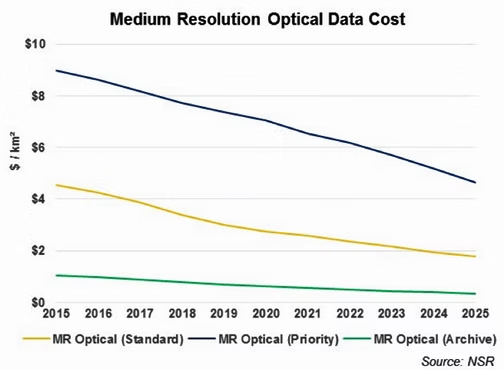
Organizations can now maintain near-continuous monitoring over ports, trade corridors, and exclusive economic zones. Data that once arrived too late to be useful can now be analyzed and acted upon in near real time.
Together, these advancements mark a shift from reactive monitoring to proactive intelligence. Remote sensing has become a critical part of every decision that touches the sea, from sanctions enforcement to supply chain planning.
The Core Sensors Behind Maritime Remote Sensing
Remote sensing depends on three primary types of sensors, each capturing a different layer of the maritime environment. Together, they deliver the detail, consistency, and coverage needed for a complete operational view.
Electro-Optical (EO)
EO imagery captures light in the visible and near-infrared spectrum, showing the Earth much as the human eye would see it. It provides the visual clarity needed for vessel identification, port analysis, and event confirmation. EO is ideal for verifying ship-to-ship (STS) transfers, port activity, and cargo operations. It is limited by weather conditions and daylight, but remains the most intuitive form of imagery for human interpretation.

Synthetic Aperture Radar (SAR)
SAR imagery is created by transmitting radar pulses and measuring how they reflect back from the surface. It works in all weather, day or night, and can detect metal objects such as ships even through clouds or darkness. SAR is indispensable for dark vessel detection, infrastructure monitoring, and wide-area surveillance. Its all-weather capability makes it the most reliable tool for continuous maritime monitoring.

Radio Frequency (RF)
RF sensors detect electromagnetic emissions from ships as they use radar, radios, and satellite communications. Unlike AIS, RF does not depend on a vessel’s cooperation or self-reporting. It can locate vessels operating covertly by triangulating their emissions across multiple satellites. RF is essential for detecting and tracking non-cooperative or deceptive shipping practices (DSPs), revealing vessels that might otherwise remain invisible.

Automatic Identification System (AIS)
While not a remote sensing technology, AIS remains a foundational data layer in maritime intelligence. It provides self-reported information such as vessel identity, position, course, and speed. However, AIS signals can be manipulated, spoofed, or switched off entirely, creating blind spots and false narratives. Remote sensing intelligence complements AIS by verifying what is reported against what is actually observed from space. By cross-referencing satellite detections, RF emissions, and imagery with AIS transmissions, analysts can confirm authenticity, identify deception, and maintain a continuous, trusted picture of global vessel activity.

Multi-Sensor Fusion
Each data source plays a distinct role. EO provides visual context, SAR ensures persistent coverage, RF uncovers hidden activity, and AIS supplies the declared data that must be validated against physical detections. When fused with behavioral analytics, these inputs create a single, coherent intelligence layer that verifies what ships are, where they are, and what they are doing.

Operational Impact Across the Maritime Ecosystem
Every sector faces its own version of the same challenge: how to turn scattered, delayed, or incomplete data into a clear operational picture. By merging satellite detections, emissions signals, and behavioral analytics, remote sensing connects these fragments into one verified source of truth. Whether the mission is security, trade, or logistics, this capability transforms reaction into readiness.
Maritime Security and Defense
Governments and defense organizations operate across vast maritime zones where risk changes by the hour. Traditional monitoring tools cannot match the pace or scale of modern threats, from smuggling to illegal fishing and sabotage near critical infrastructure. Remote sensing intelligence delivers the continuity, precision, and context required to manage these domains effectively.
Dark Vessel Detection & Tracking
Many illicit operations begin with a vessel going dark. Ships disable AIS to hide their location or identity, creating blind spots that limit enforcement response. Remote sensing intelligence fills those gaps by combining SAR’s all-weather detections with RF emissions and behavioral models to identify, classify, and track non-cooperative vessels. Agencies can verify movement in near real time and correlate it with historical imagery to expose repeat offenders.
IUU Fishing Detection
Illegal, unreported, and unregulated (IUU) fishing undermines national economies and environmental stability. Conventional patrols cannot cover entire exclusive economic zones (EEZs), leaving open water unmonitored for weeks. Remote sensing intelligence enables wide-area coverage with SAR and RF detections, spotting clusters of vessels or nighttime operations even under cloud cover. This insight supports faster interdictions and long-term enforcement planning.
Maritime Border Surveillance
Migration and smuggling routes are increasingly dynamic, shifting across maritime borders that lack constant coverage. Remote sensing intelligence identifies small craft and unusual movements across these corridors, correlating satellite detections with AIS and historical traffic to distinguish legitimate crossings from threats. The ability to detect, classify, and cue new imagery as events unfold turns fragmented border data into actionable awareness.
Critical Maritime Infrastructure Monitoring
Energy platforms, pipelines, and subsea cables are frequent targets of interference or sabotage. Ground-based sensors alone cannot detect approaching vessels or construction near exclusion zones. Remote sensing intelligence merges historical imagery with new satellite collections to track change over time, flag unauthorized activity, and alert when a vessel enters restricted waters. This continuous monitoring supports both protection and rapid response.
Offshore Platform & Rig Security
Operators of offshore energy infrastructure face constant risk from unauthorized vessel approaches and potential interference. Conventional radar coverage is limited by distance and weather. Remote sensing intelligence combines SAR and RF detections with real-time alerts to monitor exclusion zones and track vessel behavior near platforms and rigs. This layered visibility enables proactive protection and swift response when anomalies occur.
Maritime Area Monitoring & Surveillance
National agencies and port authorities require persistent situational awareness across sensitive maritime zones. Manual observation or single-sensor systems leave significant gaps. By fusing SAR, EO, RF, and AIS data, remote sensing intelligence maintains an evolving picture of what is normal in each area and highlights deviations the moment they occur. It builds baselines over time, allowing analysts to recognize unusual behavior with confidence.
Global Trade and Shipping
The global trading environment depends on trust – trust in documents, declarations, and vessel behavior. Yet manipulation of AIS, forged paperwork, and hidden transfers have made visibility increasingly unreliable. Remote sensing intelligence verifies what data alone cannot, exposing deceptive shipping practices and supporting compliance with confidence.
Wet Bulk Commodity Trading: Dark Ship-to-Ship (STS) Transfer Intelligence
In wet bulk trading, the true origin of cargo can be obscured through ship-to-ship transfers that take place far from port oversight. Traders and compliance teams struggle to determine which movements are legitimate and which mask sanctions evasion. Remote sensing intelligence fuses SAR and EO imagery with RF and behavioral models to detect dark and semi-dark STS events, estimate transfer duration, and flag high-risk patterns. It provides proof where declarations fall short.
Dry Bulk Commodity Trading: Stockpile & Port Monitoring
For dry bulk commodities such as iron ore, coal, or grain, decision-making relies on accurate knowledge of stockpile levels and port activity. Traditional reporting is inconsistent or delayed. Remote sensing intelligence uses high-resolution imagery to measure storage volumes and vessel throughput with precision, revealing true market supply and operational flow. These insights support traders, analysts, and logistics planners with ground-truth data they can act on immediately.
Maritime Logistics and Port Operations
Modern supply chains depend on visibility that spans from anchorage to inland transport. Congestion, delays, and route disruptions can ripple through the system in hours, yet on-the-ground reporting rarely provides early warning. Remote sensing intelligence extends situational awareness beyond the terminal, turning satellite data into a live operational advantage.
Port Activity & Supply Chain Intelligence
Logistics teams need to understand vessel queues, cargo throughput, and capacity limits in real time. Traditional AIS tracking offers limited context, especially when ships wait offshore or fail to report accurate ETAs. By layering SAR and EO imagery over behavioral analytics, remote sensing intelligence captures vessel density, anchorage conditions, and container volumes with high accuracy. This enables better planning, faster decision-making, and stronger resilience to disruption.
Connecting the Dots Across the Maritime Domain
From defense enforcement to global trade and logistics, the value of remote sensing intelligence lies in its ability to connect the dots. It bridges the space between what is declared and what is real, transforming disconnected signals into a single operational picture. By integrating satellite detections, emissions data, and behavioral analytics, it delivers verified visibility across every layer of the maritime ecosystem. This convergence marks a turning point: the shift from observing events to truly understanding them, and from fragmented monitoring to informed, confident action.
Delivering the Complete Picture: Windward Remote Sensing Intelligence
The growing demand for verified, real-time visibility has made remote sensing intelligence central to maritime decision-making. Windward’s Remote Sensing Intelligence solution was purpose-built for this new reality. It fuses SAR, EO, RF, and AIS data with proprietary behavioral analytics to deliver a continuous, contextual view of maritime activity. Through a single collaborative interface, users can annotate imagery, add comments, and share insights with colleagues in real time, ensuring every investigation is transparent and aligned across teams. The result is a single environment where detections are verified, intent is understood, and every decision is grounded in reality.
Multi-Sensor Fusion
Windward integrates synthetic aperture radar (SAR), electro-optical (EO), and radio frequency (RF) detections with AIS and behavioral models to create one unified operational picture. Each data layer contributes unique strengths – SAR for all-weather coverage, EO for visual confirmation, and RF for uncovering non-cooperative vessels. Together, they eliminate blind spots and provide continuous awareness in every maritime domain.
AI-Driven Behavioral Analytics
Detection alone is not enough. Windward’s proprietary Maritime AI™ interprets each event in context, connecting movement, intent, and risk indicators. It goes beyond analysis, guiding users to where attention is needed most by identifying behaviors and anomalies that signal potential risk. The platform identifies patterns such as dark activity, spoofing, STS transfers, and loitering behavior with exceptional accuracy, reducing false positives and prioritizing the insights that matter most. This behavioral layer ensures that remote sensing is applied effectively, focusing tasking, investigations, and decision-making on the areas of highest operational relevance.
Bring Your Own Imagery (BYOI)
Flexibility is built into the platform. Users can upload and analyze their own SAR or EO imagery directly within Windward’s environment. The system automatically enhances each image with detections, overlays, and contextual data, allowing organizations to combine their proprietary collections with Windward’s intelligence for complete operational clarity.
Integrated Workflows and Tasking
Windward’s platform streamlines every stage of the intelligence process. Users can procure archived images, task new imagery, correlate detections with vessel histories, and build investigations within the same workspace. Processes that once took days – requiring analysts to juggle between four to six separate systems, coordinate with multiple satellite providers, and manually piece together results – now happen seamlessly within one platform. Windward manages the provider network behind the scenes, so users receive fully processed results without the operational friction of sourcing or scheduling collections.
At the core of this workflow is MAI Expert™, Windward’s Gen AI maritime agent. Before imagery is even tasked, MAI Expert™ performs a feasibility check, analyzing the area of interest, satellite availability, and weather conditions to recommend the optimal sensor and provider for each operation. Once the tasking is complete, MAI Expert™ automatically summarizes the investigation from start to finish, consolidating detections, vessel behaviors, and analytical context into a single, ready-to-share report.
Latency is reduced from days to hours, and all data, tasked or archived, feeds into a single, dynamic operational record.
Wide-Area and Environmental Response
Beyond security and trade, Windward’s capabilities support environmental protection and incident response. SAR-based oil spill detection enables early identification of pollution events, while predictive modeling forecasts spill trajectories for timely containment. Combined with multi-sensor detections, these insights give authorities and operators the ability to act quickly and minimize impact.

Windward Remote Sensing Intelligence bridges the space between detection and decision. By combining satellite data, behavioral context, and user-driven analytics, it turns multi-sensor inputs into verified operational insight. Every layer – tasked imagery, emissions data, or uploaded collections – feeds into a single, trusted picture of maritime reality. It is visibility with purpose, built for those who must know what is happening, where, and why.

From Detection to Decision
The maritime ecosystem no longer has the luxury of delayed awareness. The speed, scale, and sophistication of global activity have made real-time, verified intelligence a prerequisite for safe and compliant operations. Remote Sensing Intelligence now defines how organizations understand risk, validate behavior, and act with confidence across the world’s oceans.
By fusing satellite imagery, radio frequency detections, and behavioral analytics, this capability transforms scattered data into a living, contextual picture of maritime reality. It allows decision-makers to move from what was declared to what is true, closing the gap between signal and certainty. The result is a shift from reactive oversight to proactive control, from isolated detections to connected decisions.
Windward was built for this new era. Our Remote Sensing Intelligence solution delivers the verified insight required to anticipate risk, ensure compliance, and protect maritime operations in real time. By connecting every sensor, data layer, and behavioral model into one unified environment, we enable users to see, understand, and act before exposure turns into consequence.
Maritime visibility has evolved from information to intelligence. Those equipped with the ability to sense, verify, and interpret the sea in context will define the next generation of resilience and control. Windward provides the clarity to make that possible, transforming detection into decision, and awareness into action.
See Remote Sensing Intelligence in Action