


October 20, 2026
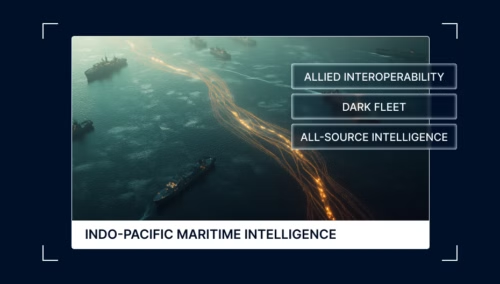
Maritime Domain Action in the Indo-Pacific Needs One Shared All-Source Picture


Introducing GPS Jamming Resilience: Cutting False Vessel Activity From Contested Waters

What’s inside?
Windward is releasing GPS Jamming Resilience, a new platform capability that automatically identifies and suppresses the false vessel activity generated by GPS interference, before any of it reaches an analyst.
It launches already proven. Since Operation Epic Fury began in late February, the capability has filtered more than 2.2 million false ship-to-ship (STS) meeting records across nearly 47,000 jammed vessels. Not one reached the platform. Not one cost an analyst a minute of investigation time.
Here is the problem it solves, how it works, and what comes next.
The Problem that Crept Up on the Industry
GPS jamming was once a regional anomaly. Today it is a fixture of global maritime operations. From the Eastern Mediterranean to the Persian Gulf, the Red Sea to the Baltic, deliberate interference with GPS signals has become a routine feature of the operating environment and it is getting more sophisticated, not less.
For maritime intelligence analysts and compliance teams, it creates two distinct problems.
The first is noise. In areas where false GPS signals are being injected, vessels appear to be somewhere they aren’t. The platform registers ship-to-ship meetings that never happened, port calls that are phantom records, risk activities that look indistinguishable from real ones. Every false alert that reaches an investigation queue costs time and in compliance, time is a direct cost.
The second is blindness. In areas where GPS signals are blocked entirely, AIS tracking degrades or disappears. Vessels go dark. Analysts lose continuity on the vessels they most need to track, in the corridors where the stakes are highest.
Noise in injection areas. Blindness in denial areas. Until now, there was no systematic way to address either.
Two Kinds of GPS Jamming, Two Kinds of Damage
GPS jamming is the deliberate interference with GPS signals in a defined geographic area. Because AIS positioning depends on GPS, jamming corrupts the position data vessels broadcast, making them appear where they aren’t, or masking where they actually are.
It takes two forms: In denial jamming, signals are overpowered and blocked, so vessels lose accurate positioning altogether and AIS tracking degrades or disappears.
In injection jamming, false GPS signals are broadcast, causing vessels to report positions they are not actually in. To any system relying on AIS, the vessel appears to be somewhere else entirely.
Both forms are increasingly common in contested maritime corridors, deployed by state and non-state actors to obscure vessel movements, protect strategic assets, or disrupt surveillance. The foundational data layer can no longer be taken at face value.
Tested Where It Counts
When GPS jamming in the Arabian Gulf reached levels the industry had not seen before at the outset of the Iran conflict, Windward’s teams were already working on the problem. Throughout the conflict, Windward customers were benefiting from active filtering of false STS meetings generated by injection zone interference, months before today’s release.
That work is now a full platform capability.
Windward’s GPS Jamming Resilience automatically identifies ship-to-ship meeting records generated by GPS interference and suppresses them before they reach the platform. The numbers speak for themselves: since Operation Epic Fury in late February, the system has filtered out over 2.2 million false ship-to-ship meetings across nearly 47,000 jammed vessels. Those records never reached the platform, and no analyst had to waste time on a single one of them.

Compliance officers and risk analysts working in regions where injection jamming is active no longer have to manually investigate and dismiss alerts that were never real to begin with. For STS meetings, the noise is solved at the source.
This matters because the alternative is both slow and unreliable: manually cross-referencing vessel positions, timestamps, and known jamming activity. With suppression built into the platform, analysts can focus their time on the alerts that deserve it.
What’s Coming Next
Suppressing false activities is the first layer. The next is making the jamming itself visible.
In the coming months, Windward will release a live GPS jamming detection map: a near real-time layer showing exactly where GPS interference is active, globally, at any given moment. It will distinguish between denial zones, where signals are blocked, and injection zones, where false signals are being transmitted. It will update within the hour as new detections arrive, making it the first commercial product that can answer the question: where is GPS jamming happening right now?
Alongside the map, users will be able to define areas of interest and receive immediate alerts the moment jamming activates inside them, turning a passive map into an active monitoring tool.
Together, these capabilities do something that has not been possible before. They turn GPS jamming from a source of chaos into a source of intelligence: see the where and the when, anchor investigations to jamming zone boundaries rather than vessel-by-vessel guesswork, and task satellite imagery and other collection assets with precision over the right area at the right time.
Why This Matters Now
GPS jamming is not a technical edge case. It is an operational reality for every team that depends on accurate vessel positioning: compliance officers screening for sanctions risk, security analysts tracking vessels of interest in contested corridors, and operations teams deploying assets in GPS-degraded environments.
The industry has largely treated it as background noise, something to work around rather than address directly. Windward’s position is that it is intelligence. Geographically bounded, typologically recognizable, and increasingly predictable. The goal is not to restore GPS. It is to make the interference itself legible, so that what happens inside a jamming zone is no longer a blind spot but a basis for action.
GPS Jamming Resilience is live now. To see the capability or speak with your account team, visit windward.ai/solutions/gps-jamming-resilience
Explore more

Mission Area Monitoring: Maintaining Maritime Operational Awareness
In Q2 2026, Windward recorded 3,137 prolonged dark activity events involving 2,157 unique cargo ships and tankers over 10,000 DWT, and 171,286 distinct vessels affected by GPS jamming at least once. None of those figures describe a list of vessels. They describe conditions inside specific stretches of water. That distinction is the operational problem of...
Read more

From Pixels to Findings: How Image Analytics Changes What Satellite Imagery Can Tell You
Satellite imagery has always shown you what’s in a scene. Every dot, every wake, every hull is a detection. What it hasn’t done, until now, is tell you who that detection is, and whether you should care. That’s the gap Windward’s new Image Analytics closes. It’s made up of two capabilities released together: Vessel Correlation,...
Read more

Ground Truth: Windward’s 2026 Commitment to Verified Maritime Intelligence
By Ariel Zibziner, VP Business Services, Windward Data Integrity in an Era of High-Frequency Signal Manipulation As we conclude 2025, the maritime domain is characterized by a trust deficit in digital signaling. The convergence of major global conflicts — continued hostilities in Ukraine, Houthi attacks disrupting Red Sea transit, suspected infrastructure sabotage in the Baltic,...
Read more

Windward Launches WhatsApp Integration for Instant Risk Insights
At a Glance Redefining Vessel Screening for a Real-Time World In global trade and shipping, decisions are rarely made from behind a desk. A call from port control, a sudden request from a counterpart, or a time-sensitive deal can trigger the need for immediate screening. Whether it’s a compliance check to prevent sanctions breaches or...
Read more