


July 23, 2026
Selective Enforcement: Saudi Crude Keeps Moving Under the Houthi Blockade


The Strait of Hormuz
What Is the Strait of Hormuz?
The Strait of Hormuz is a narrow maritime passage connecting the Persian Gulf to the Gulf of Oman and the Arabian Sea, forming the primary gateway between Gulf energy exporters and global shipping routes.
Located between Iran to the north and Oman and the United Arab Emirates to the south, the strait is one of the world’s most strategically important maritime chokepoints. A large share of the world’s oil and liquefied natural gas exports pass through this corridor every day, roughly one-fifth of global oil demand, making it central to global energy supply chains.
At its narrowest point, the Strait of Hormuz is about 20 miles (32 kilometers) wide, but the designated shipping lanes used by commercial vessels are much narrower, with two-mile-wide traffic lanes in each direction separated by a buffer zone.
Because of this geography, disruptions in the strait can quickly affect global energy markets, shipping routes, and maritime security operations.
Key Takeaways
- The Strait of Hormuz connects the Persian Gulf with the Gulf of Oman and the Arabian Sea.
- At its narrowest point, the strait is only about 20 miles wide, with designated shipping lanes only a few miles across.
- Roughly 20 million barrels of oil pass through the strait each day, representing a significant portion of global oil trade.
- The corridor is bordered by Iran, Oman, and the UAE, placing it at the center of regional geopolitical tensions.
- Conflicts or disruptions in the strait can quickly affect global energy prices, maritime insurance risk, and tanker routing decisions.
The Strait of Hormuz Key Facts
| Attribute | Detail |
| Location | Between Iran and Oman/UAE. |
| Connects | Persian Gulf → Gulf of Oman → Arabian Sea. |
| Narrowest Width | ~20 miles (32km). |
| Shipping Lanes | ~2 miles wide in each direction. |
| Oil Transit | ~20 million barrels per day. |
| Strategic Role | World’s most important energy shipping chokepoint. |
Where the Strait of Hormuz Is Located
The Strait of Hormuz lies at the southern entrance of the Persian Gulf, forming the only maritime outlet for Gulf energy exporters.

Ships leaving major oil terminals across the Gulf must pass through the strait before continuing into the Gulf of Oman and the Arabian Sea, which then connect to international shipping lanes across the Indian Ocean.
The surrounding coastline is divided between Iran, which borders the northern side of the strait, and Oman and the United Arab Emirates, which control the southern side.
Despite the waterway’s global importance, the navigable corridor used by commercial shipping is relatively narrow. International maritime traffic follows a traffic separation scheme (TSS) — adopted in 1973 and revised in 1979 by the International Maritime Organization (IMO), making it one of the oldest TSS globally — where inbound and outbound vessels travel in separate lanes to reduce collision risk.
These lanes are approximately two miles wide in each direction, meaning a large portion of global energy shipments passes through a corridor only a few miles across.
Why the Strait of Hormuz Is One of the World’s Most Important Maritime Chokepoints
The Strait of Hormuz plays a critical role in global energy supply chains because it serves as the primary export route for oil produced in the Persian Gulf.
Major energy exporters that rely on the strait include Saudi Arabia, Iraq, Kuwait, the United Arab Emirates, and Qatar.
Oil tankers departing these countries must transit the strait before reaching international markets in Asia, Europe, and North America, with almost 90% of the total volumes exported via the Strait of Hormuz was destined to the Asian market.
Liquefied natural gas shipments from Qatar, one of the world’s largest LNG exporters that exported over 112 bcm in 2025, also move through the corridor. There are no alternative routes to supply natural gas from Qatar or the UAE to the global LNG market other than existing LNG liquefaction facilities.
In total, roughly 20 million barrels of oil transit the strait every day, representing a significant share of global energy supply.
Because such a large portion of global oil flows through a single narrow passage, even short disruptions can have immediate consequences for global oil prices, tanker charter markets, maritime insurance premiums, and energy supply chains.
For this reason, the Strait of Hormuz is widely considered the most important energy chokepoint in the global maritime system.
Major Global Maritime Chokepoints
| Chokepoint | Why It Matters |
| Strait of Hormuz | Primary export corridor for Persian Gulf oil and LNG. |
| Suez Canal | Key trade route linking Europe and Asia. |
| Strait of Malacca | Major shipping route between the Indian and Pacific Oceans. |
| Panama Canal | Connects Atlantic and Pacific shipping lanes. |
Among these routes, the Strait of Hormuz stands out because disruptions can immediately affect global energy supply chains. While chokepoints like the Suez Canal or Panama Canal primarily influence trade efficiency and transit time, the Strait of Hormuz governs access to a significant portion of the world’s oil supply. This means that even minor disruptions, threats, or security incidents can have disproportionate effects on global energy markets, driving price volatility and increasing operational risk for maritime stakeholders.
A Long History of Trade Through the Strait
Although the Strait of Hormuz is closely associated with modern oil trade, it has served as an important maritime passage for centuries.
Historically, the strait connected Middle Eastern ports with trade routes to India and Asia, carrying goods such as spices, silk, pearls, and horses.
In the early sixteenth century, Portuguese explorers captured the island of Hormuz and established a fortress and customs station to control trade through the strait. Ships traveling between the Persian Gulf and the Indian Ocean were required to obtain permission to pass, allowing Portugal to collect tolls on regional commerce.
Portuguese control lasted for more than a century until an alliance between the Safavid Persian Empire and the English East India Company drove them out in 1622.
This early competition for control of the strait illustrates a long-standing pattern: whoever controls the Strait of Hormuz can influence regional trade flows.
Conflicts and Geopolitical Tensions in the Strait of Hormuz
Because of its importance to global energy markets, the Strait of Hormuz has repeatedly become a focal point during geopolitical conflicts.
Several key episodes illustrate how tensions in the region can influence maritime activity.
The Tanker War (1980s)
During the Iran-Iraq War (1980-1988), both sides launched sustained attacks on commercial shipping in the Persian Gulf in an effort to disrupt each other’s energy exports. These campaigns became known as the Tanker War.
The campaign escalated in two phases. Beginning in 1981, Iraq targeted vessels calling at Iranian ports, expanding from military supply ships to oil tankers using air power and anti-ship missiles such as Exocets. By 1984, attacks intensified, prompting Iran to retaliate by targeting vessels linked to Iraq’s trading partners. With more limited anti-ship capabilities, Iran relied on improvised methods that disrupted voyages and endangered crews, bringing commercial shipping deeper into the conflict.
As attacks intensified, neutral commercial shipping was increasingly exposed. In response, the United States and other nations deployed naval forces to escort vessels through the Strait of Hormuz and the Persian Gulf.
The Tanker War showed how quickly energy shipping routes can become contested, and how disruptions in key chokepoints can extend beyond the immediate parties involved.
Sanctions and Nuclear Tensions
Throughout the 2000s and early 2010s, international sanctions targeting Iran’s nuclear program led to repeated threats by Iranian leaders to close the Strait of Hormuz.
While the strait was never fully blocked during these disputes, tensions prompted large naval deployments from Western and regional powers to ensure that commercial shipping could continue moving through the corridor.
These standoffs reinforced the strait’s role as a strategic pressure point in global geopolitics.
Tanker Seizures and Maritime Confrontations
In the past decade, the Strait of Hormuz has also been the site of several tanker seizures and maritime confrontations.
Commercial vessels have occasionally been detained by regional authorities or involved in incidents linked to sanctions enforcement and diplomatic disputes.
For example, in April 2015, Iranian patrol boats seized the Maersk Tigris, a Marshall Islands-flagged container ship, after firing warning shots in the Strait of Hormuz. Iran stated the seizure was linked to a legal dispute, and while the vessel was later released, the incident raised concerns about freedom of navigation.
Another example includes the July 2019 detention of the Stena Impero, a British-flagged oil tanker, shortly after UK authorities seized an Iranian tanker near Gibraltar. The incident was widely viewed as retaliatory and led to increased naval escorts for commercial shipping in the region.
According to the U.S. Navy’s Fifth Fleet, Iran has “harassed, attacked, or seized” multiple internationally flagged merchant vessels in the region in recent years, underscoring the persistent risk to regional maritime security and commercial shipping in the corridor.
These incidents rarely halt traffic entirely but can significantly increase insurance risk, naval patrol activity, and commercial uncertainty.
These examples show how maritime trade can be used as a tool of geopolitical signaling and retaliation, exposing commercial vessels to risk beyond traditional operational factors.
Operation Epic Fury (2026)
The escalation surrounding Operation Epic Fury in 2026 marked one of the clearest modern examples of how conflict can directly disrupt maritime transit through the Strait of Hormuz.
Following large-scale military strikes involving Iran, the United States, and Israel, tensions in the region intensified rapidly. Iranian forces responded with direct threats to commercial shipping, including targeting vessels and offshore infrastructure in and around the Strait of Hormuz, expanding the risk environment beyond the narrow passage itself.
Maritime security risk across the Gulf rose sharply. More than 20 confirmed incidents involving commercial vessels and offshore assets were recorded during the early phase of the conflict, including vessels such as Skylight, MKD Vyom, Stena Imperative, Athe Nova, and others. These incidents underscored how quickly commercial shipping can become exposed during high-intensity geopolitical escalation.
At the same time, the region experienced widespread electronic interference. On March 7 alone, over 1,650 vessels were affected by GPS and AIS disruption across the Gulf, with vessels falsely positioned across a wide geographic area from Kuwait to Oman. Windward identified at least 30 jamming clusters across Saudi Arabia, Kuwait, the UAE, Qatar, Oman, and Iran, affecting both land and maritime environments.
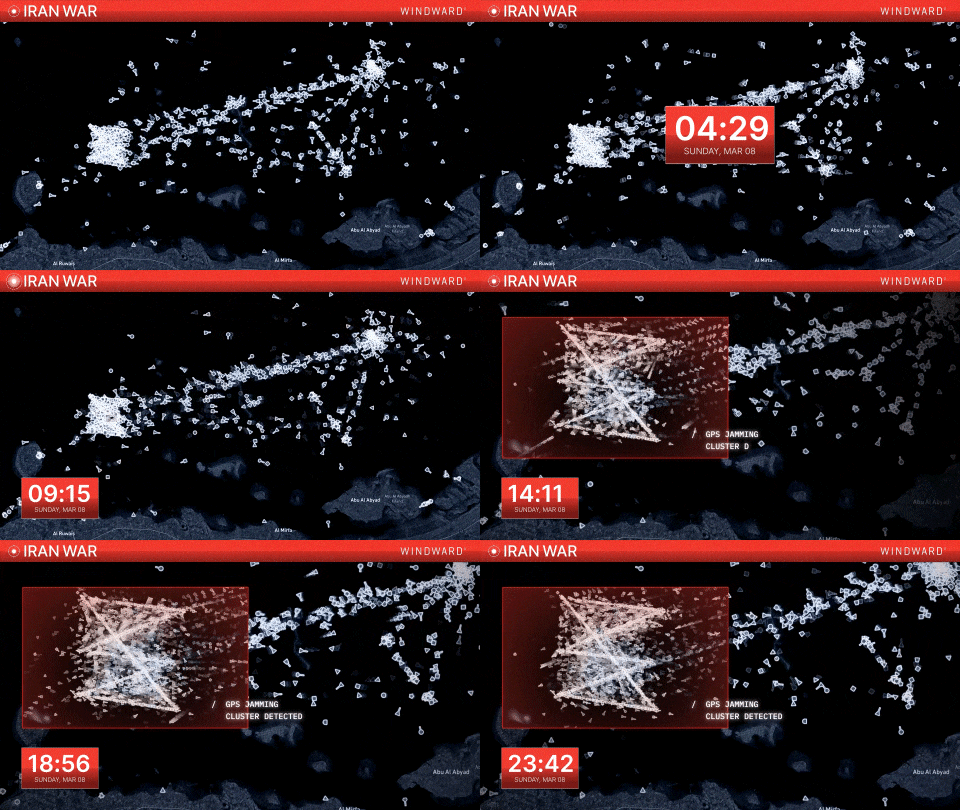
This level of interference introduced additional operational risk, increasing the likelihood of navigation errors, collision risk, and false compliance alerts in one of the world’s most critical energy corridors.
Commercial traffic through the Strait of Hormuz dropped significantly during this period. Between March 7 and March 11, only 10 commercial vessel crossings were recorded, compared to a typical daily average of 70-80. Many of the vessels that continued to transit were Iranian-flagged or linked to higher-risk operators, including sanctioned or shadow fleet participants.
A notable behavioral shift also emerged. Some vessels began broadcasting explicit nationality signals through AIS destination fields, including messages such as “CHINESE CREW OWNER” or “IRAQI OWNER,” in what appeared to be an attempt to signal affiliation and reduce the risk of targeting. Windward identified 36 vessels exhibiting this pattern, primarily cargo vessels and tankers operating under flags such as Panama, Liberia, and Hong Kong.
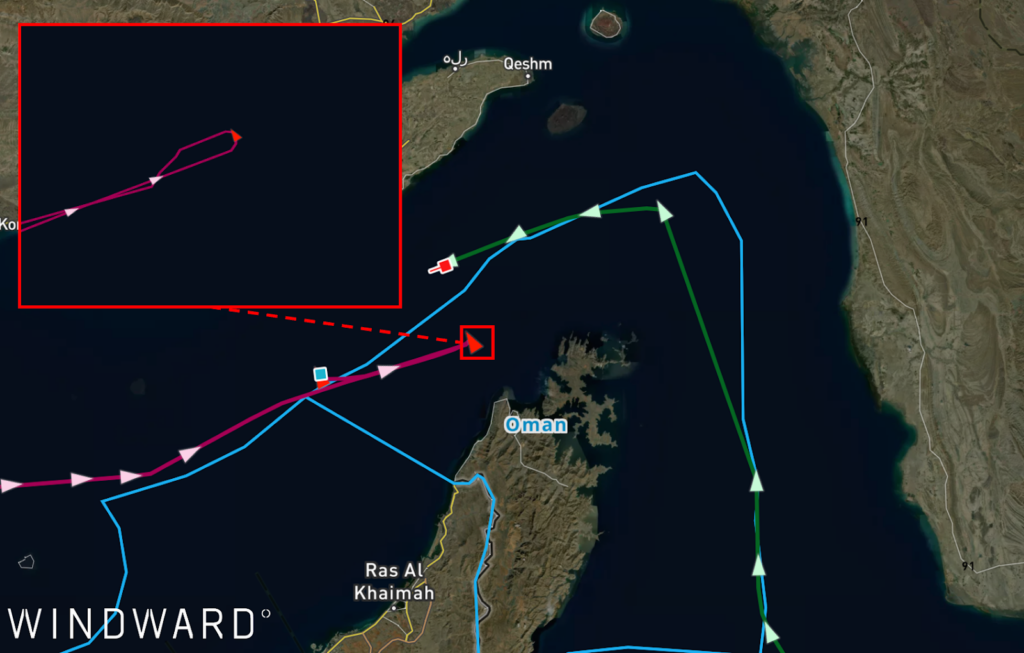
These developments illustrate how maritime behavior adapts under pressure. During periods of conflict, vessel operators may alter routing, identity signaling, or transmission patterns in response to perceived risk.
The events surrounding Operation Epic Fury reinforce a critical point: the Strait of Hormuz does not need to be fully closed to disrupt global trade. Targeted attacks, electronic interference, and reduced traffic flow are sufficient to constrain movement, increase costs, and introduce systemic uncertainty across global energy supply chains.
How Conflicts in the Strait Affect Global Trade
Because the Strait of Hormuz carries such a large portion of global oil exports, disruptions in the waterway can quickly ripple through global markets.
Even the possibility of conflict can influence global oil prices, shipping insurance premiums, tanker charter markets, and energy supply planning.
For example, during the escalation surrounding Operation Epic Fury, oil markets reacted immediately to both actual disruption and the threat of restricted transit through the Strait of Hormuz. Brent crude rose by more than 4% intraday and stabilized around $103 per barrel, while WTI climbed to approximately $97 per barrel. These increases were driven not only by attacks on vessels and energy infrastructure, but also by statements from Iranian officials indicating that the strait would no longer be safe for shipping. The episode illustrates how even the perception of constrained access to the corridor can trigger rapid price volatility across global energy markets.
Shipping companies may also alter vessel routing, delay departures, or coordinate with naval escorts when security risks increase.
These dynamics illustrate how strategic chokepoints amplify geopolitical risk, particularly when global energy supply depends on uninterrupted maritime traffic.
Monitoring Strategic Chokepoints
Chokepoints like the Strait of Hormuz highlight the importance of monitoring vessel behavior and maritime activity in high-risk regions.
Governments and maritime organizations increasingly rely on technologies such as satellite imagery, AIS vessel tracking, behavioral analytics, anomaly detection, and multi-source intelligence.
These tools help analysts understand how vessel activity changes during periods of geopolitical tension.
Platforms such as Windward Maritime AI™ combine behavioral analysis, satellite data, and vessel intelligence to monitor activity patterns in strategic waterways and identify unusual maritime behavior.
By analyzing vessel traffic across multiple data sources, maritime stakeholders can maintain better situational awareness in high-risk corridors like the Strait of Hormuz.
Frequently Asked Questions (FAQs)
Why is the Strait of Hormuz strategically important?
The strait serves as the primary export route for Persian Gulf oil and liquefied natural gas. Approximately 20% to 25% of the world’s total seaborne oil trade passes through the Strait of Hormuz annually, representing about 20 million barrels of oil per day. Because such a significant share of global energy supply depends on this route, even limited disruptions can affect international energy markets and geopolitical stability.
How is vessel activity monitored in the Strait of Hormuz?
Vessel movements are monitored through AIS tracking systems, satellite imagery, radar coverage, and maritime intelligence platforms that analyze shipping patterns.
What role do naval forces play in the Strait of Hormuz?
Naval forces help deter attacks on commercial shipping, escort vessels during periods of tension, and monitor maritime traffic to ensure safe passage through the corridor.
Why does the Strait of Hormuz affect global oil markets?
Because roughly 20 million barrels of oil transit the strait each day, disruptions or threats to shipping in the corridor can quickly influence global oil prices and energy supply chains.
What risks do vessels face when transiting the Strait of Hormuz?
Under normal conditions, the Strait of Hormuz operates as a heavily trafficked but stable shipping corridor. However, during periods of geopolitical tension or conflict, commercial vessels may face increased risk, such as maritime security incidents, vessel seizures, electronic interference, or intensified naval activity. These conditions can affect routing decisions, operational planning, and insurance costs.
How do geopolitical tensions affect tanker operations in the Strait of Hormuz?
Periods of heightened tension can significantly alter vessel operations. Shipping companies may rely on naval escorts, face sharply higher insurance premiums, or adjust voyage planning to reduce exposure. In more severe scenarios, vessels may delay transit or reroute where possible, although alternatives are limited, which makes rerouting costly and operationally complex. Because the Strait of Hormuz is a primary gateway for Gulf exports, avoiding it often requires longer routes, partial cargo reallocation, or reliance on pipeline infrastructure, all of which add time, cost, and logistical constraints.
What technologies help detect maritime security risks in chokepoints?
Technologies such as behavioral analytics, satellite surveillance, and anomaly detection models help identify unusual vessel activity and potential maritime security threats.
Why is multi-source intelligence important in strategic waterways?
Combining multiple data sources allows analysts to verify vessel locations and behavior, detect deceptive shipping practices, and maintain accurate situational awareness in high-traffic maritime corridors.
Explore more

The Suez Canal
What Is the Suez Canal? The Suez Canal is a 193-kilometer (120-mile) artificial waterway in Egypt that connects the Mediterranean Sea at Port Said to the Red Sea at Suez, providing the only direct maritime route between Europe and Asia without circumnavigating Africa. The canal runs north-to-south across the Isthmus of Suez, crossing several natural...
Read more

Barnacles
What Are Barnacles? Barnacles are small marine crustaceans that permanently cement themselves to hard surfaces underwater, including the hulls, propellers, and sea chests of ships. Once attached, they form rough, calcified colonies that disrupt the smooth flow of water along a vessel’s hull, increasing hydrodynamic drag and forcing the engine to burn more fuel to...
Read more

EMCON (Emissions Control)
What Is EMCON? EMCON, short for emissions control, is the naval discipline of deliberately silencing or restricting a ship, submarine, aircraft, or task force’s electromagnetic emissions to avoid detection. Under EMCON, units shut down or limit radar, radio, AIS, IFF, and other emitters while still receiving outside signals, turning a vessel that is physically present...
Read more

Decision Intelligence
What Is Decision Intelligence? Decision intelligence is the discipline of combining data, analytics, and artificial intelligence to support better human decision-making in complex, high-stakes environments. It goes beyond traditional business intelligence — which focuses on reporting what has happened — by modeling causes, predicting outcomes, and recommending actions, while keeping the human decision-maker in the...
Read more

Territorial Waters
What Are Territorial Waters? Territorial waters are the belt of sea extending up to 12 nautical miles from a coastal state’s baseline, over which that state exercises sovereignty subject to the rules of international law. Within this zone, the coastal state has full legal authority over the water, seabed, subsoil, and airspace above, with the...
Read more