


June 11, 2026
Hormuz Traffic Falls as Military Pressure Intensifies


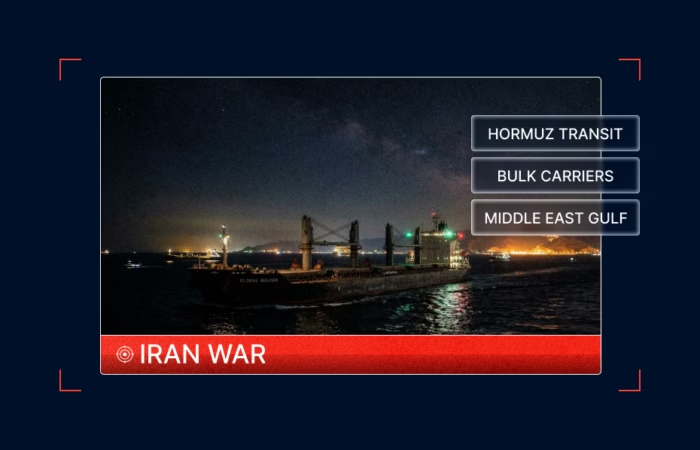
Bulk Carriers Find New Route Out of Hormuz Strait
What’s inside?
At a Glance
- Bulk carriers sailing eastbound to exit the Middle East Gulf are re-routing through Iranian territorial waters to navigate the Strait of Hormuz, circumventing shorter, normal international navigation channels.
- Windward tracked at least five ships using this Iranian waters route over March 15 and 16.
- Traffic through the Strait of Hormuz — the waterway for 20% of the world’s oil and gas — is down by approximately 97%.
- The new route, which allows allies and supporters to transit, illustrates how Iran’s selective blockade has evolved.
- The bulk carriers tracked eastbound through the strait had, in nearly all cases, previously called at Imam Khomeini port in Iran.
Re-Routing Through Iranian Territorial Waters
Bulk carriers sailing eastbound to exit the Middle East Gulf are seen re-routing through Iranian waters over the past 48 hours as they navigate through the Strait of Hormuz, one of the first signs of a workaround in the region.
Windward tracked at least five ships over March 15 and 16 leaving via a route that takes ships well within Iran’s territorial waters, circumventing shorter, normal international navigation channels.

Source: Windward Maritime AI™ Platform
There’s intense scrutiny around the number of transits via the Strait of Hormuz as the international waterway through which 20% of the world’s oil and gas remains effectively shut to shipping. Traffic is down around 97%.
Yet limited traffic is emerging, including evidence that vessels are sailing via longer routes through the Hormuz strait as they leave the Middle East Gulf.
In nearly all cases these bulk carriers, and others, that have been tracked eastbound through the Strait of Hormuz have previously called at Imam Khomeini port in Iran, one of the Islamic Republic’s key commercial ports.
The tracking augments rising evidence that Iran is exerting permission-based transit and control of the strait as the war extends into its third week, with its effective closure roiling the global economy.

Source: Windward Maritime AI™ Platform
The new route illustrates how Iran’s selective blockade has evolved to allow allies and supporters to transit. In addition to bulk carriers, two liquefied petroleum gas carriers have sailed through in the past 36 hours. Their route wasn’t immediately apparent as GPS jamming obscured the tankers’ trajectory via AIS.
Eight ships, excluding Iranian flagged vessels, were tracked through the strait with their AIS on March 16, nearly double numbers seen earlier this week.
Explore more

Hormuz Traffic Falls as Military Pressure Intensifies
At a Glance Operational Overview The Strait of Hormuz remains operational, but increasingly constrained. While Iranian officials continue to characterize the Strait as closed, recent observations suggest a more nuanced reality. Commercial traffic continues to move, but at extremely low levels. Dark vessel activity remains persistent, military enforcement continues to expand, and maritime visibility across...
Read more

LPG Flows Test the Blockade as Hormuz Tightens
At a Glance Operational Overview The June 5–10 reporting period shows a maritime environment under tightening enforcement, but not full immobilization. While Iranian crude exports remain heavily constrained, limited LPG cargoes continue reaching South Asian markets through deceptive shipping practices. At the same time, U.S. enforcement is expanding geographically, commercial traffic through Hormuz is adjusting...
Read more

Iranian Exports Collapse as Enforcement Pressure Widens
At a Glance Operational Overview The June 1–4 reporting period highlights three parallel developments: Iranian exports are collapsing under blockade pressure, enforcement against sanctioned vessels is becoming more kinetic, and maritime control activity across Hormuz remains elevated. Iranian crude and condensate exports fell to 186,000 barrels per day in May, down 84% from April and...
Read more

Hormuz Tightens as Iran’s Dark Fleet Stalls and Enforcement Widens
At a Glance A Parallel Enforcement Track Takes Shape in the Atlantic On the enforcement side, pressure on both Iranian and Russian shadow tonnage intensified across the same reporting cycle. The U.S. Department of the Treasury issued a new Operation Economic Fury action targeting Iranian maritime extortion, expanding the cumulative enforcement track against Iranian shadow...
Read more

Three Months Into Operation Epic Fury: How Iran Restructured Hormuz Instead of Closing It
At a Glance Operational Overview Hormuz transits remain at approximately 6% of their pre-conflict baseline, and the residual flow is increasingly Iranian-flagged, dark, or hugging Iranian territorial waters. IRGC small-craft counts have moved decisively off the Iranian shore and into the open strait body, with the swarm now positioned within visual range of every commercial...
Read more