


October 1, 2026
Vessels Loiter Over Subsea Cables and Pipelines Across Five Theaters


Venezuela’s Oil Policy Shift and the Rising Maritime Risk Landscape
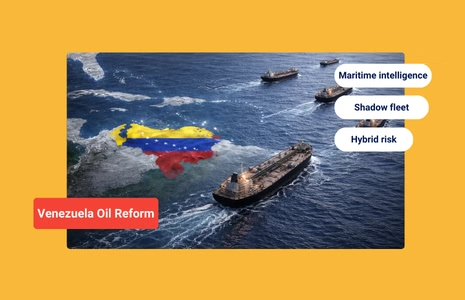
What’s inside?
At a Glance
- Venezuela’s 2026 oil sector reform opens production to foreign investment following extraordinary U.S. intervention and has fundamentally transformed the country’s maritime oil trade.
- The shadow fleet that dominated Venezuelan crude exports for years has been displaced entirely since mid-December 2025, replaced by Western-linked vessels operating under OFAC licenses.
- Maritime intelligence now focuses on verifying compliance credentials, monitoring the transition to legitimate operators, and detecting any attempts by previously non-compliant vessels to re-enter the market.
How Venezuela’s Oil Reform Is Changing Maritime Risk
In late January 2026, Venezuela’s legislature approved sweeping reforms to the nation’s oil laws, effectively opening its state-dominated energy sector to private and foreign investment in a dramatic policy shift after more than two decades of socialist control. This overhaul aims to attract capital and increase production by giving private firms greater control over production and sales, reducing taxes, and introducing independent arbitration for disputes – a sharp reversal of the nationalization policies that have defined Venezuelan oil for decades.
The maritime implications of this policy shift have already been profound. The shadow fleet that sustained Venezuelan oil exports under sanctions has been completely expelled from the market, replaced by a new operational model built on licensing, transparency, and industry vetting standards.
A Geopolitical Pivot With Maritime Consequences
The reform followed extraordinary political and military intervention. After the U.S. captured Venezuelan President Nicolás Maduro in early January, his vice president, Delcy Rodríguez, assumed control under direct pressure from Washington. With the threat of further military action looming, her government fast-tracked the oil sector overhaul, effectively reversing decades of resource nationalism.
But unlike typical policy reforms that take months or years to affect operational behavior, this transformation reshaped Venezuela’s maritime oil trade almost immediately. The shadow fleet model —characterized by opaque ownership, AIS manipulation, ship-to-ship transfers, and sanctions evasion — has been dismantled.
The Shadow Fleet Displacement: A Market Transformed
Prior to mid-December 2025, approximately 100 tankers shipped Venezuelan crude, with roughly 40% under sanctions and 53% identified as high-risk by Windward’s platform. These vessels routinely deployed deceptive shipping practices including spoofing, AIS manipulation, and complex ship-to-ship transfer operations in Venezuelan waters to mask cargo origins and evade enforcement.
That model collapsed abruptly. Since mid-December, not a single dark fleet tanker has successfully shipped from Venezuela. The transition was driven by two factors: aggressive U.S. enforcement including vessel seizures, and the introduction of OFAC licensing requirements that shadow fleet operators cannot meet.
OFAC licenses are now required for all Venezuelan oil exports. These licenses are only granted to vessels that meet rigorous industry vetting standards—the same standards that dark fleet tankers systematically failed to maintain. Without P&I club certification, recognized flag state governance, and transparent ownership structures, shadow fleet vessels cannot obtain the licenses necessary to call at Venezuelan terminals or deliver to U.S. Gulf Coast refineries.
Western Vessels, Compliant Operations
The vessels now handling Venezuelan crude exports represent a sharp operational contrast. Western-linked tankers with established commercial credentials have replaced the aging, high-risk fleet that previously dominated the trade. These operators arrive with:
- Cooperative AIS broadcasting and standard navigation practices.
- Valid OFAC licenses.
- Recognized industry vetting approvals.
- Transparent ownership and flag state registration.
Windward tracking shows Western-linked tankers arriving at Jose Terminal and Maracaibo in early January, with initial shipments departing for U.S. Gulf Coast refineries on January 2 and 6. The deal structure — reportedly 30 to 50 million barrels at approximately $50 per barrel, generating $1.5-2.5 billion in proceeds overseen by the White House — requires this level of operational transparency and compliance.
What This Means for Maritime Risk Intelligence
ACredential verification: Confirming that vessels claiming to operate under OFAC licenses actually possess valid authorizations and meet vetting requirements.
Transition monitoring: Tracking whether previously high-risk or sanctioned vessels attempt to re-enter Venezuelan trade through flag changes, ownership transfers, or other transformations designed to appear compliant.
Supply chain transparency: Verifying that the entire export chain—from terminal operations to final delivery—maintains the compliance standards required under the new framework.
Diluent supply logistics: Monitoring imports of naphtha and other diluents necessary for Venezuela’s heavy crude operations, particularly any resumption of U.S. shipments that had previously been handled by Russian suppliers using non-transparent methods.
Secondary activity: While the dark fleet has been displaced from Venezuelan crude exports, monitoring continues for any residual ship-to-ship activity, particularly involving smaller vessels or non-oil cargo that might indicate smuggling operations or attempts to circumvent the new framework.
The Role of Multi-Source Intelligence in the New Environment
Document verification: Cross-referencing vessel registries, flag state records, and OFAC license databases to confirm claimed credentials.
Behavioral validation: Ensuring that vessel movements, AIS broadcasting, and operational patterns align with legitimate commercial activity rather than legacy evasive practices.
Historical risk contextualization: Tracking whether vessels previously engaged in high-risk trades have genuinely transformed their operations or are attempting to exploit the transition period.
Anomaly detection: Identifying any vessels or patterns that deviate from the established compliant operational model, which could indicate either inadvertent non-compliance or deliberate attempts to circumvent requirements.
Multi-source intelligence blending AIS data, satellite imagery (SAR and EO), registry validation, and behavioral analytics creates the operational picture necessary to distinguish genuine compliance from attempts to exploit the new framework’s legitimacy.
From Shadow Fleet to Transparency: A Structural Shift
Venezuela’s oil reform represents more than a policy change—it marks a complete restructuring of how Venezuelan crude reaches global markets. The shadow fleet model that sustained exports under sanctions has been displaced by a framework requiring transparency, licensing, and industry-standard vetting.
For maritime stakeholders, this creates new imperatives. Rather than focusing primarily on detecting evasion, the priority becomes verifying that the new compliant model is functioning as intended and that previously non-compliant operators do not find pathways to re-enter the market through superficial transformations.
By leveraging maritime intelligence—particularly multi-source intelligence that validates credentials and monitors operational behavior—government agencies, defense organizations, and commercial operators can maintain visibility into this transformed trade environment and ensure the integrity of Venezuela’s maritime oil operations going forward.
Frequently Asked Questions (FAQs)
What is maritime risk intelligence?
Maritime risk intelligence is the analysis of vessel behavior, ownership, registry, and trade patterns to detect hidden risk. It builds on maritime domain awareness (MDA) by integrating multiple data sources for real-time insight into illicit or deceptive behavior.
How does multi-source intelligence help in high-risk environments like Venezuela?
It validates claims made via AIS and documentation by cross-checking multiple sources, including SAR, RF, EO, and behavioral models. This allows agencies and companies to spot inconsistencies, confirm intent, and detect evasive behavior before it causes exposure.
Why should commercial teams care about shadow fleet behavior?
Even if a vessel appears compliant on paper, insurers, shippers, and traders could face reputational or legal risk if it’s tied to deceptive operations. Multi-source intelligence helps confirm legitimacy and manage that exposure in volatile trade corridors.
How can government agencies adapt enforcement strategies during Venezuela’s oil transition?
Agencies need real-time behavioral risk signals and multi-source intelligence to detect hybrid activity and anticipate non-compliant behavior before violations occur.
What role does Windward play in this space?
Windward delivers operationalized maritime intelligence that fuses behavioral analytics, document validation, and multi-sensor data to give decision-makers across sectors the visibility and context they need to act before risk becomes liability.
Trending
- The EU’s 18th Sanctions Package Lookback Started. Trading Russian Products? You're At Risk. Nov 24, 2025
- Tanker Freight Rates Hit Five-Year High Amid Russian Oil Sanctions Shake-Out Nov 6, 2025
- Sanctioned, Stateless, and Still Sailing: Expert Insights from the Frontlines of Maritime Sanctions Nov 3, 2025
Explore more

Forty-Five Shadow Fleet Tankers Link to a Single Hong Kong Nominee
At a Glance One Nominee, Forty-Five Companies, Forty-Five Tankers Windward’s visual link analysis has identified 45 Russia-trading shadow fleet tankers connected through 45 single-ship Hong Kong companies to one beneficial owner. All but three share 19 different ISM managers with addresses in the same industrial cluster in the Azerbaijani city of Sumqayit. 42 of the...
Read more

What Is the Shadow Fleet, and Why Is It So Hard to Count?
At a Glance There Is No Official Shadow Fleet List The shadow fleet, also called the dark fleet, refers to tankers and support vessels that rely on deceptive shipping practices to move sanctioned or high-risk commodities while concealing their true origin, ownership, or destination. That definition is broadly recognized in practice. It has no standing...
Read more

Suez Transits Are Up 59%, and Rates Are About to Fall
At a Glance Carriers Have Returned to Suez, and the Data Confirms It Maritime media sources state that container shipping is moving from a capacity shortage to a surplus as carriers return to Suez and shorter voyages free up ships. Windward MIOC data supports this claim. Suez containership transits rose 59% from March to September,...
Read more

How to Track Dark Vessels When AIS Goes Silent
2,157 cargo ships and tankers over 10,000 DWT went dark in Q2 2026, nearly five times the 449 recorded in Q1. Prolonged dark events, three days or longer, rose sevenfold to 3,137. Russia alone recorded roughly 4,000 dark activity events in the quarter. The Gap Is Now the Norm 2,157 cargo ships and tankers over...
Read more

Ship-to-Ship Relays Are Moving Cargo Across the Strait of Hormuz in Two Stages
At a Glance One Tanker Met Fifteen Counterparts in Ninety Days Between May 27 and August 27, 2026, Windward tracked a Barbados-flagged product tanker of roughly 40,000 deadweight tonnes across two anchorage clusters at opposite ends of the Strait of Hormuz. Inside the Gulf, it worked the Basrah and Kuwait anchorages. Outside, it worked Fujairah...
Read more