


April 2, 2026
April 2, 2026: Iran War Maritime Intelligence Daily


Naval Blockade
What Is a Naval Blockade?
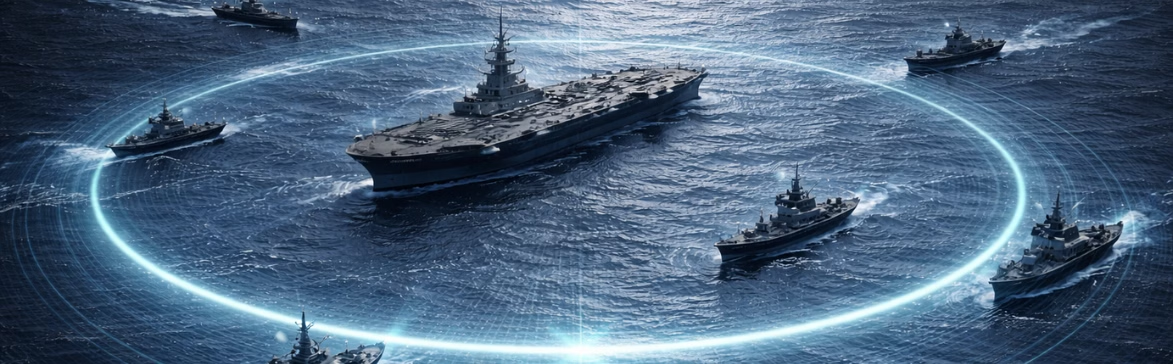
A naval blockade is a strategic military and economic tool used to restrict maritime access to a coastline or region, typically to sever an adversary’s primary sources of revenue and supply. In practice, this involves deploying a concentrated military force – often including aircraft carriers, guided-missile destroyers, and amphibious assault ships – to monitor and intercept all vessels entering or leaving a sanctioned zone. As seen in recent geopolitical escalations, a total naval blockade can be used to freeze a nation’s oil exports, effectively paralyzing its government budget and forcing a transition in leadership.
Modern blockades are integrated intelligence operations. Enforcement relies on maritime interdiction to stop the flow of specific goods like sanctioned petroleum or illegal narcotics. By leveraging multi-source intelligence (such as AIS, satellite imagery, and behavioral analytics), authorities can maintain a decision advantage, ensuring that even dark vessels attempting to breach the blockade are identified and intercepted.
Key Takeaways
- A naval blockade restricts maritime access to apply pressure without requiring a full-scale invasion.
- The primary goal is to cripple an adversary’s economy or military capability by cutting off sea-based trade and supply lines.
- Blockades can be formally declared or informally enforced through sustained interdiction.
- Governments monitor compliance by tracking whether vessels stay clear of the restricted zone, and any attempt to enter, especially by vessels using dark activity, is flagged as a breach and met with maritime interdiction.
- Commercial vessels operating near blockades face elevated legal, insurance, and contractual risk.
- Modern blockades depend on real-time multi-sensor fusion rather than static charts or declarations to detect non-cooperative dark vessels and identify breaches as they happen.
National Security and the Enforcement of a Naval Blockade
For defense and national security organizations, a naval blockade is a high-stakes instrument of maritime strategy. It transforms vast stretches of water into a controlled environment where every vessel must be identified, vetted, and, if necessary, intercepted. Governments rely on a Common Operational Picture (COP) to manage the thousands of troops and specialized naval assets – ranging from carrier strike groups to fast-intercept units – required to sustain a total blockade across strategic corridors.
In practice, this means moving beyond simple observation to active maritime interdiction. When a state designates substances like fentanyl as a weapon of mass destruction or classifies an adversary as a Foreign Terrorist Organization (FTO), the rules of engagement shift. Naval units transition from monitoring to conducting maritime interdiction operations (MIO), which consist of physical boardings and strikes designed to halt the flow of sanctioned crude or neutralize illicit cargo before it reaches its destination.
A recent example of this strategic pressure is the U.S. deployment in the Caribbean. To cripple the revenue streams of the Maduro government, the U.S. declared a total naval blockade on all sanctioned oil tankers. This operation involved 15,000 troops and the world’s largest aircraft carrier, the USS Gerald Ford. By intercepting tankers carrying millions of barrels of crude, the blockade targeted the primary source of foreign revenue for the regime, demonstrating how maritime denial is used to achieve geopolitical transitions.

Core Components of Blockade Enforcement
| Component | Operational FUnction | Strategic Impact |
| Surface armada | Provides physical presence and the capacity for kinetic strikes. | Deterrence of state-backed smuggling and blockade breaches. |
| Aerial ISR | Conducts wide-area surveillance and tip-offs for interceptions. | Rapid response to vessels attempting to bypass naval lines. |
| Maritime intelligence | Fuses AIS, satellite imagery, RF detections, and behavioral data to track dark activity. | Decision advantage through the attribution of gray zone vessels. |
What is a naval blockade under international maritime law?
A naval blockade is a belligerent operation intended to prevent vessels of all nations from entering or exiting specified ports or coastal areas belonging to an enemy. Under international law, it must be formally declared, notified to neutral states, and enforced impartially.
How are naval blockades enforced across large maritime regions?
Enforcement uses a tiered “picket line” of naval assets supported by persistent satellite and aerial surveillance. When a vessel is detected entering the restricted zone, it is queried and, if non-compliant, intercepted by fast-response units for boarding and search.
What intelligence is required to monitor compliance with a naval blockade?
Success depends on multi-source fusion and behavioral analytics that can spot anomalies, such as GNSS manipulation or sudden changes in speed that suggest a vessel is attempting to meet a smuggling boat or slip through a gap in the blockade.
Navigating Commercial Risk in Naval Blockade Zones
For trading and shipping organizations, a naval blockade directly affects route viability, port access, insurance exposure, and contractual risk. Understanding where blockades are declared, enforced, or informally exercised is critical for avoiding violations and supply disruptions.
When a total blockade is active – as seen in recent enforcement actions targeting Venezuela’s 900,000 barrels of daily oil exports – it effectively turns specific regions into no-go zones. This creates immediate legal risks for vessel owners. Operating near a blockade can lead to the seizure of the ship and its cargo under suspicion of assisting the blockaded party. Beyond the physical risk, the presence of a blockade force in major chokepoints triggers immediate market ripple effects, including insurance premiums skyrocketing, and the time-on-water for cargo increasing as ships take longer, safer routes around the interdiction zone.
Commercial Impact of Maritime Interdiction
| Operational Area | Primary Risk | Financial Impact |
| Voyage planning | Forced diversions and lane closures. | Increased bunkering costs and time-on-water delays. |
| Insurance | Withdrawl of standard cover or spike in war-risk. | Rapid escalation of P&I and cargo insurance premiums. |
| Charter parties | Claims of frustration of contract or force majeure. | Legal disputes over demurrage and delivery obligations. |
How does a naval blockade impact commercial shipping routes and port access?
A blockade essentially closes specific maritime corridors. This forces vessels to divert to alternative ports, leading to port congestion, increased fuel costs (bunker adjustment factors), and potential legal disputes over deviation clauses in charter parties.
What are the legal risks for vessels operating near a declared maritime blockade?
Vessels risk being designated as “sanctions evaders,” leading to cargo seizure, vessel forfeiture under prize law, or even kinetic strikes if they are perceived as carrying contraband.
How can shipping companies assess exposure to when a blockade is informally enforced?
Operators must move beyond static tracking to monitor real-time maritime interdiction activity. By identifying the positioning of naval armadas, it is possible to proactively reroute vessels, preventing their commitment to high-risk corridors.
Advancing Blockade Enforcement and Compliance with Maritime Intelligence
From a technology perspective, naval blockades expose the limits of static route monitoring. Effective awareness depends on fusing vessel tracking, behavioral analytics, satellite data, and real-time intelligence to assess access restrictions and enforcement activity dynamically.
Reliance on a single data source is a significant vulnerability during a blockade. For instance, AIS data alone is insufficient because non-compliant vessels frequently engage in dark activity or GNSS spoofing to mask their presence. Sophisticated monitoring requires Remote Sensing Intelligence to ensure that no ship slips through the blockade undetected.
How is naval blockade activity monitored using maritime data and analytics?
Monitoring platforms integrate satellite imagery with behavioral models to identify anomalies. If a vessel’s reported AIS position does not match its physical location as captured by SAR, it is flagged for potential breach of the blockade.
Why is AIS data alone insufficient during naval blockades?
AIS is a cooperative system that can be easily turned off or manipulated. During blockades, vessels often go dark to conceal their movements, meaning only non-cooperative sensors (like radar and satellites) can provide an accurate picture of activity.
How do satellite and behavioral data support real-time blockade monitoring?
Behavioral data identifies pattern of life deviations, such as a tanker loitering in a specific area for a ship-to-ship transfer. Satellite data provides the visual or radar confirmation needed to attribute that behavior to a specific vessel, even in the absence of an AIS signal.
Securing Interdiction Zones and Trade Integrity with Windward Intelligence
Windward’s Maritime AI™ platform provides the truth layer required to navigate or enforce the complexities of a naval blockade. For government and defense organizations, our Early Detection models surface vessels exhibiting deceptive shipping practices, such as GNSS manipulation or AIS spoofing, ensuring that no vessel slips through a blockade or interdiction zone unnoticed. By fusing behavioral analytics with Remote Sensing Intelligence, Windward enables agencies to prioritize limited patrol resources on the highest-risk targets.
For commercial stakeholders, Windward identifies blockade-linked risk and high-risk zones in real time. Our platform allows traders and shipping companies to vet their entire fleet against the latest enforcement actions, providing the clarity needed to avoid seizure and manage insurance exposure. MAI Expert™ further strengthens these workflows by providing contextual, explainable insights into why a vessel’s behavior is flagged, allowing for faster, defensible decisions in contested waters.
Book a demo to see how Windward’s behavior-based intelligence provides the visibility needed to manage naval blockade risks and strengthen maritime interdiction workflows.
Explore more

The Strait of Hormuz
What Is the Strait of Hormuz? The Strait of Hormuz is a narrow maritime passage connecting the Persian Gulf to the Gulf of Oman and the Arabian Sea, forming the primary gateway between Gulf energy exporters and global shipping routes. Located between Iran to the north and Oman and the United Arab Emirates to the...
Read more

Sanctions Enforcement
What Is Sanctions Enforcement? Sanctions enforcement refers to the implementation and monitoring of economic and trade restrictions imposed by governments or international bodies. These measures may target states, companies, vessels, individuals, or sectors to influence political behavior, restrict financial flows, or respond to security threats. In the maritime domain, sanctions enforcement focuses on detecting and...
Read more

Intelligence, Surveillance, and Reconnaissance (ISR)
What Is Intelligence, Surveillance, and Reconnaissance (ISR)? Intelligence, Surveillance, and Reconnaissance (ISR) refers to the coordinated collection, processing, and analysis of information to support military and security decision-making. ISR operations integrate multiple sensors, platforms, and intelligence disciplines to build situational awareness, detect threats, and guide operational response. In maritime security environments, ISR combines satellite imagery,...
Read more

Bring Your Own Imagery (BYOI)
What Is Bring Your Own Imagery (BYOI)? Bring Your Own Imagery (BYOI) refers to the ability to ingest externally sourced imagery into an intelligence platform for integrated analysis. Rather than reviewing satellite images or sensor outputs in standalone tools, BYOI enables users to upload and analyze third-party imagery directly within an existing analytical environment. BYOI...
Read more

Explainable AI (XAI)
What Is Explainabe AI? Explainable AI (XAI) refers to artificial intelligence systems designed to make their reasoning transparent and understandable to human users. Instead of generating a risk score or anomaly alert without context, explainable artificial intelligence exposes the factors that influenced the outcome. In machine learning systems, this means connecting predictions to identifiable behavioral...
Read more