


March 24, 2026
March 24, 2026: Iran War Maritime Intelligence Daily


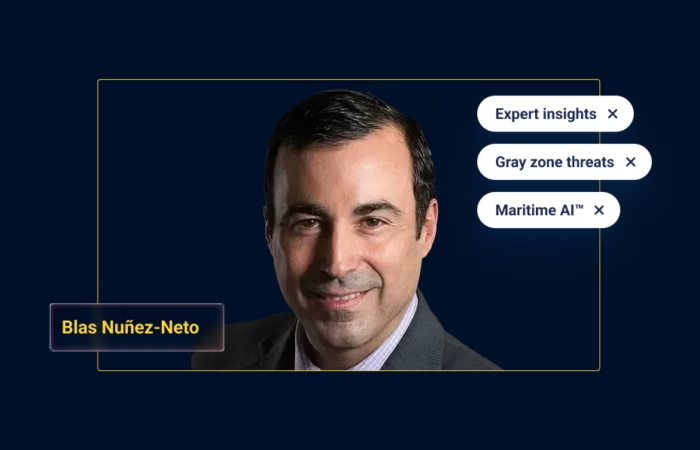
What U.S. Maritime Enforcement Is Up Against in 2026: An Exclusive Interview with Blas Nuñez-Neto
What’s inside?
Key Takeaways
- Maritime enforcement is shifting from observation to interdiction, as illicit actors increasingly embed themselves within legitimate trade flows.
- Operational superiority now depends on decision speed and prioritization, not additional sensors or raw visibility.
- AI and Remote Sensing Intelligence enable earlier risk detection and more confident action, particularly in gray-zone environments where ambiguity is deliberate.
- Frontline operators face a prioritization challenge at an unprecedented scale, requiring intelligence-led approaches that balance enforcement, trade flow, and geopolitical risk.
- As 2026 unfolds, maritime risk will be shaped more by behavior than declarations, demanding approaches that can operate across scale, speed, and complexity.
- The analysis in this article is guided by Blas Nuñez-Neto’s interpretation of the current maritime enforcement environment, informed by his experience at DHS, the National Security Council, and in advisory roles.
An Expert Perspective on Maritime Enforcement in 2026
By any traditional measure, maritime enforcement should be getting easier. There is more data than ever before – we have more sensors, more satellites, and more visibility across the world’s oceans. Yet for agencies tasked with protecting borders, enforcing sanctions, and interdicting illicit trade, the opposite is true.
Illicit activity has not disappeared – it has adapted.
Bad actors are no longer relying on obscure routes or isolated tactics. They are embedding themselves directly into legitimate trade flows, exploiting scale, complexity, and time pressure to hide in plain sight.
This is the operating environment Blas Nuñez-Neto has navigated as a former Assistant Secretary for the U.S. Department of Homeland Security and National Security Council, and now Senior Advisor at WestExec Advisors. Having spent years in this environment, Blas has seen how the operating landscape has evolved and why older, manual approaches no longer scale to today’s challenges.

Recent developments around Venezuela illustrate this shift clearly. U.S. enforcement actions have moved beyond static sanctions monitoring toward active maritime risk management, with interdictions and boardings occurring across multiple regions rather than within a single, contained theater. These operations reflect a broader reality: maritime enforcement increasingly unfolds under conditions of uncertainty, compressed timelines, and adaptive adversaries.
At the core of that shift is the simple constraint that human judgment remains decisive, but the tempo and volume of maritime risk have outpaced human-only analysis. AI does not replace decision-makers, but it does compress the decision cycle, enabling analysts and operators to surface patterns, behaviors, and risk signals that would otherwise emerge too late to influence outcomes. As 2026 unfolds, the operating environment will increasingly demand approaches capable of handling scale, speed, and behavioral complexity simultaneously.
The analysis that follows is guided by Nuñez-Neto’s interpretation of this environment, informed by his experience across maritime security, trade policy, and national security.
Why This Conversation Matters Now
U.S. action in and around Venezuela has highlighted how quickly maritime enforcement can move from regulatory oversight into active operational decision-making. Coordinated interdictions of Venezuela-linked tankers in both the North Atlantic and the Caribbean have demonstrated that enforcement pressure is no longer geographically bounded and is not limited to a single legal or policy mechanism.
At the same time, the broader operating environment remains fluid. While policy signals around Venezuelan oil sanctions may evolve in the near term, the structural dynamics shaping maritime risk remain in place. Shadow fleet operators continue to adjust routing, identity, and protective strategies in response to enforcement activity, while state actors observe and test the boundaries of intervention.
For maritime and border agencies, the significance of this moment lies less in any one sanctions framework and more in a durable shift in how risk manifests at sea. Enforcement actions are increasingly global in execution, adversary adaptation occurs on compressed timelines, and commercial trade, security operations, and geopolitical signaling intersect in ways that complicate both detection and response.
This is the context in which operational superiority is being redefined, and why the challenges facing maritime enforcement today differ materially from those of even a few years ago.
From Operational Awareness to Operational Superiority
In this environment, operational superiority is defined not by how much of the maritime domain can be observed but by how quickly uncertainty can be reduced, and decisions can be made with confidence under time pressure.
For agencies operating at the seam between routine law enforcement and national security response, the challenge is not a lack of information. It is the speed at which disparate signals must be fused, assessed, and prioritized. Satellite imagery, AIS data, radar returns, open-source reporting, and sensor feeds all contribute pieces of the picture, but without synthesis, volume becomes friction.
AI changes that equation by accelerating the intelligence cycle. By correlating data across sources and time, it allows analysts and operators to move beyond static indicators and toward a dynamic understanding of behavior. In practice, this creates a decision advantage in the gray zone, where delays, ambiguity, and misprioritization carry real operational cost.

Dark Fleet Activity and the Shift in Non-Combat Intelligence
The rise of dark fleet activity in the Caribbean illustrates why this shift matters. State-linked sanctions evasion and transnational smuggling increasingly rely on the same underlying tactics: blending into legitimate trade, manipulating identity, and exploiting jurisdictional seams.
From an intelligence perspective, this has reduced the utility of ship-by-ship monitoring alone. The problem is no longer identifying a single anomalous vessel, but recognizing coordinated behavior across fleets, corporate networks, and transit patterns.
Non-combat intelligence requirements have therefore moved toward behavioral analysis at scale. AI enables the fusion of satellite, thermal, optical, and open-source data to surface patterns that would be impractical to identify manually, particularly when adversaries deliberately operate below traditional thresholds of detection.

Frontline Operations in an Era of Behavioral Interdiction
These intelligence shifts are felt most acutely by frontline maritime operators. The growth and diversification of illicit networks have increased the number of actors, commodities, and transactions involved in any given scheme. Drug trafficking organizations now move oil, humans, and chemical precursors alongside narcotics, often using legitimate shipping channels to obscure activity.
As a result, the frontline challenge has shifted from detection to prioritization. With limited resources and overwhelming volumes of lawful maritime traffic, operators must determine which vessels, cargoes, or movements warrant inspection, boarding, or seizure.

AI-driven risk scoring supports this transition by narrowing focus to the highest-risk targets, enabling enforcement actions that are both more effective and more defensible. This is particularly critical in environments where enforcement decisions must be justified operationally, legally, and politically, often simultaneously.
Precision Intelligence and Mission Risk
When enforcement actions escalate to boarding, seizure, or interdiction, the cost of incomplete intelligence increases sharply. Misjudging a vessel’s history, ownership, crew, or proximity to other actors can raise the risk of unintended escalation or operational failure.
High-fidelity intelligence mitigates this risk by providing a more complete operational picture. Historical behavior, network associations, and real-time situational awareness combine to inform decisions before action is taken. In this context, AI’s role is not autonomy, but precision, supporting confidence in execution under compressed timelines.

The Friction Between Trade and Security
One of the defining constraints in U.S. maritime security is scale. Tens of thousands of containers move through ports daily, while enforcement resources remain finite. The tension between facilitating legitimate trade and identifying higher-risk activity is structural, not episodic.

Addressing that tension requires the ability to distinguish risk without disrupting commerce. Intelligence-led prioritization, enabled by bulk data analysis, allows agencies to apply scrutiny where it is most needed while maintaining throughput elsewhere. In practice, this is the only viable way to reconcile enforcement objectives with the operational realities of global trade volume.
The Role of AI and Remote Sensing Intelligence
As maritime risk becomes more distributed and adaptive, the value of AI lies in its ability to operate across scale and time in ways human teams cannot. Remote Sensing Intelligence extends that capability by providing persistent, independent visibility that is not reliant on self-reported data.
Together, AI and remote sensing allow enforcement agencies to move beyond what vessels claim to be doing and focus instead on what they are actually doing. Satellite imagery, combined with behavioral models, makes it possible to correlate reported positions with observed movement, identify anomalies, and track patterns across regions and timeframes.

This capability is particularly relevant in environments where adversaries deliberately exploit ambiguity. When vessels spoof AIS signals, reroute to avoid scrutiny, or operate across multiple jurisdictions, AI-driven analysis of remote sensing data enables earlier detection and more confident assessment of risk.
The result is not automation of enforcement decisions, but improved decision quality. By surfacing high-confidence signals and contextualizing them within broader behavioral patterns, AI and remote sensing support faster prioritization, more precise interdiction planning, and reduced uncertainty at the point of action. The remaining challenge is not whether these tools work, but how consistently they are integrated into operational workflows rather than treated as standalone analytical aids.
Looking Ahead
The opening months of 2026 have underscored how quickly maritime risk can evolve from regulatory concern to operational reality. The environment facing maritime and border agencies is faster, more interconnected, and more adaptive than in years past.

The question is no longer whether this shift will continue, but how enforcement organizations position themselves to operate effectively within it. The answer lies in approaches that combine human judgment with the ability to operate at scale, speed, and behavioral depth – capabilities that are increasingly necessary as maritime enforcement moves further into an era defined by interdiction rather than observation.
Where These Conversations Matter
The questions raised by this moment are not theoretical. They are being confronted daily by practitioners responsible for maritime security, border enforcement, intelligence integration, and national risk management.
As maritime operations move further into the space between routine enforcement and strategic competition, leaders are being asked to make decisions with incomplete information, compressed timelines, and real geopolitical consequences. The challenge is not simply understanding what is happening at sea, but determining how to act and when.
This is the context in which Windward Academy operates. Designed as a focused, practitioner-driven forum, Windward Academy brings together industry experts to examine how intelligence is produced, how risk is prioritized, and how interdiction decisions are executed under real-world constraints.
Rather than debating abstract policy or emerging technology in isolation, the Academy centers on operational experience and applied insight. Experts like Blas Nuñez-Neto will come together to unpack how today’s enforcement environment is reshaping decision-making, intelligence workflows, and mission execution as 2026 continues to unfold.

Explore more

Maritime Defense Weekly: Energy Flows and Infrastructure Risk
Week in Focus Russian Diesel Cargo Signaling Arrival in Cuba A Hong Kong-flagged medium-range tanker is signaling arrival in Cuba on March 2 after multiple AIS destination revisions. The vessel initially broadcast Havana, then shifted to “Caribbean Sea,” and later to “Gibraltar for orders,” despite already transiting the strait. Windward’s assessment indicates the tanker likely...
Read more

Maritime Defense Weekly: Offshore Enforcement and Baltic Exposure
Week in Focus Sanctions Enforcement Moves Further Offshore The United States intercepted and boarded Aquila II (IMO 9281152) in the Indian Ocean, nearly 1,000 nautical miles from where it fled a Venezuelan quarantine zone in January. The 22-year-old Suezmax had falsely broadcast under the Panamanian flag and has a history of extended dark activity and...
Read more

Enforcement Shock Accelerates Dark Fleet Reflagging to Russia
At a Glance A Structural Shift in Russia’s Shadow Fleet At least 120 falsely flagged, sanctioned tankers are likely to reflag to Russia’s registry in the coming months, as Western interdictions of stateless shadow fleet vessels accelerates a structural shift in Russia’s oil export logistics. All ships fit the profile and trading pattern of tankers...
Read more

Maritime Defense Weekly: Enforcement Tightens Across Global Shipping
The Week in Focus Maritime Enforcement Is Shifting From Designation to Constraint Maritime enforcement is increasingly focused on restricting how vessels operate in practice, not just on whether they appear on a sanctions list. Rather than relying solely on designations, recent actions are targeting the services and access that make maritime trade possible, including insurance,...
Read more

Tracking RAIDER: How Long-Term Vessel Behavior Uncovered a Pacific Drug Operation
At a Glance How a Dormant Vessel Triggered a Major Seizure In January 2026, French naval forces interdicted the MV RAIDER, a 41-meter pontoon vessel, in French Polynesian waters, seizing nearly five tonnes of cocaine, with an estimated value of nearly $150 million. Although the vessel was released without charges, its risk profile illustrates how...
Read more