


October 5, 2026
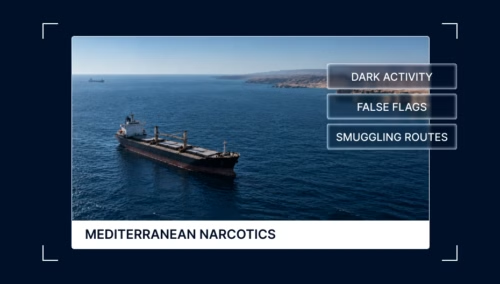
What a 25-Day AIS Blackout Off Libya Tells Us About Mediterranean Narcotics Routes


What a 25-Day AIS Blackout Off Libya Tells Us About Mediterranean Narcotics Routes

What’s inside?
At a Glance
- A Mali-flagged general cargo vessel went dark for 25 days off eastern Libya between August 28 and September 23, 2026.
- The vessel sailed from an Albanian port declaring Egypt, went dark in open water, reappeared at nearly the same position, and returned directly to Albania.
- The vessel reflagged to Mali in June 2026 after a renaming and prior identity changes, and Mali has informed the IMO that vessels are fraudulently broadcasting its flag, removing effective flag-state oversight.
- The operational footprint links Albania, a leading European narcotics consolidation hub, to a North African coast heavily exploited for illicit ship-to-ship transfers, fuel smuggling, and arms trafficking.
- The dark period covers waters transited by livestock carriers arriving from South America, creating opportunity for an at-sea drop-off or pick-up while the vessel was untracked.
The 25-Day Gap Between Albania and Libya
In late August 2026, a Mali-flagged general cargo vessel left an Albanian port, declared Egypt as its destination, and switched off its AIS transponder in open water off eastern Libya. For 25 days and 8 hours, nothing was transmitted. When it reappeared on September 23, it was at nearly the same position where it had gone dark. It immediately changed its declared destination back to Albania and sailed directly there.
None of that is impossible to explain. AIS gaps happen, destinations can change, and vessels do turn around in the Mediterranean.

What is harder to explain is all of it, together, on a vessel whose profile reads as the operational signature of a transshipment platform rather than a cargo ship running late. The Albanian base port, the recent reflag to a flag of no effective oversight, and the prior dark periods off Egypt all point in the same direction.
Deliberate and Repeating Dark Activity
The vessel reported normally right up to the moment it switched off, and again immediately after it reappeared. There is no coverage gap on either side of the dark activity. The dark period is assessed as deliberate.
It was also singular. During the 25-day window, the vessel was the only ship in the surrounding area to go dark. If equipment failure or regional interference were the cause, other vessels transiting the same waters would be expected to show matching signatures. None did.
In addition, it was not a first-time behavior. The same vessel went dark twice off Egypt’s northern Sinai coast in March 2026. What happened off Libya in late August was consistent with a pattern the vessel had been establishing for months.
A Flag That No One Is Watching
The vessel reflagged to Mali in June 2026, following a renaming and a series of prior identity changes. On paper, that provides a flag state. In practice, it does not.
Mali has informed the IMO that vessels are fraudulently broadcasting its flag. The registration cannot be taken as a genuine flag state providing oversight. For any vessel operating in a maritime corridor where flag-state inspection is one of the few enforcement levers available to port authorities, a flag that no sovereign is actively administering is a signal, not a technicality.
Repeated identity changes compound the effect. A vessel that cycles through names, broadcast identifiers, and now a flag with no oversight behind it is a vessel whose documented identity has been built to resist persistence-based screening.
The Two Ends of the Voyage
The two ends of the voyage matter as much as the dark period in between.
Albania has emerged in recent years as a leading European narcotics hub and consolidation point. Powerful domestic organized crime groups control trans-Atlantic and trans-Mediterranean cocaine and heroin routes through the country. A vessel whose operating base is in Albania, with long port stays between voyages, is operating from the center of that network rather than the edge of it.
The waters off eastern Libya are the other half of the geography. The area is heavily exploited for illicit ship-to-ship transfers, fuel smuggling, and arms trafficking. The specific stretch where this vessel went dark is also transited by livestock carriers arriving from South America. For 25 days, a vessel with a documented pattern of deliberate dark periods was positioned in waters where South American livestock traffic passes through.
No at-sea encounter or cargo transfer has been observed. No satellite imagery is currently held for the dark window. What is known is the geometry of the operation.
What One Voyage Says About Mediterranean Narcotics Routes
What makes this case worth attention is not the single dark activity, but the repeatability built into it.
A vessel that returns consistently to the same Albanian base, under a flag with no oversight behind it, with a documented history of going dark off the same coasts, is a vessel whose operational pattern can be run again. The March 2026 Sinai gaps and the August–September Libya gap are consistent with a methodology, not an improvisation.
For interdiction and compliance stakeholders tracking Mediterranean narcotics routes, the question is not whether this specific voyage carried something. The question is how many vessels operating out of Albanian ports fit the same behavioral profile — recent reflag to a problem registry, documented identity changes, repeat dark periods along North African coasts — and whether that fleet-level pattern is visible before an interdiction opportunity closes.
The vessel that vanished for 25 days off Libya may be one example of a wider operational practice. Behavioral intelligence is the layer that turns one suspicious voyage into a fleet-level pattern before the next interdiction opportunity closes.
Written by Maya Romi, Windward Senior Maritime Intelligence Content Manager. Analysis by Windward’s MIOC team.
Explore more

Vessels Loiter Over Subsea Cables and Pipelines Across Five Theaters
At a Glance Chinese Survey Grids Converge on the Guam and Japan Cable Corridors Two Chinese state-linked vessels have spent September running structured survey grids over separate transpacific subsea cable corridors, one around the Guam cable hub and one over the Japan to U.S. cables east of Japan. A Chinese-flagged fishery patrol vessel operated by...
Read more

Ordinary Traffic Is Where Military and Criminal Threats Hide
A vessel’s AIS track goes quiet. A ship slows and holds position outside a shipping lane. A port call shows cargo that doesn’t match what left the previous port. Each of these is the same kind of event — a break from a known pattern. None of them says, on its own, what kind of...
Read more

Why Navies Need Purpose-Built Tools for Adversarial and Commercial Traffic
At a Glance Two Missions, Same Waters, Different Questions A frigate operating in the Baltic and a coast guard cutter in the same waters are asking different questions of the maritime picture in front of them. The frigate wants to know about the vessels that are not what they claim to be. Which of the...
Read more

Why Maritime Operations Centers Need Fusion, Not Another Data Feed
At a Glance The Constraint Isn’t Data, It’s Fusion MOCs receive multi-sensor data at volumes the operational teams inside them cannot fully process, cross-reference, or turn into decision-relevant intelligence at the pace commanders require. The constraint on decision advantage is not the size of the incoming data pipeline. It is the fusion layer that turns...
Read more