


November 24, 2026
How Smuggling Networks Use the Same Tactics as Sanctions Evaders


How Smuggling Networks Use the Same Tactics as Sanctions Evaders

What’s inside?
At a Glance
- The techniques narcotics vessels use to hide where cargo came from are the same ones documented in sanctions evasion cases.
- Those techniques include going dark (disabling AIS), transferring cargo at sea, spoofing identity, and changing origin.
- A gap in the AIS record looks identical whether the cargo is cocaine or sanctioned crude, so the gap alone never resolves the question.
- What resolves it is the vessel’s own history, which is why the same analysis works for both.
- Compliance teams and enforcement agencies are looking at the same behavior from opposite sides.
The Same Techniques, Whatever the Cargo
A tanker carrying sanctioned crude and a cargo ship carrying cocaine have different buyers and different destinations. In the middle of the voyage, they have the same problem. Neither can let anyone work out where the cargo came from.
The techniques documented on both sides are the same.
They switch off AIS at the point that would incriminate them, usually the load or the transfer, then switch it back on.
They move cargo between ships at sea, so the vessel arriving in port is not the one that loaded.
They change flag, name, and MMSI, so the vessel’s history does not follow it.
And they falsely declare their origin.
A Windward counter-narcotics assessment described one vessel as using fake registries, switching off AIS deliberately, and hiding behind shell companies. That description would fit a sanctions case without changing a word.
Compliance teams at traders, insurers and banks deal with one half of this. Customs and enforcement agencies deal with the other. Different systems, different alerts, same playbook.
An AIS Gap Tells You Nothing About Why
When a vessel stops transmitting, the record shows where it stopped, how long the signal was off, and where and when it came back on. It does not show what happened in between.
A sanctions analyst sees a gap near a sanctioned terminal and suspects a port call. A counter-narcotics officer sees a gap in open water and suspects a transfer. Same gap, different reading.
Three cases show how the gap gets resolved:
Case One
Windward tracked a Mali-flagged cargo ship that left Albania in late August 2026 declaring Egypt as its destination. It switched off AIS off eastern Libya and stayed dark for three weeks. It reappeared almost exactly where it had disappeared, changed its destination back to Albania, and sailed home.
Two things make that gap suspicious rather than ambiguous. The vessel transmitted normally right up to the switch-off and again immediately after. It was also the only ship in that area to go dark.

Case Two
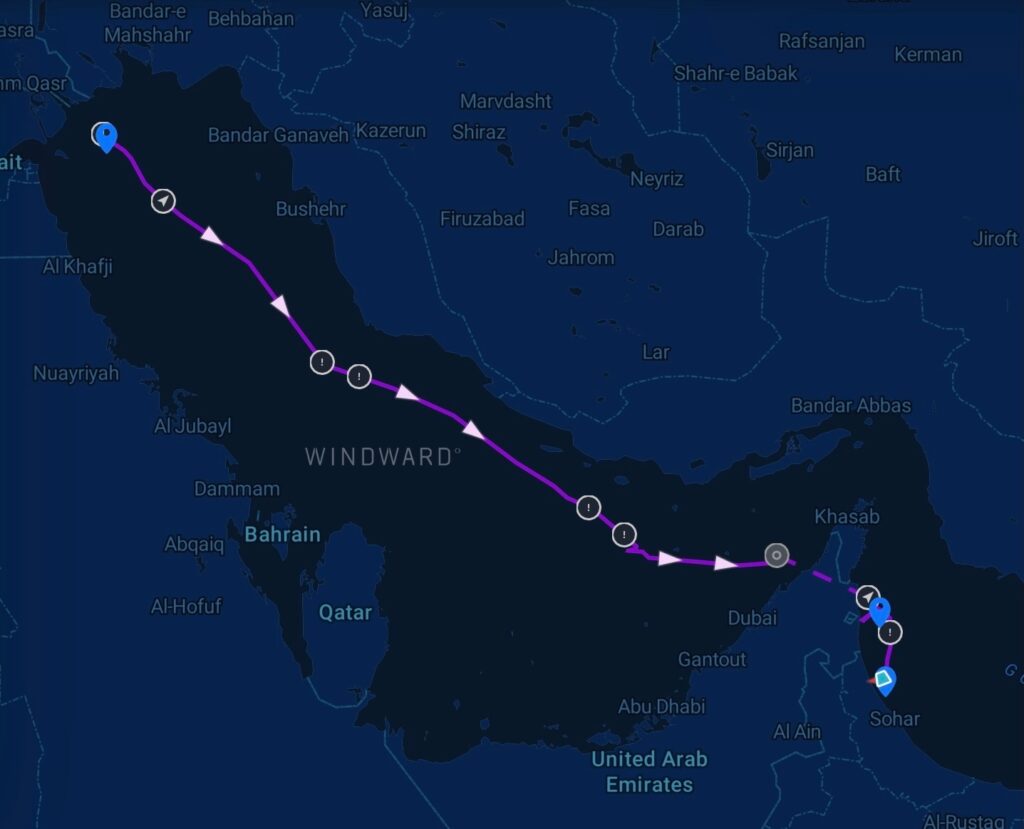
Windward tracked a tanker that left the Riau archipelago on April 12, 2026, went dark near Fujairah on April 26, and completed a four-day covert transit to Kharg Island to load.
The two vessels did not behave identically. The Mali-flagged ship disappeared and returned to where it started. The tanker disappeared and kept going. What they share is the timing. Both went quiet for the part of the voyage that would have identified where the cargo came from.
Case Three
A vessel went dark for nine days, surfaced for a two-hour stop at a private wharf, and went dark again. It had never called at that country before, across 632 recorded port calls. Coast guard officers boarded it on the return leg and found empty cartons.
What flagged it was the port call itself. A vessel with 632 recorded calls had never been to that country, and the one time it did, it stopped for two hours at a private wharf between two dark periods.

None of these was solved by reading the AIS record. All three were solved by comparing the gap against how the vessel normally behaves.
Transfers at Sea Break the Chain
Moving cargo via ship-to-ship transfer is the most useful technique for both.
Sanctioned operators use it to separate the cargo from its origin. Oil loads at a designated terminal, moves to a clean vessel at sea, and arrives in port with paperwork describing a different voyage.
Traffickers use it for the same reason. Cargo moves from a ship that cannot enter a controlled port to one that can, or down to a small boat that has no AIS, no registration, and appears in no shipping record.
Windward tracked a product tanker doing this repeatedly across the Strait of Hormuz. Over 90 days, it met 15 different vessels, taking cargo from feeder tankers at anchorages inside the Gulf, transiting the strait, and handing the same cargo to different tankers waiting outside. Four of those transfers were confirmed against cargo records.
No single vessel carried a parcel through the chokepoint. The ship that loaded was never the ship that delivered, which is the whole point of the structure.
Satellite imagery catches transfers whether or not either ship is transmitting. Two hulls alongside are visible. So is a draft change consistent with a transfer.
There is a limit worth stating. A fast boat doing 40 knots can be gone before the image is processed. It is easier to find the mothership than to catch the handover.
Identity Changes Exist to Lose the History
Changing flag, name, and MMSI does one thing. It stops a vessel’s record from being followed.
A ship with a bad history reflags, renames, and comes back looking clean. Screened on what it declares, it passes. Screened against ownership records and years of behavior, it does not.
The flag is increasingly the giveaway. The Mali-flagged ship above had reflagged in June 2026 after a rename and a run of identity changes. Mali does not operate a ship registry. It confirmed this to the IMO, which found 17 vessels broadcasting a Mali flag fraudulently. The registration means nothing. No flag state is overseeing this ship.
The sanctions side does this at a greater scale. Another sanctioned tanker went dark for 47 days. When it came back, its ownership had changed, and it was operating under a new name, one of at least 18 it has used.
Three weeks dark and a reflag, or 47 days dark and a new identity. The scale differs. The method does not.
That matters as much to a customs officer deciding whether to inspect as to a compliance analyst screening a counterparty.
Some Vessels Hide Nothing and Are Still Worth Looking At
Everything above involves hiding something. Not all of it does.
One case breaks the pattern.
A cargo ship ran three voyages from Colombia to Turkey over eleven months. Each time it made a short stop off a stretch of Colombian coast known for small-boat interdictions. Each time, about two weeks later, it slowed to under three knots on the Atlantic approach to Gibraltar before carrying on into the Mediterranean.
AIS ran continuously. No dark periods, no identity changes, no meetings.
Nothing was hidden. The vessel simply slowed for no reason, three times, in the same place, on voyages that were not going anywhere near it. None of nine comparable ships did the same.
A system looking for concealment finds nothing here. A system comparing a vessel against its own history and its peers finds a question worth asking.
One Architecture, Two Jobs
Customs enforcement and sanctions compliance run on different systems with different alerts. The vessels do not know the difference.
In the Caribbean, CARICOM IMPACS used Windward to run a multi-agency operation that seized 4,841 kg of cocaine. The same models and the same ownership data sit behind sanctions screening for commercial teams.
The same models and the same ownership data sit behind sanctions screening for commercial teams.
That is the point. A vessel hiding cocaine and a vessel hiding sanctioned crude leave the same traces, so the system that finds one finds the other. Which problem you were looking for does not decide what you can see.
Written by Maya Romi, Windward Senior Content Manager.
Explore more

Russian Vessels Have Shifted From Europe’s Cables to Its Energy Grid
At a Glance Energy Went From One Event Every Two Weeks to Six in Nine Days Windward’s MIOC tracks vessels loitering over European subsea and offshore infrastructure. Between late August and mid-November, Russia-linked loitering events in that record shifted decisively toward energy. Through September and October, energy appeared roughly once every two weeks. In the...
Read more

Unregulated Squid Fishing in the Arabian Sea Surges as the 2026–27 Season Opens
At a Glance A Squid Fishery No One Manages Since 2015, distant-water fishing (DWF) fleets have steadily expanded their presence in the Arabian Sea to harvest purpleback flying squid. The number of vessels in the northwest Indian Ocean squid fishery grew from 30 in 2015 to 361 in 2025, according to the Environmental Justice Foundation....
Read more

PRC Research Vessels Nearly Double Survey Time Around Taiwan in 2026
From January 1, 2018 to October 9, 2026, Windward MIOC analysis of 52 PRC research vessels shows several distinct changes in where and how the fleet works. The northern South China Sea’s share of fleet working time (slow-speed survey and station work offshore) rose from 22% in 2019–21 to 41% in 2023–25. China Geological Survey...
Read more

GPS Jamming in Contested Waters Demands an All-Source Operational Maritime Picture
At a Glance GPS Jamming Has Become Routine in Contested Waters Operations in degraded environments are no longer a planning scenario. For anyone responsible for a maritime operational picture, they are already the operating condition in much of the water European navies patrol. GPS jamming touched 124,235 distinct vessels worldwide in Q3 2026, up 11.7%...
Read more