


February 5, 2026
Tracking RAIDER: How Long-Term Vessel Behavior Uncovered a Pacific Drug Operation


Tracking RAIDER: How Long-Term Vessel Behavior Uncovered a Pacific Drug Operation
What’s inside?
At a Glance
- RAIDER, a 41-meter vessel, resurfaced in late 2025 after years of dormancy.
- Within weeks, it changed identity and flagged under Togo – a known low-oversight registry.
- Windward flagged the vessel as a moderate border risk before it reached the Pacific.
- French authorities seized 4.87 tonnes of cocaine aboard the vessel in January 2026.
- No legal charges were filed, but the case highlights why historical behavior is critical to interdiction.
How a Dormant Vessel Triggered a Major Seizure
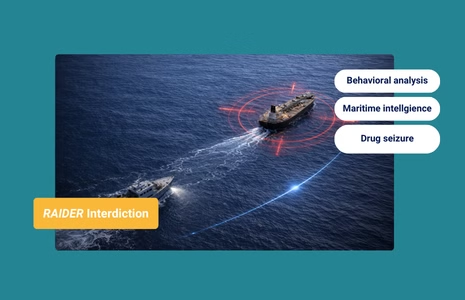
In January 2026, French naval forces interdicted the MV RAIDER, a 41-meter pontoon vessel, in French Polynesian waters, seizing nearly five tonnes of cocaine, with an estimated value of nearly $150 million. Although the vessel was released without charges, its risk profile illustrates how maritime intelligence can surface elevated risk patterns before illicit activity escalates.

Windward tracked RAIDER’s reappearance after a long dormancy. After disappearing in August 2021 in the Honduras EEZ, the vessel resurfaced in November 2025 with a new name, MMSI, and Togo registration. Our system flagged it as a moderate border risk just two weeks later based on identity manipulation, irregular routing, and weak ownership structure.

Behavioral Indicators That Preceded the Interdiction
Prior to the interdiction, RAIDER exhibited a series of behavioral indicators associated with elevated trafficking risk, including:
- Reactivation after a multi-year dormancy, breaking continuity in vessel activity history.
- Flag hopping and identity changes, consistent with deceptive repapering behavior.
- First-time transit through the Panama Canal, deviating from prior operational patterns.
- Limited and opaque ownership documentation, increasing attribution and enforcement ambiguity.
These patterns don’t necessarily confirm criminal activity, but they raise operational risk. Furthermore, when combined, they signaled that the vessel warranted closer scrutiny before reaching the Pacific.
Why Multi-Source Intelligence Matters
In environments where vessels change identity, flags, and patterns over months or years, static monitoring falls short. Risk doesn’t always stem from what a vessel is doing today, but from what it’s been allowed to do over time. That’s where multi-source intelligence becomes essential.
Windward’s platform fuses multiple independent data sources to deliver operational clarity, including:
- AIS gaps and spoofing patterns to detect attempts to manipulate location data or obscure real-time movements.
- Satellite imagery, including synthetic aperture radar (SAR), electro-optical (EO), and radio frequency (RF) detections to validate presence and activity regardless of visibility, weather, or AIS status.
- Document and registry validation to verify the legitimacy of claimed flags, identify provisional or low-oversight registrations, and flag inconsistencies in vessel identity.
- Historical behavioral modeling to identify anomalies in routing, repapering cycles, and port activity compared to expected operational patterns.

In cases like RAIDER, layered intelligence can create a full picture of risk before a vessel enters high-consequence waters. For governments and enforcement teams, this kind of insight supports a more proactive posture, improving visibility into long-term behavioral risks that may otherwise go undetected.
Lessons for Maritime Security Teams
RAIDER is a textbook case for why long-term vessel behavior matters.
It wasn’t one datapoint that raised alarms, but rather a full behavioral arc of dormancy, reactivation, identity shifts, irregular routing, and weak ownership signals. Each event might have seemed routine in isolation, but together, they built a risk profile that supported early interdiction.
Cases like this show the value of tracking behavioral changes over time, especially when individual data points may appear routine in isolation.
For security and enforcement teams, it reinforces the need to monitor continuity, identity, and movement history, especially when legal documentation appears valid.
Behavioral intelligence isn’t just about detecting what a vessel is doing now – it’s about understanding what it’s done, what’s changed, and what that means for what happens next.
Frequently Asked Questions (FAQs)
Why wasn’t RAIDER prosecuted despite the drug seizure?
Jurisdictional complexity and flag state cooperation often delay or dilute legal outcomes in maritime cases. While French forces successfully interdicted RAIDER and seized nearly five tonnes of cocaine, the vessel’s provisional registration under Togo and the ambiguity of ownership limited immediate prosecutorial action.
What behavioral indicators should maritime security teams monitor?
Key indicators include long-term dormancy, identity manipulation (name/MMSI changes), atypical routing, weak or opaque ownership structures, and first-time registry with low-oversight flag states. When assessed together, these signals can reveal elevated risk, even before illicit activity occurs.
How does multi-source intelligence differ from traditional maritime domain awareness (MDA)?
Maritime domain awareness typically relies on cooperative data sources, such as AIS. Multi-source intelligence integrates non-cooperative and independent sources like SAR, EO, RF, registry validation, and behavioral models to build a complete, verified risk profile, which is especially important in cases dealing with deceptive shipping practices and bad actors.
How can multi-source maritime intelligence support interagency and international cooperation?
By integrating independent data sources and verified behavioral indicators, multi-source intelligence provides a shared operational picture. This enables governments, law enforcement, and international partners to align on threat assessments, coordinate interdictions, and track high-risk vessels across jurisdictions.
Why do both real-time alerts and long-term behavior matter in maritime security?
Real-time alerts help identify immediate operational risks, while long-term behavioral patterns reveal deeper intent and vulnerabilities. When used together, they provide the context and foresight needed to act decisively before high-risk vessels can evade detection or legal accountability.
Everything you need to know about Maritime AI™ directly to your LinkedIn

Explore more

Maritime Defense Weekly: Maritime Enforcement Accelerates Across Global Energy Routes
The Week in Focus Enforcement Is Expanding Beyond a Single Theater Western maritime enforcement is no longer confined to designation, monitoring, or administrative friction. Recent activity indicates a growing reliance on physical constraints at sea, including boardings, safety-based interventions, and access denial, applied across multiple regions rather than within a single sanctions theater. This approach...
Read more

How the 2026 U.S. National Defense Strategy Reframes Maritime Access
Key Takeaways Why Maritime Access Can No Longer Be Taken for Granted For decades, maritime access was treated as a given. Shipping lanes remained open, chokepoints functioned, and infrastructure disruption was framed as an exception, something to manage during conflict or crisis. The 2026 U.S. National Defense Strategy challenges that assumption. It treats maritime routes,...
Read more
Six Essential Takeaways from the 2026 U.S. National Defense Strategy for Maritime Leaders
At a Glance The Maritime Logic of the 2026 National Defense Strategy The 2026 National Defense Strategy defines how U.S. defense priorities translate into action, shaping where attention, resources, and enforcement are applied. Across the document, the strategy prioritizes defending the U.S. homeland, securing economic access, and protecting critical terrain as enduring priorities rather than...
Read more

Maritime Defense Weekly: Maritime Enforcement Is Accelerating
The Week in Focus U.S. Maritime Enforcement Expands Beyond Venezuela U.S. actions over recent weeks indicate a clear transition from sanctions monitoring to physical maritime enforcement. Interdictions linked to Venezuela-related oil sanctions have demonstrated that distance from the original theater does not insulate vessels from enforcement action. The enforcement model emphasizes ambiguity rather than declaration....
Read more