


March 31, 2026
One Month of War in the Gulf: Mapping the Global Maritime Disruption


The New Sanctions Reality: How Multi-Sensor Fusion Detects What Paperwork Hides
What’s inside?
At a Glance
- Sanctions compliance now requires seeing beyond AIS and paperwork to actual behavior at sea.
- Deceptive shipping practices, dark fleets, and false flags exploit the limits of cooperative data and static documentation.
- Multi-sensor fusion combines SAR, EO, RF, AIS, and behavioral analytics, and document validation to verify what ships really do.
- This approach exposes hidden ship-to-ship transfers, fraudulent registries, and misdeclared trades that look “clean” on paper.
- Windward’s Remote Sensing Intelligence and Document Validation solutions operationalize this fusion, giving compliance teams decision-ready insight instead of raw data.
Sanctions Compliance Has Outgrown Paper Trails
Sanctions regimes have become increasingly complex, coordinated, and aggressive. The U.S., EU, and UK now issue frequent updates targeting vessels, companies, sectors, and behaviors, not just obvious bad actors.
Yet most sanctions compliance workflows still start from the same two pillars:
- Static documentation: Bills of Lading (BoL), Certificates of Origin (COO), ownership records, and insurance documents.
- Cooperative signals: Primarily automatic identification systems (AIS), sometimes supplemented with manual checks and open-source information.
On their own, these inputs describe how a transaction should look, not what actually happened. When a shipment moves through multiple jurisdictions, charterers, and owners, each with their own incentives and paperwork, the gap between declared reality and maritime reality widens fast.
This is the space where sanctions evasion thrives.
The Modern Visibility Problem: Manipulation at Scale
Today’s maritime risk landscape is defined by actors who understand exactly where traditional monitoring breaks down. They exploit the gaps between what vessels report, what paperwork claims, and what truly occurs offshore, building entire operations around those blind spots.
Dark fleet tankers routinely disable AIS before entering known loading zones, reappearing only once cargo is already onboard. Others use identity manipulation to cycle through flags, owners, and technical managers in ways that allow them to maintain “clean” documentation even while engaging in deceptive activity. Smuggling networks and illicit supply chains take advantage of AIS spoofing, cloned MMSIs, and falsified voyage trails to mask true origins or destinations.
On paper, these voyages appear fully compliant. AIS tracks look orderly. Certificates seem correct. Ownership charts are neatly structured. But without independent verification, there is no way to understand where a vessel actually traveled, which ships it met, or whether its declared cargo aligns with its observed behavior. AIS-only or paperwork-first screening often misses these risks and can even unintentionally validate them.
How Remote Sensing Intelligence Closes the Gap
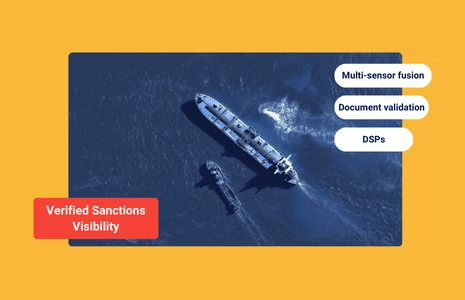
Modern sanctions compliance requires data that vessels cannot manipulate and that fraudulent documents cannot obscure. Multi-sensor fusion brings together several independent detection layers, each revealing a different piece of the truth.
Synthetic aperture radar (SAR) imagery provides continuous detection across weather, visibility, and time-of-day constraints. Electro-optical (EO) imagery adds visual clarity, including hull configuration, vessel proximity, port activity, or the physical setup of a potential ship-to-ship (STS) transfer. Radio frequency (RF) detections highlight where vessels are communicating or operating, even when AIS is silent. AIS itself remains useful, but now as a signal to test and corroborate rather than a source of truth. Document verification adds another layer, checking registry claims, certificates, and manifests against sensor-driven evidence of movement and identity.
When these inputs converge and are interpreted through behavioral analytics and AI, they produce a verified operational picture. Dark activity becomes traceable. False narratives collapse under physical evidence. Patterns that would never appear in AIS or paperwork, such as consistent routing through sanctioned corridors or repeat visits to high-risk rendezvous zones, become immediately visible.

AIS vs. Multi-Sensor Fusion: What Each Can & Can’t Reveal
AIS was built for safety and collision avoidance. It tells you what a vessel says about itself: identity, course, speed, and destination.
Multi-sensor fusion reveals whether that story holds up.
| Dimension | Paper Trail & AIS View | What Multi-Sensor Fusion Reveals |
| Vessel Location | Reported position and past track. | Physically detected position via SAR/EP, plus RF emissions and gaps. |
| Identity & Flag | Declared name, MMSI, flag, registry documents. | Identity changes, suspicious re-flagging, false flag, or shell registries. |
| Cargo & Routing | Manifests, declared ports, contractual documents. | Undeclared STS, hidden port calls, implausible voyage sequences. |
| Counterpart Risk | KYC files, ownership charts. | Real control structures, shared patterns with known high-risk entities. |
AIS and paperwork are still essential. But they show intent and declaration. Multi-sensor fusion tests those declarations against reality, making it the only way to meaningfully improve sanctions compliance in this new environment.
How Multi-Sensor Intelligence Solves Real Maritime Problems
Sanctions Evasion
Sanctions evasion is designed to exploit systems built on trust, such as AIS transmissions, documentation, and reported routes. Operators engaged in illicit trades often present clean manifests and polished paperwork, all while conducting undeclared STS transfers, masking port calls, or laundering identities through rapid reflagging.
Multi-sensor fusion counteracts these tactics by providing independent, verifiable context. SAR and RF detections highlight suspicious gatherings or dark zones, EO imagery shows how vessels actually behaved, and behavioral analytics connect these pieces into clear patterns of evasion. Document validation then checks whether certificates and declarations align with the physical evidence. Together, they expose supply chain routes that would remain invisible in AIS alone.
Trade and Chartering Risk
Traders, charterers, and financial institutions carry significant exposure when selecting vessels, especially when sanctions, insurance requirements, and contract terms depend on clean operational histories.
AIS and documentation, however, often fail to reveal long-term behavioral patterns such as repeated dark activity, undeclared port calls, or links to high-risk corporate networks. Multi-sensor fusion builds a complete behavioral profile by combining SAR, EO, RF, and AIS data with historical analytics. Document validation verifies whether ownership records, certificates, and voyage declarations are consistent with that behavior. This reduces the likelihood of taking on vessels with hidden liabilities.
Border and Maritime Security
Enforcement agencies operate in environments where most activity is non-cooperative and beyond the reach of paperwork entirely. Smuggling, trafficking, irregular migration, and unreported crossings rely on turning off AIS or never transmitting it in the first place.
Multi-sensor intelligence provides the non-cooperative detection required for these missions. RF emissions reveal hidden movement. SAR identifies vessels in poor weather or at night. EO confirms activity visually. Behavioral analytics highlight unusual patterns along maritime borders. Together, these layers allow security forces to detect, prioritize, and respond to high-risk events far earlier than traditional monitoring.
Supply Chain and Port Visibility
Supply chain operators need clarity on congestion, delays, and risk-driven disruptions, but AIS alone cannot explain why a vessel is delayed, whether congestion is worsening, or whether a disruption is regulatory or operational in nature.
Remote sensing fills in these gaps. EO and SAR show real conditions around anchorages and terminals. Behavioral analytics reveal anomalies in waiting times or routing patterns. Document validation helps reconcile declared cargo movements or schedules with observed behavior. This allows logistics teams to anticipate problems and understand their root causes instead of reacting late.
The Shift: From Declared Visibility to Verified Visibility
AIS and documentation reflect what participants say happened. Multi-sensor fusion shows what actually occurred. As sanctions enforcement grows more behavior-driven and more data-centric, verified visibility is becoming the industry baseline for managing exposure and proving compliance.
Organizations that adopt this approach gain the ability to identify risk earlier, validate counterparties independently, and demonstrate rigorous due diligence to regulators. Those that rely solely on AIS and paperwork are operating with partial visibility and increasing vulnerability.
How Windward Turns Multi-Sensor Data into Sanctions Intelligence
Windward brings military-grade Remote Sensing Intelligence into the commercial sanctions workflow. Instead of relying on what vessels declare, the platform reveals what they actually do by fusing SAR, EO, RF, AIS, behavioral analytics, and advanced document validation into a single operational picture.
This integration gives compliance teams access to capabilities that were once limited to defense and intelligence agencies – continuous detection, non-cooperative tracking, identity verification, and sensor-driven confirmation of events at sea. Whether you’re screening a single voyage or monitoring a global fleet, Windward provides the clarity to distinguish legitimate operations from deceptive activity.
With AI-automated Document Validation, real-time sensor correlation, and AI-driven behavioral modeling, the platform closes the gap between declared transactions and maritime reality. It ensures organizations can verify cargo origins, uncover hidden ownership links, expose false port calls, and detect the hallmarks of sanctions evasion long before paperwork or AIS would raise a flag.

Windward enables teams to move beyond compliance checklists toward mission-ready, decision-grade intelligence, giving commercial operators the same level of insight that warfighters and national security agencies rely on to understand risk in complex maritime environments.
Frequently Asked Questions (FAQs)
Why isn’t AIS enough for sanctions compliance anymore?
AIS is a cooperative system that depends on honest transmission. Modern evasion tactics exploit that cooperation by turning AIS off, spoofing positions, or cloning identities. Multi-sensor fusion cross-checks AIS against independent detections, making it far harder for deceptive behavior to stay hidden.
What is multi-sensor fusion in maritime sanctions monitoring?
Multi-sensor fusion is the process of combining SAR, EO, RF, AIS, port data, and document checks into a single analytical framework. Instead of looking at each sensor separately, behavioral models interpret them together to reveal patterns linked to sanctions risk.
How does document validation fit into remote sensing intelligence?
Document validation compares what paperwork claims – flags, ownership, routes, cargo – with sensor-driven evidence of behavior. If certificates, manifests, or registry records don’t match the vessel’s observed movements or identity history, that inconsistency becomes a clear sanctions risk signal.
Do we need access to raw satellite imagery to benefit from multi-sensor fusion?
No. Platforms like Windward handle the heavy lifting of collecting, processing, and fusing multi-sensor data. Compliance and risk teams consume the results as risk alerts, scores, and investigations – without managing imagery pipelines or RF processing themselves.
How quickly can multi-sensor fusion detect sanctions risk in practice?
Because AI models process live and historical data continuously, risky patterns such as dark STS near sensitive zones or unexplained identity changes can be flagged in near real time. That gives organizations a chance to pause payments, re-route cargo, or seek clarification before a transaction settles or a voyage completes.
Trending
- The EU’s 18th Sanctions Package Lookback Started. Trading Russian Products? You're At Risk. Nov 24, 2025
- Tanker Freight Rates Hit Five-Year High Amid Russian Oil Sanctions Shake-Out Nov 6, 2025
- Sanctioned, Stateless, and Still Sailing: Expert Insights from the Frontlines of Maritime Sanctions Nov 3, 2025
Explore more

Russia Expands Dark Fleet of LNG Carriers
At a Glance Covert Transfers and Reflagging Activity Three 20-year-old liquefied natural gas (LNG) carriers were recently sold to a newly formed company in Türkiye, with two subsequently reflagged to Sierra Leone, a ship registry favored by Russia’s dark fleet. All three LNG carriers have yet to signal their next destination to load a post-sale...
Read more

Distress or Deception? Sea Horse ‘Not Under Command’ While Delivering Cuba Gasoil
At a Glance Sea Horse, a medium range tanker sailing for Cuba laden with Russian gasoil has been broadcasting it is “not under command” and that it is drifting in the Sargasso Sea for nearly three weeks. AIS tracking suggest the Hong Kong-flagged tanker has now resumed its voyage for Cuba and is set is...
Read more

U.S. Treasury Expands Pressure on Iran’s Shadow Fleet and Weapons Procurement Networks
At a Glance Expanding Pressure on Iran’s Maritime and Weapons Networks On February 25, 2026, the U.S. Department of the Treasury’s Office of Foreign Assets Control (OFAC) designated more than 30 individuals, entities, and vessels linked to Iran’s shadow fleet and to networks supporting ballistic missile and advanced conventional weapons production. The action targets two...
Read more

The EU Maritime Services Ban That Didn’t Pass: Implications for Russian Trade
At a Glance A Sanctions Escalation That Stalled The European Union’s proposed maritime services ban on Russia was expected to mark a structural escalation in sanctions enforcement. Instead, EU ministers failed to reach an agreement, delaying the adoption of the bloc’s 20th sanctions package after opposition led by Hungary, with at least one other member...
Read more

Russian Diesel Tanker Sails for Cuba as U.S. Order Blocks Oil Imports
A tanker carrying Russian diesel is sailing for Cuba even as tightening U.S. pressure on the island’s fuel supply has forced other shipments to abort voyages or cancel loadings. Vessel Movements, AIS Changes, and Cargo Origin The Hong Kong-flagged medium-range tanker initially broadcast Havana as its destination on February 7, then altered its AIS signal...
Read more