


October 8, 2026
Tanker Attacks Spread Beyond the Strait of Hormuz as Gulf Freight Costs Soar


Russia Is the Leading Flag for Shadow Fleet Tankers

What’s inside?
WHAT: Russia is now the leading flag for the shadow fleet after shifting some 69 sanctioned ships to its registry since November 2025 in response to the interdiction of stateless tankers by U.S. and European militaries.
More than one in five of the 1,000-plus tankers sanctioned by Western regulators now flies the Russian flag, Windward analysis shows.
The second-largest flag was the open registry of Cameroon, accounting for 16.5%, or 157 tankers, followed by Sierra Leone with 98 vessels.
Cameroon’s government expelled some 55 Western-sanctioned tankers from its registry between February and May, claiming they had not been legitimately registered and saying an investigation was ongoing.
At least 20 of the 157 ships on this list falsely broadcast their affiliation with Cameroon after being de-flagged.
SO WHAT: Intensifying regulatory scrutiny and increased sanctions on tankers trading with Russia are leaving the Kremlin, associated oil producers, and maritime agencies with little choice but to incorporate the shadow fleet into the federation’s infrastructure.
Over the past 18 months, Russian state-owned insurers have provided P&I and hull and machinery coverage to more shadow fleet ships. The Russian Maritime Register of Shipping is also classifying tankers, including those not flagged in Russia.
Some 98 tankers reflagged to Russia in 2025 and 2026, Windward analysis shows, bringing the total number of Russia-flagged tankers to more than 213.

The UK and EU alone have collectively sanctioned more than 650 aging, sanctions-circumventing ships since the end of 2023. All of the tankers were deployed solely to ship sanctioned oil from Russia, Iran, or Venezuela.
Alongside these sanctions, Western governments have lobbied national maritime authorities to expel sanctioned ships.
Many smaller countries had contracted private companies to operate ship registries on their behalf and were unaware that these companies had opportunistically added shadow fleet tonnage.
Crackdowns triggered repeated rounds of flag-hopping and the eventual use of fraudulent ship registries as fewer flags offered the shadow fleet regulatory refuge.
Windward has identified tankers flying the flags of 23 countries that the IMO has determined do not have international ship registries, leaving the vessels stateless.
They include Aruba, Angola, Benin, Botswana, Curaçao, Guinea, Guyana, Equatorial Guinea*, Mali, Malawi, Mozambique, Madagascar, the Maldives, Nicaragua*, Timor-Leste, Sint Maarten, Syria*, Tonga, Lesotho, Zimbabwe, and Zambia. Syria, Eritrea, and Myanmar are additional fraudulent ship registries identified in 2026.
The U.S. first began boarding and interdicting stateless vessels off Venezuela in November 2025, followed by European and UK navies from January through July. Some 13 tankers were boarded and detained in European or UK coastal waters in the first half of 2026.
Vessels normally have what is known as the right of innocent passage when sailing through coastal waters to onward destinations, but this right is not granted to stateless ships.
This vulnerability, alongside the diminishing number of places where vessels can be flagged, is driving the accelerating shift to the Russian flag.
The latest flags identified are Sierra Leone’s registry, operated by a Cyprus-incorporated company based in Cyprus, the newly established Equatorial Guinea ship registry, and Oman.
Equatorial Guinea Case Study
Equatorial Guinea provides a current example of how small African countries are being exploited to provide maritime services that facilitate shadow fleet logistics. The same pattern has played out across other African and Pacific island countries over the past three years.
Thirty-six of the 38 sanctioned shadow fleet tankers currently flying the flag of Equatorial Guinea joined the registry in 2026.
These tankers account for 95% of Equatorial Guinea’s total ship registry by gross tonnage, but only 40% by number of ships, according to the Equasis database.
The remaining vessels are primarily smaller domestic ships or fishing vessels.
Attempts to verify the legitimacy of these new Equatorial Guinea registrations highlight the flag-governance shortcomings sought by unscrupulous owners and operators of shadow fleet tonnage.
The ship registry purporting to act on behalf of the country’s maritime authority cannot be identified. The government has not listed any ship registry details in the International Maritime Organization’s Global Integrated Shipping Information System (GISIS), as required.
A Turkey-based company whose website said it acted for the Equatorial Guinea ship registry told Windward that its contract had been suspended and that it no longer provided these services.
A lawyer in Dubai is now investigating ship registrations on behalf of the Equatorial Guinea government, the company said.
Tankers flagged with Equatorial Guinea show clear affiliations with Russia. Twenty-six of the 38 are classed by the Russian Maritime Register of Shipping. All of these tankers transferred there between February 2025 and June 2026. The remaining 12 had their class withdrawn by previous providers, and their current class is unknown.
Over the past three years, the 38 tankers recorded:
- 255 MMSI changes.
- 155 dark activity events.
- 182 registered owners.
- 82 ISM managers.
Two ships broadcast other IMO numbers.
Cameroon Cluster
Similar behavior can be seen in a recent cluster of 38 Cameroon-flagged shadow fleet tankers that were expelled from the registry by the country’s maritime authority on May 26 as part of a cleanup.
This revealed a concentrated sanctions-circumvention network.
- Twenty-four of the 38 were still broadcasting via AIS that they were flagged in Cameroon, meaning they were falsely flagged and stateless.
- The remainder had moved to Sierra Leone (5), Equatorial Guinea (4), Russia (2), Myanmar (1), or an unknown flag (2).
Over the past three years, the tankers collectively recorded:
- 117 flag changes, with five vessels changing flags five to seven times.
- 94 ISM managers.
- 58 different names.
- 98 MMSI changes.


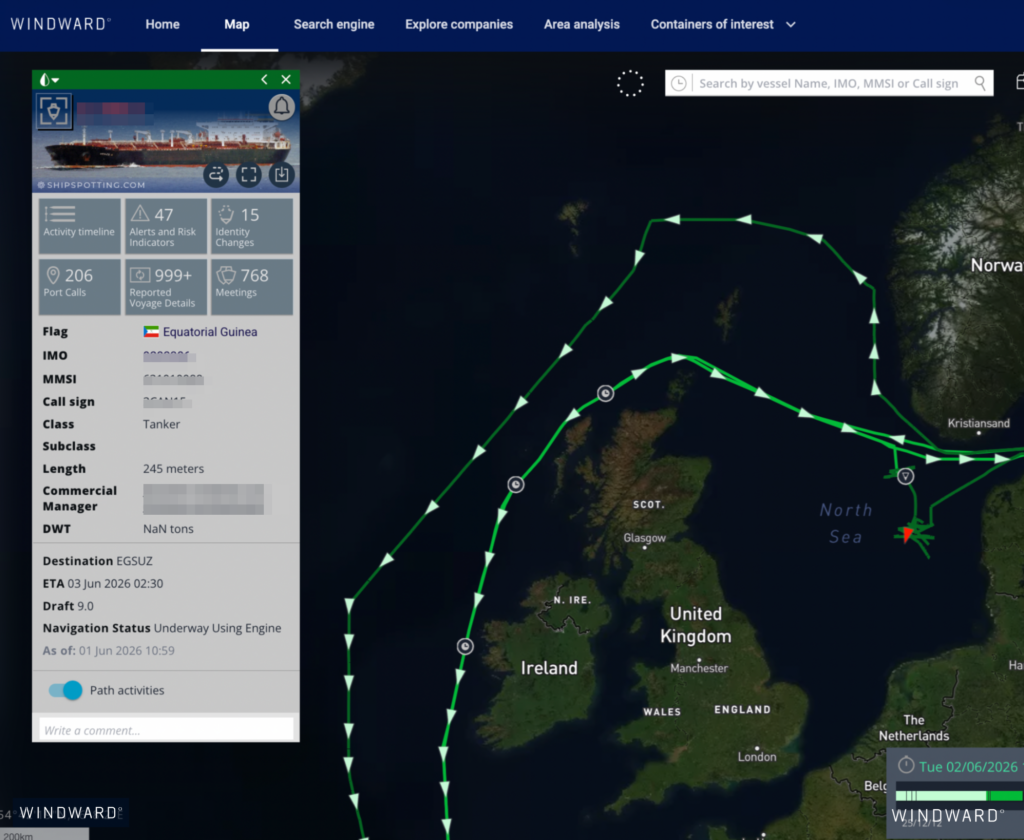
Some of the tankers were part of a cohort of 11 Cameroon-flagged vessels tracked making uneconomical voyages around Great Britain while sailing to and from Russian Baltic ports.
These diversions added hundreds of nautical miles to their voyages and included extended periods over undersea cables and in the North Sea.
MIOC analysis by Michelle Wiese Bockmann, Windward Senior Maritime Intelligence Analyst
Trending
- The EU’s 18th Sanctions Package Lookback Started. Trading Russian Products? You're At Risk. Nov 24, 2025
- Tanker Freight Rates Hit Five-Year High Amid Russian Oil Sanctions Shake-Out Nov 6, 2025
- Sanctioned, Stateless, and Still Sailing: Expert Insights from the Frontlines of Maritime Sanctions Nov 3, 2025
Explore more

War-Diverted Traffic Is Reshaping NEOM’s Port. What Happens If Hormuz Reopens?
At a Glance A Port Not Behaving Like the Megacity It Was Built For By any reasonable metric, 2026 should have been a difficult year for the Port of NEOM. The megacity it was built to serve has been through a visible contraction. The Public Investment Fund wrote down the giga-projects by $8 billion at...
Read more

Forty-Five Shadow Fleet Tankers Link to a Single Hong Kong Nominee
At a Glance One Nominee, Forty-Five Companies, Forty-Five Tankers Windward’s visual link analysis has identified 45 Russia-trading shadow fleet tankers connected through 45 single-ship Hong Kong companies to one beneficial owner. All but three share 19 different ISM managers with addresses in the same industrial cluster in the Azerbaijani city of Sumqayit. 42 of the...
Read more

What Is the Shadow Fleet, and Why Is It So Hard to Count?
At a Glance There Is No Official Shadow Fleet List The shadow fleet, also called the dark fleet, refers to tankers and support vessels that rely on deceptive shipping practices to move sanctioned or high-risk commodities while concealing their true origin, ownership, or destination. That definition is broadly recognized in practice. It has no standing...
Read more

Suez Transits Are Up 59%, and Rates Are About to Fall
At a Glance Carriers Have Returned to Suez, and the Data Confirms It Maritime media sources state that container shipping is moving from a capacity shortage to a surplus as carriers return to Suez and shorter voyages free up ships. Windward MIOC data supports this claim. Suez containership transits rose 59% from March to September,...
Read more

How to Track Dark Vessels When AIS Goes Silent
2,157 cargo ships and tankers over 10,000 DWT went dark in Q2 2026, nearly five times the 449 recorded in Q1. Prolonged dark events, three days or longer, rose sevenfold to 3,137. Russia alone recorded roughly 4,000 dark activity events in the quarter. The Gap Is Now the Norm 2,157 cargo ships and tankers over...
Read more