


March 22, 2026
Russia Expands Dark Fleet of LNG Carriers


Russia Expands Dark Fleet of LNG Carriers
What’s inside?
At a Glance
- Three 20-year-old LNG carriers sold to a newly formed company in Türkiye; two reflagged to Sierra Leone.
- Vessels currently idle or repositioning, with no post-sale LNG cargo destinations signaled.
- Moves signal Russia’s push to build an LNG dark fleet beyond Western oversight.
- Sanctions on Russian LNG trade are tightening, increasing pressure on traditional shipping channels.
- Sierra Leone emerging as a flag state for sanctioned and Russia-linked vessels.
Covert Transfers and Reflagging Activity
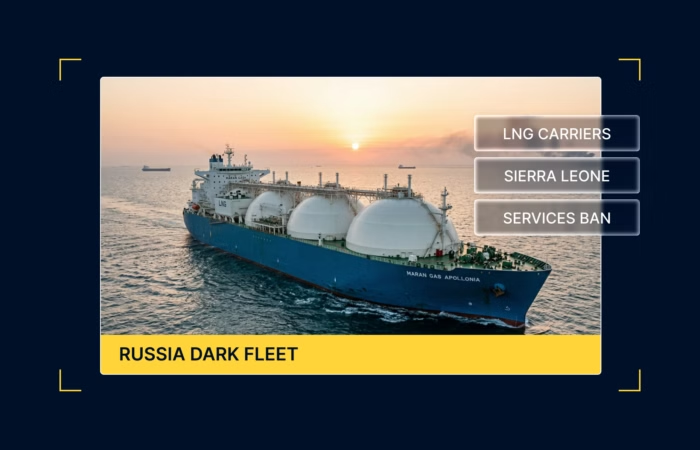
Three 20-year-old liquefied natural gas (LNG) carriers were recently sold to a newly formed company in Türkiye, with two subsequently reflagged to Sierra Leone, a ship registry favored by Russia’s dark fleet.
All three LNG carriers have yet to signal their next destination to load a post-sale cargo.
Two of the vessels are currently sailing around the Cape of Good Hope in ballast and are expected to bunker at Port Elizabeth or Cape Town based on current signals. The third is anchored off Galle, Sri Lanka, a well-known hub for crew changes and resupply.

Signals of Strategic Expansion
These purchases point to Russian preparations to deploy a dark fleet of LNG carriers operating outside Western jurisdiction, as European and U.K. sanctions expand beyond oil into the gas sector.
In November, the U.K. government announced a maritime services ban on Russian LNG shipped to third countries. This effectively bars most LNG carriers from participating in these trades, given their reliance on marine insurers linked to Lloyd’s of London.
In February, the U.K. also sanctioned three Greek-owned LNG carriers chartered to the marketing and trading arm of the non-sanctioned Yamal Arctic gas project, adding further ambiguity and operational risk for Western-affiliated vessels still engaged in these routes.
Beginning in April, Russian LNG shipments to Europe purchased on the spot market are banned, with volumes under long-term contracts set to be phased out by year-end.
Sierra Leone Emerges as a Key Flag State
The Sierra Leone ship registry, managed on behalf of the government by a Cyprus-domiciled private company, has become a significant flagging hub for Russian-linked vessels over the past 12 months.
Of the 156 tankers and gas carriers that have broadcast AIS signals in the past 60 days under the Sierra Leone flag, 93 are sanctioned by the U.S., EU, or U.K., all in connection with Russia.
Russia began developing a nascent dark fleet of LNG carriers more than 18 months ago, though early vessels were quickly identified and sanctioned.
The fleet has since grown to 18 sanctioned LNG carriers. Some are older vessels acquired specifically for dark fleet operations, including use in the sanctioned Arctic LNG 2 project. Others are newer, ice-class ships purpose-built for Russia’s Arctic LNG developments.
Pattern Follows Established Playbook
The three latest LNG carriers appear to have been sold in February, prior to the escalation of the Iran conflict, against a backdrop of increasingly hardline policies on LNG imports across the EU27 and U.K.
The acquisition strategy mirrors the established Russian dark fleet model: targeting aging tonnage, deploying it exclusively in Russian trades, and routing ownership through newly formed entities with no operating history and opaque beneficial ownership structures.
Trending
- The EU’s 18th Sanctions Package Lookback Started. Trading Russian Products? You're At Risk. Nov 24, 2025
- Tanker Freight Rates Hit Five-Year High Amid Russian Oil Sanctions Shake-Out Nov 6, 2025
- Sanctioned, Stateless, and Still Sailing: Expert Insights from the Frontlines of Maritime Sanctions Nov 3, 2025
Explore more

Distress or Deception? Sea Horse ‘Not Under Command’ While Delivering Cuba Gasoil
At a Glance Sea Horse, a medium range tanker sailing for Cuba laden with Russian gasoil has been broadcasting it is “not under command” and that it is drifting in the Sargasso Sea for nearly three weeks. AIS tracking suggest the Hong Kong-flagged tanker has now resumed its voyage for Cuba and is set is...
Read more

U.S. Treasury Expands Pressure on Iran’s Shadow Fleet and Weapons Procurement Networks
At a Glance Expanding Pressure on Iran’s Maritime and Weapons Networks On February 25, 2026, the U.S. Department of the Treasury’s Office of Foreign Assets Control (OFAC) designated more than 30 individuals, entities, and vessels linked to Iran’s shadow fleet and to networks supporting ballistic missile and advanced conventional weapons production. The action targets two...
Read more

The EU Maritime Services Ban That Didn’t Pass: Implications for Russian Trade
At a Glance A Sanctions Escalation That Stalled The European Union’s proposed maritime services ban on Russia was expected to mark a structural escalation in sanctions enforcement. Instead, EU ministers failed to reach an agreement, delaying the adoption of the bloc’s 20th sanctions package after opposition led by Hungary, with at least one other member...
Read more

Russian Diesel Tanker Sails for Cuba as U.S. Order Blocks Oil Imports
A tanker carrying Russian diesel is sailing for Cuba even as tightening U.S. pressure on the island’s fuel supply has forced other shipments to abort voyages or cancel loadings. Vessel Movements, AIS Changes, and Cargo Origin The Hong Kong-flagged medium-range tanker initially broadcast Havana as its destination on February 7, then altered its AIS signal...
Read more