


March 30, 2026
March 30, 2026: Iran War Maritime Intelligence Daily


Maritime Compliance in 2026: Why Behavioral Risk Is the New Red Flag
What’s inside?
At a Glance
- In 2026, maritime enforcement has escalated with global tanker seizures under Operation Southern Spear and drone attacks targeting commercial traffic in the Black Sea.
- Vessels are increasingly being flagged and interdicted based on behavioral anomalies like identity manipulation and erratic routing, not just sanctioned cargo.
- Cases like the Marinera and Oceanic Tug show how consistent patterns of dark activity and deceptive movement signal risk long before paperwork changes.
- Shadow fleets are adapting with spoofed AIS, fraudulent documents, and registry hopping, forcing compliance teams to shift from static screening to dynamic monitoring.
- To stay ahead, organizations are adopting tools like behavioral intelligence, document validation, and remote sensing to act on risk signals, not react to violations.
Strikes, Seizures, and Sanctions: Maritime Risk Heats Up in 2026
In early 2026, maritime enforcement crossed a threshold.
Under Operation Southern Spear, the U.S. has launched a sustained campaign of global interdictions, extending far beyond Venezuela’s proximate waters and targeting tankers for deceptive shipping practices and sanctions evasion.
U.S. forces recently seized seven tankers under this expanded effort, most recently capturing the Sagitta after it departed Venezuela carrying Venezuelan oil in defiance of a U.S. “quarantine” on sanctioned oil shipments.
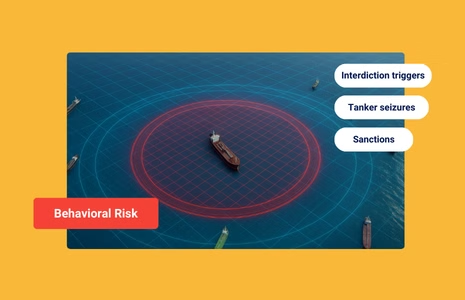
Vessels like the Marinera and Veronica, flagged by Windward as high risk long before their capture, were intercepted after displaying persistent behavioral red flags – including identity manipulation, erratic routing, and registry hopping – consistent with shadow fleet evasion tactics. This shift reflects a broader enforcement posture where behavioral signals are treated as triggers for interdiction, not mere anomalies. Together, these seizures confirm that deceptive shipping practices, even without an explicit sanctions violation, now carry real interdiction risk, especially as enforcement expands across ocean basins.
The enforcement focus is expanding even as other risk vectors intensify. In the Black Sea, multiple commercial tankers – including Delta Harmony, Matilda, Freud, and Delta Supreme – were struck by drone attacks while awaiting access to critical export nodes like the Caspian Pipeline Consortium (CPC) terminal near Novorossiysk. These incidents, coupled with reported GPS and AIS anomalies in the same corridors, compound navigational uncertainty and highlight the escalation of kinetic and electronic threats to global maritime trade.
This evolution in enforcement and risk signals a new compliance reality for 2026: authorities are no longer waiting for direct violations or region‑specific triggers — they’re acting on vessel behavior and disruptive activity itself.
Real-World Cases Show When Behavior Becomes the Risk Signal
Sanctions are reactive. Behavior is predictive.
The recent interdictions of the Marinera and the Oceanic Tug show how early behavioral anomalies can signal risk long before paperwork changes or sanctions catch up.
The Marinera: Evasion Risk Revealed by Behavior
The Marinera was seized in the North Atlantic in January 2026, intercepted by U.S. forces after evading authorities for weeks. The vessel, formerly known as Bella-1, had a long operational history linked to sanctioned Iranian oil and was ultimately tied to a Russian-controlled company using evasive ownership and flagging tactics.

This aging VLCC followed a familiar shadow fleet pattern – years of sanctioned activity followed by intensified identity manipulation. Between 2023 and 2025, it displayed:
- Multiple MMSI changes, breaking vessel history trails.
- Extended dark activity in high-risk zones.
- Deceptive flagging, from Guyana to Russia, in pursuit of safe harbors.
- First-time port calls that deviated from legitimate trade patterns.
Windward flagged the vessel as high risk in April 2023. Formal U.S. sanctions followed in June 2025, and the vessel was intercepted in January 2026.

By the time Marinera was boarded, its operational patterns had already raised multiple red flags. What looked like identity changes on paper were part of a larger behavioral picture, one that consistently signaled elevated risk and aligned with known evasion tactics. In this case, behavioral intelligence provided early, actionable insight before enforcement formally intervened.
The Oceanic Tug: Trafficking Risk Revealed by Behavior
In November 2025, Panamanian authorities seized the Oceanic Tug in the Eastern Pacific, uncovering 13.5 metric tons of cocaine, one of the largest maritime drug busts in recent memory. But the vessel’s behavior had raised concerns months earlier.
In April 2024, the Oceanic Tug changed flags from the United States to Tanzania. While the move appeared administrative, it marked the start of a shift. After that, the vessel’s typical trading pattern, consistent transits through Central America, began to diverge, illustrating:
- Repeated offshore loitering without completing commercial voyages.
- New southbound sailing patterns that broke from its historic behavior.
- Unexplained returns to port without cargo movement.
- Flag and MMSI changes that obfuscated ownership and vessel history.

By October 2025, these anomalies became persistent. Behavior models flagged a shift from legitimate trade to potentially illicit operations.

In early November, synthetic aperture radar (SAR) imagery confirmed the vessel anchored off Penico Island, Panama.

Less than 48 hours later, authorities interdicted the vessel and found the cocaine haul.
Like the Marinera, Oceanic Tug was not flagged because of its cargo – it was flagged because of its behavior.
Together, these cases illustrate why compliance in 2026 requires more than static screening. They show how monitoring behavioral risk – from routing and identity shifts to dark activity patterns – is essential to anticipating and preventing exposure.
The Behavioral Indicators That Matter Most for Compliance
As global enforcement shifts from reactive sanctions lists to proactive interdictions, compliance teams need to understand which vessel behaviors raise red flags and why.
Whether it’s dark activity near sanctioned jurisdictions or identity changes that fragment vessel history, the following behavioral indicators are emerging as the new baseline for risk assessment in 2026.
| Behavioral Indicator | What It Signals | Why It Matters |
| MMSI/IMO Changes | Attempts to fragment vessel identity and history. | Hinders tracking and masks past activity. |
| Frequent Flag or Name Changes | Attempts to reset the compliance profile. | Common in evasion tactics and shadow fleet operations. |
| Extended Dark Activity (AIS Off) | Intentional concealment of location or operations. | Often used to obscure sanctioned cargo or illicit behavior. |
| First-Time Port Calls | Deviations from normal trade patterns. | Can indicate new risk exposure or abnormal routing. |
| Unusual Loitering or Course Shifts | Possible ship-to-ship transfers, evasive action, or illicit rendezvous. | Frequently seen in smuggling and sanctions evasion attempts. |
| Inconsistent Economic Utilization | Operational patterns that don’t align with declared trade routes or commercial logic. | Indicates potential decoy activity or falsified voyage intent. |
| Remote Sensing Discrepancies | Satellite imagery or RF detections reveal vessel movement inconsistent with AIS data. | Confirms spoofing or identity manipulation. |
These are recurring elements in real-world enforcement cases, from sanctioned oil routes to maritime trafficking and smuggling.
Compliance isn’t about tracking paperwork anymore – it’s about spotting patterns. With shadow fleets and illicit networks growing more sophisticated, understanding these indicators is essential to preemptive risk mitigation.
The 2026 Toolkit for Seeing Risk Before It Becomes Exposure
Legacy compliance frameworks were built for a static world: fixed identities, known bad actors, and violations you could prove on paper. But in 2026, maritime risk is adaptive, and so are the tools needed to manage it.
Here’s what leading compliance teams are using to stay ahead:
| Capability | Purpose | Why It Matters in 2026 |
| Behavioral Intelligence Models | Analyze vessel operations over time to surface anomalies. | Capture risk beyond static screening, including sanctions evasion and smuggling. |
| Remote Sensing Intelligence | Detect dark vessels, validate AIS claims, and confirm location. | Delivers visibility when AIS and documentation are manipulated. |
| Document Validation | Cross-check registration, insurance, and registry documents at scale. | Blocks false flags, fraudulent registries, and forged documentation. |
| KYV™ (Know Your Vessel) | Focuses on vessel behavior, not just identity. | Powers real-time decisions across compliance, trade, and credit teams. |
| Integrated Risk Scoring | Unifies behavioral, structural, and documentation risk. | Enables fast, clear go/no-go decisions at scale. |
These tools are being used now across government, trade, and maritime operations. They turn deception into data and give compliance teams the clarity to act before risk becomes exposure.
The Compliance Mandate for 2026
Maritime risk in 2026 isn’t static, and compliance can’t be either.
As shadow fleets evolve, enforcement adapts, and geopolitical flashpoints multiply, it is becoming clear that behavior is the new red flag. Whether it’s a vessel spoofing its location, hopping registries mid-voyage, or drifting far offshore on non-commercial routes, these aren’t edge cases. They’re signals, and they’re actionable.
Enforcement is no longer waiting for paperwork to catch up. It’s acting on patterns. In this environment, institutions that rely solely on static screening or manual reviews will find themselves reacting too late.
The mandate for 2026 is to equip your teams with the visibility to detect deception, the tools to validate what’s real, and the intelligence to stay ahead, not just compliant.
Frequently Asked Questions (FAQs)
How does Windward define “behavioral risk”?
Behavioral risk refers to patterns in vessel activity – such as dark operations, identity manipulation, and non-commercial routing – that indicate potential non-compliance, smuggling, or sanctions evasion. Unlike static screening, it focuses on how a vessel operates, not just who it is on paper.
Why are vessels being interdicted even if they aren’t sanctioned?
Enforcement agencies are treating deceptive behavior – like false flagging, erratic routing, and spoofed AIS – as grounds for interdiction. Behavior has become a risk indicator in its own right, particularly when it aligns with known evasion tactics.
What is KYV™ (Know Your Vessel) and how does it differ from traditional screening?
KYV™ is a behavior-first approach that evaluates how a vessel acts over time, not just its name, owner, or flag. It enables more accurate, real-time risk assessments by surfacing anomalies before they escalate to formal violations.
How does Remote Sensing Intelligence support KYV™ and compliance operations?
Remote Sensing Intelligence – made up of synthetic aperture radar (SAR), electro-optical (EO) imagery, and radio frequency (RF) detection – validate vessel location and behavior, especially when AIS data is unreliable or spoofed. These technologies provide visual confirmation of deceptive routing and support faster interdiction.
What role does document validation play in compliance in 2026?
Document validation allows compliance teams to verify the authenticity of registration, insurance, and flag certificates. It’s a critical step to counter false flags and fraudulent registries, especially as bad actors use forged documents to bypass sanctions or access ports.
Trending
- The EU’s 18th Sanctions Package Lookback Started. Trading Russian Products? You're At Risk. Nov 24, 2025
- Tanker Freight Rates Hit Five-Year High Amid Russian Oil Sanctions Shake-Out Nov 6, 2025
- Sanctioned, Stateless, and Still Sailing: Expert Insights from the Frontlines of Maritime Sanctions Nov 3, 2025
Explore more

Russia Expands Dark Fleet of LNG Carriers
At a Glance Covert Transfers and Reflagging Activity Three 20-year-old liquefied natural gas (LNG) carriers were recently sold to a newly formed company in Türkiye, with two subsequently reflagged to Sierra Leone, a ship registry favored by Russia’s dark fleet. All three LNG carriers have yet to signal their next destination to load a post-sale...
Read more

Distress or Deception? Sea Horse ‘Not Under Command’ While Delivering Cuba Gasoil
At a Glance Sea Horse, a medium range tanker sailing for Cuba laden with Russian gasoil has been broadcasting it is “not under command” and that it is drifting in the Sargasso Sea for nearly three weeks. AIS tracking suggest the Hong Kong-flagged tanker has now resumed its voyage for Cuba and is set is...
Read more

U.S. Treasury Expands Pressure on Iran’s Shadow Fleet and Weapons Procurement Networks
At a Glance Expanding Pressure on Iran’s Maritime and Weapons Networks On February 25, 2026, the U.S. Department of the Treasury’s Office of Foreign Assets Control (OFAC) designated more than 30 individuals, entities, and vessels linked to Iran’s shadow fleet and to networks supporting ballistic missile and advanced conventional weapons production. The action targets two...
Read more

The EU Maritime Services Ban That Didn’t Pass: Implications for Russian Trade
At a Glance A Sanctions Escalation That Stalled The European Union’s proposed maritime services ban on Russia was expected to mark a structural escalation in sanctions enforcement. Instead, EU ministers failed to reach an agreement, delaying the adoption of the bloc’s 20th sanctions package after opposition led by Hungary, with at least one other member...
Read more

Russian Diesel Tanker Sails for Cuba as U.S. Order Blocks Oil Imports
A tanker carrying Russian diesel is sailing for Cuba even as tightening U.S. pressure on the island’s fuel supply has forced other shipments to abort voyages or cancel loadings. Vessel Movements, AIS Changes, and Cargo Origin The Hong Kong-flagged medium-range tanker initially broadcast Havana as its destination on February 7, then altered its AIS signal...
Read more