


April 7, 2026
April 7, 2026: Iran War Maritime Intelligence Daily


March 18, 2026: Iran War Maritime Intelligence Daily
What’s inside?
At a Glance
- Traffic through the Strait of Hormuz remains severely constrained, with transit operating under controlled conditions rather than normal commercial flow.
- Eight large vessels were detected operating without AIS in the Strait, indicating concentrated dark activity among high-capacity assets.
- Bulk carriers continue routing through Iranian territorial waters, reinforcing a permission-based transit model.
- Iranian crude exports remain active, with ongoing loading operations and vessel buildup at Kharg Island.
- Port operations show rising volatility, with sharp increases in rollovers and delays across key Gulf and regional hubs.
- Global routing patterns show early signs of stabilization, with increased traffic through Bab el-Mandeb and the Suez Canal.
- Traffic around the Cape of Good Hope remains elevated, confirming continued reliance on long-haul alternative routes.
- Global participation in Gulf operations persists, with international fleets maintaining a presence despite reduced transit volumes.
Operational Overview
Maritime activity across the Strait of Hormuz remains severely constrained, with continued evidence that transit is being tightly controlled rather than fully restored. Commercial movement through the Strait has not normalized, and access appears increasingly selective.
At the same time, visibility within the Strait is deteriorating. Remote Sensing Intelligence has identified a concentration of large vessels operating without AIS transmission, indicating that high-capacity assets are actively suppressing visibility while navigating the chokepoint.
Routing behavior continues to evolve under these conditions. Bulk carriers are exiting the Gulf via Iranian territorial waters, sailing along the coastline rather than standard international navigation channels. This pattern reinforces the emergence of a controlled transit model, where movement is selectively enabled.
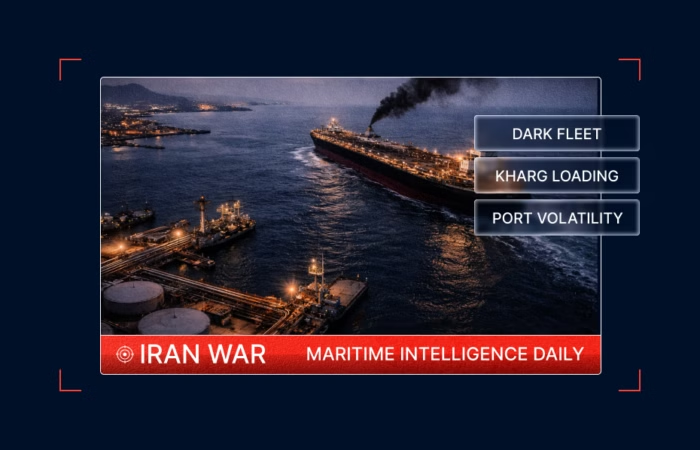
Iranian export activity remains active despite disruption. Loading operations at Kharg Island continue, supported by both berthed tankers and a buildup of vessels in anchorage, indicating sustained throughput capacity under constrained conditions.
Beyond the Gulf, maritime traffic patterns indicate early signs of global rebalancing. Increased transit volumes through Bab el-Mandeb and the Suez Canal, alongside continued traffic around the Cape of Good Hope, suggest that shipping is adapting through alternative corridors.
Strait of Hormuz Dark Activity
On March 16, Remote Sensing Intelligence identified eight vessels exceeding 290 meters in length operating within the Strait of Hormuz.

All detected vessels were operating without AIS transmission at the time of observation. While vessel classifications could not be confirmed, their size indicates high-capacity platforms, consistent with VLCCs, VLOCs, Capesize bulk carriers, ultra large container ships, or New Panamax vessels.
The concentration of large, dark vessels within the Strait suggests intentional suppression of visibility among high-value maritime assets operating in a high-risk environment.
Iranian Export Activity at Kharg Island
Loading operations at Kharg Island remain active.
As of March 17, Remote Sensing Intelligence detected two VLCCs and one Aframax tanker berthed at the terminal, with sixteen additional vessels present in anchorage, likely awaiting loading.

The anchorage includes a wide range of vessel sizes, including nine vessels in the 250–333 meter range, indicating the presence of multiple large-capacity ships queued for crude export.
This buildup suggests continued demand and queuing for loading, reinforcing that export capacity remains active despite disruption across the Gulf. Activity appears to be supported by staging and controlled throughput rather than unrestricted transit.
Gulf Operations Snapshot
Maritime activity within the Gulf continues to reflect broad international participation despite constrained transit conditions.
Panama (229 vessels), the Marshall Islands (156 vessels), and Liberia (155 vessels) remain the leading flag states operating in the region, followed by Comoros (99 vessels) and Singapore (90 vessels). Vessel activity is led by bulk carriers (163 vessels), alongside oil product tankers (93 vessels), crude oil tankers (83 vessels), and container vessels (51 vessels), with a smaller presence of LNG carriers (12 vessels).
Company ownership spans major maritime hubs including Japan, Germany, South Korea, Hong Kong, and Singapore, indicating that global operators continue to maintain exposure to Gulf operations despite elevated risk and reduced mobility.
Global Routing Shifts and Alternative Corridors
Maritime traffic across key chokepoints indicates early signs of rerouting stabilization.
Traffic through Bab el-Mandeb increased sharply to 38 crossings on March 16, representing a significant rise compared to the previous day. Activity was led by bulk carriers, container vessels, and crude oil tankers, with flag states including the Marshall Islands, Panama, and China.
Suez Canal traffic also remained elevated, with 39 vessels transiting on March 15. The traffic mix included bulk carriers, crude oil tankers, and container vessels, led by Liberia, Panama, and Sierra Leone-flagged ships.
At the same time, 71 vessels transited the Cape of Good Hope on March 16. Bulk carriers dominated traffic, followed by container vessels and ore carriers, with the Marshall Islands, Liberia, and Singapore as leading flag states.
While the Cape route remains heavily utilized, increased traffic through Bab el-Mandeb and the Suez Canal suggests that vessels are beginning to return to shorter routes. This reflects early-stage normalization of global routing outside the Gulf, even as Hormuz remains constrained.
Port Operations Disruptions
Operational signals indicate rising volatility across both Gulf and external ports.
Inside the Gulf, Khalifa Port recorded 15 transshipment rollovers (+1,400% day-over-day, +2,525% vs 7-day average) and 8 transshipment-delay cases (+700% day-over-day, +833.33% vs 7-day average), reflecting a sharp spike in disruption. Jubail recorded 12 transshipment rollovers, with no change compared to both the previous day and the 7-day average.
Outside the Gulf, Karachi recorded 5 port-of-loading rollovers (−28.57% day-over-day, +288.89% vs 7-day average), alongside 4 transshipment rollovers (+300% day-over-day, +55.56% vs 7-day average) and 2 transshipment-delay cases (no change day-over-day, −54.84% vs 7-day average).
Salalah showed mixed but elevated activity, with 11 late departures (+1,000% day-over-day, +75% vs 7-day average), 4 rollovers (no change day-over-day, +600% vs 7-day average), 17 transshipment rollovers (+54.55% day-over-day, −31.21% vs 7-day average), and 69 transshipment-delay cases (+263.16% day-over-day, +82.95% vs 7-day average).

These patterns indicate significant instability in port operations, with sharp increases in delays and rollovers reflecting ongoing disruption to cargo flow and scheduling.
Outlook
The March 18 operating picture reflects a maritime system functioning under constraint rather than recovery, with the Strait of Hormuz remaining tightly controlled and visibility within the corridor significantly reduced.
At the same time, adaptive behaviors are becoming more defined. Dark vessel activity among large-capacity ships, controlled routing through Iranian territorial waters, and continued export operations at Kharg Island indicate that maritime and energy flows are being sustained through structured, non-transparent mechanisms.
Beyond the Gulf, global shipping patterns show early signs of adjustment. Increased use of Bab el-Mandeb and the Suez Canal, alongside continued reliance on the Cape of Good Hope, suggests that operators are recalibrating route strategies to balance risk, cost, and transit time.
In the near term, maritime activity is likely to remain defined by restricted access to Hormuz, controlled transit conditions, and continued reliance on alternative corridors, with global trade flows adapting to a persistently constrained operating environment.
Explore more
April 7, 2026: Iran War Maritime Intelligence Daily
At a Glance Operational Overview Bulk carriers in Iranian trades including those with beneficial ownership in Greece and China continue to exit the Strait of Hormuz while Iran ensures regular transits for its oil and gas shipments. Energy commodities exports from other Gulf countries are seen on an ad-hoc basis. Strait of Hormuz Transits Steady...
Read more

April 6, 2026: Iran War Maritime Intelligence Daily
At a Glance Operational Overview The Strait of Hormuz is no longer operating as a single controlled chokepoint. Between April 2 and 5, transit evolved into a dual-corridor system, combining military control with emerging diplomatic coordination. A northern route remains centered around IRGC control near Larak Island. In parallel, a southern corridor has emerged along...
Read more

Week Five of the Iran War: A Maritime Intelligence Breakdown
At a Glance The Fifth Week of the Iran War at Sea Five weeks into the conflict, the maritime system is no longer defined by simple restriction. It is being managed. Transit through the Strait of Hormuz increased over the course of the week, with movement continuing under a permission-based model that now includes both...
Read more

April 2, 2026: Iran War Maritime Intelligence Daily
At a Glance Operational Overview Three of the four bulk carriers that exited on April 1 were Greece-owned and one China-owned. This signals that EU as well as Asia shipowners are negotiating at both diplomatic and commercial levels to use the permission-based system. Strait of Hormuz Transits Rise Sanctioned, Iran-linked tankers dominated inbound transits on...
Read more

April 1, 2026: Iran War Maritime Intelligence Daily
At a Glance Operational Overview 36% of transits seen March 31 were on US-sanctioned vessels, while 27% were Greece-owned bulk carriers shipping agricultural commodities to or from the Islamic Republic. This highlights how the selective blockade of the Strait of Hormuz is benefiting Iran. Strait of Hormuz Transit and Selective Denial Transit through the Strait...
Read more