


October 7, 2026
War-Diverted Traffic Is Reshaping NEOM's Port. What Happens If Hormuz Reopens?


IRGC Orders Vessels to Turn Back: The Southern Corridor Reversal Stalls the Hormuz Recovery

What’s inside?
At a Glance
- The IRGC published a claim on its official Telegram channel that three tankers transiting the southern corridor were ordered to turn back, with Windward identifying five vessels exhibiting turnaround behavior consistent with the claim and a sixth losing AIS signal during the incident.
- A VHF Channel 16 broadcast warned all vessels that transit without AIS or IRGC permission would be at their own risk.
- The southern corridor, previously described as not requiring Iranian approval, is now subject to active IRGC enforcement, eliminating the only route operators believed to be free of Iranian control.
- June 24 recorded approximately 49 AIS-visible transits, the highest single-day count of the conflict, before the June 25 incident introduced renewed uncertainty.
- June 25 itself recorded 43 transits, confirming Hormuz remains operationally open despite the IRGC enforcement action.
- Cargo throughput is running at approximately 50% of pre-conflict crude volume, with LPG recovering to 100% of pre-conflict volume at approximately triple the pre-conflict price.
- Two OFAC-sanctioned VLCCs departed Kharg Island together via the northern corridor in a paired transit assessed as a deliberate tactic to dilute enforcement exposure.
Operational Overview
A week of widening commercial confidence in the Strait of Hormuz has run into the first significant test of the post-MoU operating environment. On June 25, the IRGC published a Telegram claim that vessels in the southern corridor had been ordered to turn back, with Windward identifying five vessels exhibiting behavior consistent with the claim. A VHF Channel 16 broadcast warned all vessels that transit without AIS or IRGC permission would be at their own risk. The southern corridor, previously described as not requiring Iranian approval, is now subject to active IRGC enforcement.
The reversal interrupts a clear normalization trajectory. June 24 had recorded approximately 49 AIS-visible transits, the highest single-day count of the conflict, supported by the IMO evacuation corridor announcement and Oman’s publication of six authorized eastbound waypoints. June 25 still recorded 43 transits, indicating Hormuz remains operationally open, but the southern corridor’s status as a safe alternative to the IRGC-controlled northern lane is now in question.
With Iran now asserting control across all three corridors, the trajectory toward full normalization has stalled. Cargo throughput is recovering unevenly, with crude running at approximately 50% of pre-conflict daily volume and LPG running at 100% of pre-conflict volume but at roughly triple the pre-conflict price.
The Lead-Up: Three Days of Widening Confidence
In the days before the IRGC enforcement action, commercial confidence in the Strait was building steadily across multiple indicators.
On June 23, following President Trump’s declaration that the Strait was open and a first round of U.S.-Iran negotiations in Switzerland that produced a communication channel for safe passage, 21 AIS-visible transits were recorded in the reporting window, with seven inbound and 14 outbound.


The center corridor, the primary commercial routing lane prior to Operation Epic Fury, returned to use in both directions for the first time since the conflict began. Zero outbound transits used the northern corridor. A South Korea-flagged container ship and a Liberia-flagged VLCC were among the outbound contacts, commercially neutral Western-affiliated tonnage whose willingness to transit signaled a market-level confidence assessment that the passage was viable.
Iranian crude exports moved in parallel. Three Iran-flagged VLCCs loaded at Kharg Island between June 20 and June 22, with a combined cargo of approximately 4.89 million barrels destined for Chinese ports, all assessed as transiting the Strait on June 22 to 23. Vortexa data for the week ending June 21 recorded 6.79 million barrels exported from Iran, the peak week in nearly two months.

June 24 then marked the clearest sign of acceleration. Transit volume reached 31 transits in the morning window, 11 inbound and 20 outbound, before climbing to approximately 49 across the full day, the highest single-day count of the conflict.


The IMO announced an evacuation corridor on June 23, and the Sultanate of Oman published six authorized eastbound waypoints for inbound transit through Omani waters, the first formal safe-passage routing since the closure. The effect was directly visible, with six of the 11 morning inbound vessels routing via the southern corridor. The IRGCN-permission model for outbound transits had not been observed for 48 hours, and commercial operators were routing without escort requirements.
Notable clearances included a South Korea-flagged VLCC of 333 meters that had been held inside the Gulf since February 2026, the longest known dwell-time vessel of the conflict, and two cargo vessels last calling at Imam Khomeini Port, consistent with accumulated cargo demand releasing post-reopening. Wet cargo fixtures originating from the Middle East Gulf loadports recovered from zero on June 21 to 14 on June 23, a direct indicator of returning commercial confidence.

QatarEnergy moved at least 11 LNG tankers toward Ras Laffan in a compressed timeframe beginning immediately after the MoU signature, with two transiting Hormuz dark. The concentration, beginning post-signing, signaled institutional confidence in Strait access and port readiness. An explosion at the Barzan Gas Plant on June 24 caused 13 fatalities but was confirmed by QatarEnergy as having no impact on LNG export operations.
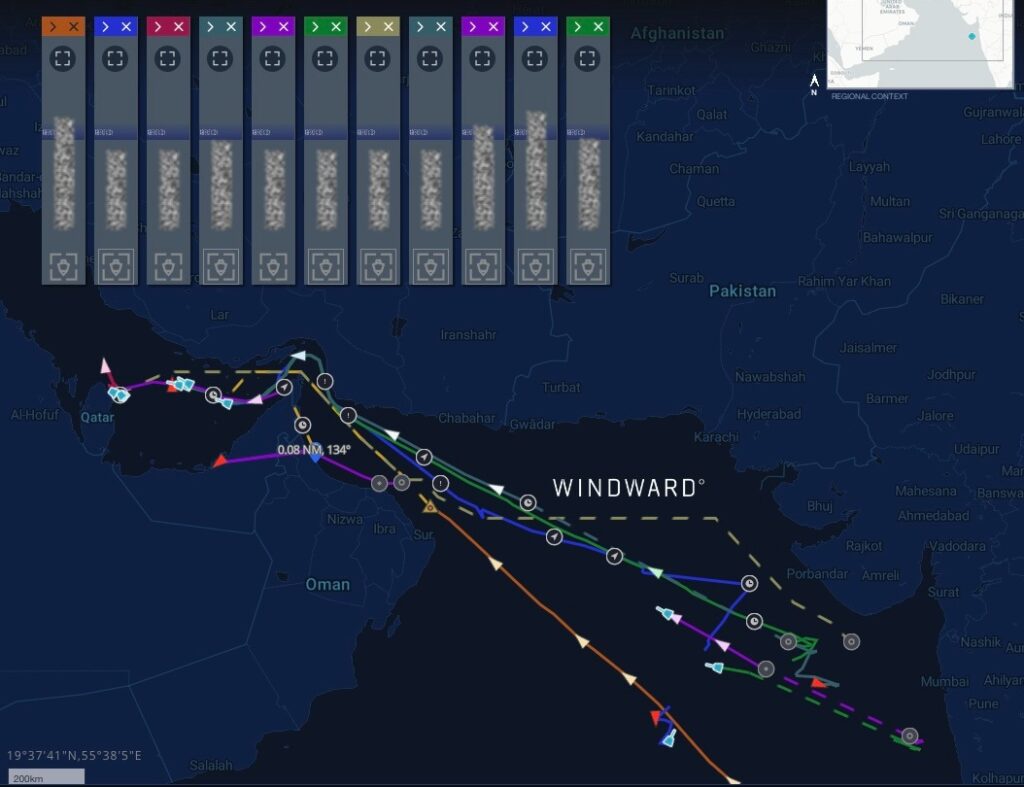
By the morning of June 25, the picture across both commercial confidence and corridor routing pointed toward continued normalization.
The Reversal: IRGC Enforcement Returns to the Southern Corridor
The most significant development of June 25 is an IRGC enforcement action targeting vessels transiting via the southern corridor.
The IRGC published a claim on its official Telegram channel stating that, following an IRGC warning, three tankers transiting the Strait via the southern corridor turned around and returned to the Arabian Gulf. Windward identified five vessels exhibiting turnaround behavior consistent with this claim, with a sixth losing AIS signal during the incident.

A VHF Channel 16 transmission, allegedly broadcast from a tanker positioned inside the Gulf, warned all vessels that if they transit with AIS off or without IRGC permission, they will be responsible for any consequences they might face. No specific timestamp was provided for the broadcast.
Of the five tracked vessels, a Singapore-flagged tanker and a Panama-flagged tanker turned back toward the Arabian Gulf. A Togo-flagged tanker also reversed course. A fourth, a Panama-flagged tanker, initially began returning before rerouting to the northern corridor, either resolving the issue with Iranian authorities or successfully evading the assumed block. A sixth vessel lost its AIS signal during the incident and could not be tracked further via Windward systems. The incident may have preceded or coincided with the transit of a UK-flagged vessel through the same area, though no confirmed causal link has been established. Two Iranian-flagged vessels also diverted in the same window.
The IRGC’s claim, the VHF broadcast, and the observed vessel behavior collectively indicate that Iran is now actively enforcing corridor access requirements in the southern route, the lane previously described as not requiring Iranian approval. Windward assesses the development as introducing a new compliance and safety dimension for operators who had been routing via the southern corridor to avoid northern corridor permit requirements.
June 25 Transits: Hormuz Remains Open Despite the Incident
Despite the IRGC enforcement action, 43 transits were recorded on June 25, with 14 inbound and 29 outbound. Hormuz remained operationally open, with no evidence of broader disruption to freedom of navigation beyond the five vessels that reversed course following the IRGC warning.


The outbound picture was dominated by heavy crude tanker flow, with seven outbound tankers, including four VLCCs, alongside eight bulk carriers. Two Iran-flagged tankers were also outbound from Imam Khomeini and Bushehr. Two OFAC-sanctioned VLCCs departed Kharg Island’s western terminal together via the northern corridor, one carrying dual Russia and UK sanctions designations with an unknown flag and the other OFAC-sanctioned under Iran programs with a Chinese crew and a São Tomé flag. Their paired northern corridor departure is assessed as a deliberate tactic to dilute enforcement exposure.
Four vessels transited dark, indicating that not all operators trust the current security environment despite corridors being formally open. The dark cohort included a Singapore-flagged LR2 tanker of 229 meters departing from Siri Island toward Djibouti, a Chinese-owned Antigua and Barbuda-flagged bulk carrier, a Marshall Islands-flagged asphalt tanker, and a UAE and ADNOC-owned service vessel.
At least 10 outbound vessels are assessed as clearing after extended Gulf stays, all having entered the Gulf between late 2025 and late February 2026, consistent with a post-operational backlog discharge. Among them, a Marshall Islands-flagged Q-Flex LNG carrier of 345 meters transited outbound after an 11-day stay, carrying approximately 210,000 cubic meters of LNG assessed as a Qatari export.
A Sri Lanka-flagged small cargo vessel with no IMO number was also outbound, with an in-and-out pattern during the conflict and extensive dark history around Somalia, Yemen, and Oman, consistent with possible smuggling or sanctions evasion activity.
The Northern Corridor Is Heavily Iran-Linked
EO imagery collected over the Strait on June 24 at 11:15 UTC identified 63 vessels across the three corridors, with the northern corridor dominant at approximately 42 vessels, the center corridor at 18, and the southern corridor at 3.
The northern corridor picture is heavily Iran-linked. Of 16 stationary AIS-transmitting vessels in the northern corridor, 15, or 94%, have a confirmed Iranian nexus, with 12 OFAC-sanctioned. A cluster of six IRISL-owned vessels was observed simultaneously stationary in the northern corridor anchorage, a significant concentration of a U.S.-designated entity’s fleet in a single location. The dark footprint in the northern corridor is also substantial, with 19 stationary dark vessels and approximately five dark movers, consistent with sanctions-evasion staging, cargo preparation, or ship-to-ship transfer activity.
The center corridor held 18 vessels, including 12 IRGC high-speed craft consistent with patrol and logistics patterns, alongside five AIS-transmitting commercial vessels and one dark inbound RoRo vessel.
The southern corridor held only three vessels at the time of the collection, two AIS-transmitting outbound vessels under Panama and Liberia flags with no OFAC sanctions exposure and one high-speed craft. The low density in the southern corridor at the time of collection contrasts with the surge in southern corridor outbound usage documented in the evening AIS transit window, suggesting the corridor filled later in the day.
Iranian Crude Exports and Fleet Status
Vortexa and Windward data as of June 23 identified 17 tankers laden with Iranian cargo, of which eight are outside the Middle East Gulf and Iranian territorial waters, having loaded in the Middle East Gulf or Gulf of Oman in May and June. All are assessed as heading toward China, carrying a combined total of approximately 14.8 million barrels. At least seven are expected to transit the Strait in the coming days.

The broader Iranian tanker fleet comprises 128 tracked vessels.

Of these, 13 Iran-flagged tankers are assessed as heading east toward China and one toward India, while five vessels in the Arabian Sea are sailing westbound toward the Gulf. AIS signals reflect the post-blockade transition, with 43 vessels transmitting in the past 48 hours, seven last seen two to seven days ago, six last seen eight to 28 days ago, 17 last seen one to four months ago, and 55, or 43% of the fleet, having been dark for over four months.

The largest concentration, 47 vessels, is in the Middle East Gulf, with 38 in the Arabian Sea assessed as transiting and 20 in the Indian Ocean or Malacca Strait area.

Cargo Volumes Recover Unevenly
Windward estimates that approximately 12.4 million barrels of oil transited outbound on June 24 via AIS-visible vessels, representing approximately 12% of one day’s global demand. Crude oil accounted for approximately 11.7 million barrels across seven tankers, including three back-to-back VLCCs, with oil products adding approximately 1.8 million barrels. Two dark outbound tankers bring the updated estimated outbound total to approximately 13.4 million barrels, or roughly 13% of one day’s global demand.
On June 25, outbound cargo is estimated at approximately 11.7 million barrels of oil and 365,000 cubic meters of LNG, with a combined estimated cargo value of approximately $910 million assuming full loads. Crude oil accounted for approximately 9.9 million barrels at approximately $673 million, oil products 1.8 million barrels at approximately $130 million, LNG 365,000 cubic meters at approximately $92 million, and LPG 60,000 cubic meters at approximately $15 million.
Vortexa data provides an updated commodity breakdown for the reporting period. LPG volume has recovered to 100% of pre-conflict levels, while LPG value is running at 269% of pre-conflict, the same volume at approximately triple the price, driven by post-conflict supply tightness and Asian demand. Crude oil is running at approximately 50% of pre-conflict daily volume. The combined cargo value is estimated at approximately $747 million against the pre-conflict baseline of approximately $1.53 billion per day, approximately 49% of pre-conflict levels. Gas value, at approximately $116 million, has reached 104% of pre-conflict levels, driven entirely by the LPG price surge rather than volume recovery.
For context, pre-conflict, the Strait carried approximately 20 million barrels of oil per day and approximately 10 billion cubic feet per day of LNG and natural gas, representing a combined gross cargo value of approximately $1.53 billion per day. All volumes are estimated based on vessel class and assumed full cargo loads and are not verified manifests.
Kharg Island: Terminals Clear and the Waiting Area Disperses
EO imagery collected over Kharg Island on June 23 captured the eastern terminal in the process of clearing. A dark VLCC of approximately 333 meters, the same vessel observed at the eastern T-jetty on June 22, was assessed as departing, with two service vessels visible eastward of the tanker consistent with active unmooring assist and outbound escort. Based on an assessed arrival date of approximately June 20 to 21 and typical VLCC loading rates at Kharg’s eastern jetty, the vessel is assessed as laden with approximately 2 million barrels. The vessel has been dark throughout its berth stay, consistent with the pattern of Iranian crude export tankers operating without AIS during the conflict window.
At the western terminal, all three tankers observed on June 22 cleared within an approximately 27-hour window, with the terminal empty by the June 23 collection. The LPG and Sulphur terminal also remained empty, with the sulphur bulk carrier tracked at this berth since June 10, having departed in the days prior.
By the June 23 11:43 UTC collection, the eastern terminal had cleared, and the eastern waiting area held 25 laden dark tankers, all stationary and non-transmitting. The composition comprised 11 VLCCs of approximately 333 meters, nine Suezmaxes of approximately 245 meters, four Aframaxes of approximately 180 meters, and one smaller tanker of approximately 118 meters, all assessed as laden.
The June 24 collection at 04:32 UTC then showed all three Kharg terminals empty, with no new vessels at any berth since the June 23 clearout. The eastern waiting area held five dark, stationary laden tankers alongside two service vessels, a sharp reduction from 25 the prior day, consistent with the waiting area dispersing as vessels proceed toward the Strait. The absence of new berth arrivals may indicate a temporary pause in crude loading operations or a scheduling gap between outgoing and incoming vessels.
Outlook
The Strait of Hormuz is open, but no longer trending cleanly toward normalization. The IRGC’s enforcement action in the southern corridor on June 25 indicates that Iran is now actively controlling access across all three lanes for the first time since the MoU signing, eliminating the only route operators believed to be free of Iranian control.
The northern corridor remains subject to IRGCN permit requirements and is heavily Iran-linked at the vessel level. The southern corridor’s status as a safe alternative is now in question. And the Traffic Separation Scheme remains uncleared.
Hormuz remains operationally open, with 43 transits recorded on June 25 following a conflict-high of 49 on June 24. But corridor access is now subject to active Iranian management across all lanes, and the coming 24 to 48 hours will determine whether the IRGC’s enforcement action represents a tactical pressure move or a more fundamental reassertion of Iranian control over the Strait.
Explore more

Is Iran Losing Its Grip on Strait of Hormuz Traffic?
Iran has demanded that all Strait of Hormuz transits use the northern corridor through its territorial waters. Rising volumes of Saudi, Iraqi, and Kuwaiti crude, along with UAE volumes that cannot reach Fujairah by pipeline, are instead moving through the southern corridor, which remains under USCENTCOM air defense and naval support. Windward MIOC assesses that...
Read more

77 Ships Blacklisted, None Deterred: Inside Iran’s Failing Hormuz Toll Regime
At a Glance Operational Overview Iran’s Persian Gulf Strait Authority opened in mid-May to oversee transits and toll payments through the Strait of Hormuz. It has since released three tranches of blacklisted vessel names, on August 24, September 2, and September 14. Windward analysis of all 77 vessels finds that every one used the “unauthorized”...
Read more

The Houthis Take Perim and Petroline Is Hit as Freight Rates Cross $1 Million a Day
At a Glance Operational Overview Saudi Arabia’s workaround to the partial closure of the Strait of Hormuz came under direct attack last week. Saudi Arabia diverted crude to the Red Sea port of Yanbu via the East-West pipeline. On September 10, a pumping station on the pipeline was attacked and preemptively shut down. On the...
Read more

A Fatal Strike and the First Seizure Since June as Iran’s Transit Rules Take Effect
At a Glance A Chief Engineer Killed Aboard a Bulk Carrier Exiting Hormuz MINOAN DIGNITY (IMO 9294484), a Liberia-flagged bulk carrier of 225 meters and 76,801 DWT, was struck by an unknown projectile in its engine room while transiting outbound through the Strait of Hormuz southern corridor overnight on August 17 to 18. The vessel’s...
Read more

A Second ADNOC Strike in a Week as Koh-e-Mubarak Hardens Into an Evasion Hub
At a Glance Two ADNOC Tankers Strcuk by Iranian UAVs The UAE Ministry of Foreign Affairs condemned what it described as a hostile Iranian attack on two ADNOC-affiliated vessels struck by UAVs while transiting the Strait of Hormuz on August 14, with no injuries reported. The UAE called it a violation of UN Security Council...
Read more