


March 26, 2026
Maritime Terms Explained: The Iran War & Strait of Hormuz Crisis


Enforcement Shock Accelerates Dark Fleet Reflagging to Russia
What’s inside?
At a Glance
- Western interdictions of falsely flagged tankers are accelerating a shift toward Russia’s registry.
- At least 120 sanctioned tankers now fit the profile of vessels already reflagging to Russia.
- Reflagging restores flag-state protection for ships that had become effectively stateless.
- The result is tighter Russian control over oil export logistics and fewer enforcement leverage points.
A Structural Shift in Russia’s Shadow Fleet
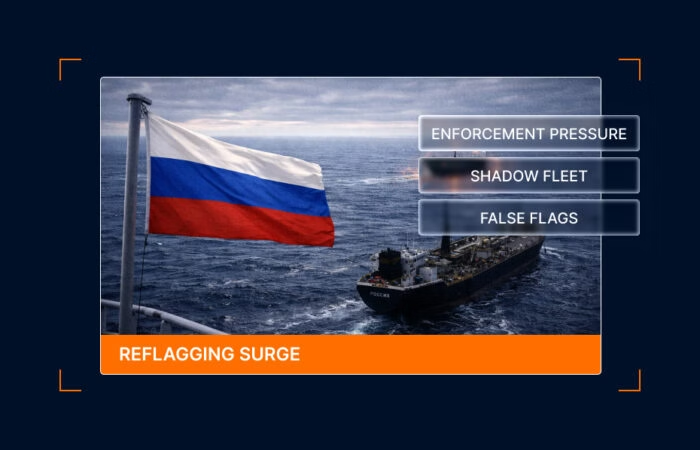
At least 120 falsely flagged, sanctioned tankers are likely to reflag to Russia’s registry in the coming months, as Western interdictions of stateless shadow fleet vessels accelerates a structural shift in Russia’s oil export logistics.
All ships fit the profile and trading pattern of tankers that have already switched to Russia’s flag following a governance crackdown and nine interdictions of sanctioned, stateless vessels in just over eight weeks.
Reflagging as a Response to Enforcement Pressure
Nearly 70 dark fleet tankers have been tracked by Windward broadcasting Russia as their new flag since May 2025, including 40 since the boarding, seizure, or detention of falsely flagged ships by the U.S., UK, and France began in December.
At least three vessels – Akkord (IMO 9259599), Saga (IMO 9318553), and Topaz (IMO 9292034) – switched to Russia’s flag from fraudulent registries last week alone.
Ships trading under fraudulent registries lack flag-state protection, making them subject to boarding under the United Nations Convention of the Law of the Seas.
Throughout 2025, more than 300 shadow fleet tankers involved in sanctioned Iranian, Venezuelan, or Russian oil trades shifted to fraudulent flags, often after repeated flag hopping.
These vessels were subsequently deregistered by permissive registries, including Gabon, Cook Islands, Barbados, Comoros, and Gambia, after sustained pressure to remove Western-sanctioned tonnage, leaving many ships effectively stateless.
This left the tankers vulnerable at sea. Reflagging to Russia, which is often the only registry willing to accept them, restores legal protection under international maritime law, at least for now.
Enforcement Pressure Drives Structural Shift
The trend toward reflagging to Russia is expected to accelerate if governments, including the U.S., maintain pressure and continue interdicting falsely flagged vessels.
The most recent interdiction, on February 9, saw U.S. commandos board the runaway Suezmax tanker Aquila II (IMO 9281152) in the Indian Ocean. This marked the eighth U.S. interdiction related to Venezuela, and the ninth overall since December.

Windward data shows approximately 120 Russia-trading tankers over 180 meters in length broadcasting flags from 19 fraudulent registries, including Botswana, Guyana, Guinea, and Madagascar. These vessels are part of the more than 650 tankers sanctioned for evading Russia-related measures and have been under close surveillance while sailing to and from Russian Baltic ports over the past two years.

A joint statement issued on January 26 by multiple coastal governments warned of increased action against vessels without nationality or valid documentation, reinforcing the growing enforcement risk of stateless ships.
Russia Tightens Control Over Export Logistics
Roughly half of the reflagged tankers are beneficially owned by Sovcomflot, Russia’s government-controlled shipping company, which operates a fleet of around 110 tankers, including LNG carriers.
Before February 2022, Sovcomflot flagged about one-third of its fleet in Russia, relying on open registries for the remainder. That figure has now risen to 56%. Nearly 30 Sovcomflot-owned tankers have reflagged and returned to Russia in the past 10 months.
The same pattern is visible across other shadow fleet vessels not beneficially owned by Sovcomflot, many of which were acquired by anonymous, untraceable entities specifically for sanctions evasion.
As a result, there are now just over 100 Russian-flagged tankers above 50,000 dwt, nearly double the numbers seen 12 months ago. The shift has tightened Russia’s control over its export logistics chain and reduced false-flag transits through the Baltic, Mediterranean, and English Channel.
Meanwhile, at least 24 falsely flagged tankers were tracked transiting the Baltic in the past four months, and at least a dozen were quarantined in Venezuela under U.S. measures imposed since late November.
Frequently Asked Questions (FAQs)
Why are sanctioned shadow fleet tankers reflagging to Russia now?
Enforcement pressure has materially increased the risk of operating without a valid flag. Western interdictions of falsely flagged and stateless vessels have demonstrated that ships lacking legitimate flag-state protection are vulnerable to boarding, seizure, or detention under international maritime law. Reflagging to Russia restores legal protection and reduces immediate exposure to interdiction.
What makes falsely flagged vessels especially vulnerable to enforcement?
Vessels operating under fraudulent registries lack recognized nationality. Under the United Nations Convention on the Law of the Sea, this removes flag-state protection and allows coastal or naval forces to board and inspect them. As permissive registries deregister sanctioned tonnage, many ships are left effectively stateless, making them prime enforcement targets.
How does this trend affect Western enforcement leverage?
Reflagging reduces enforcement options. Russian-flagged vessels regain protection under international maritime law, limiting the circumstances under which they can be boarded. At the same time, the decline in false-flag transits through sensitive waterways reduces visibility and jurisdictional touchpoints for enforcement authorities.
What role do fraudulent registries play in sanctions evasion?
Fraudulent registries act as temporary enablers. They allow sanctioned vessels to continue trading after being deregistered by legitimate flags, often following repeated flag hopping. However, sustained diplomatic and regulatory pressure has led many of these registries to revoke registrations, pushing vessels toward either statelessness or reflagging to Russia.
Why is Sovcomflot central to this reflagging trend?
Sovcomflot controls a significant portion of Russia’s tanker fleet and has steadily increased the share of vessels flagged in Russia since 2022. As enforcement risk has grown, returning ships to the Russian registry provides legal protection and operational continuity, reinforcing state control over energy exports.
How does this shift impact global oil markets and maritime risk?
Greater Russian control over export logistics reduces transparency and increases concentration risk. Fewer enforcement leverage points, combined with continued use of sanctioned vessels, complicate monitoring, risk assessment, and response planning for governments, insurers, and market participants.
What signals indicate that enforcement pressure is driving this behavior?
The timing aligns closely with interdictions, seizures, and public warnings targeting stateless and falsely flagged vessels. The acceleration of reflagging activity following high-profile boardings and joint government statements suggests a direct behavioral response to enforcement actions rather than organic fleet renewal.
Explore more

Maritime Defense Weekly: Energy Flows and Infrastructure Risk
Week in Focus Russian Diesel Cargo Signaling Arrival in Cuba A Hong Kong-flagged medium-range tanker is signaling arrival in Cuba on March 2 after multiple AIS destination revisions. The vessel initially broadcast Havana, then shifted to “Caribbean Sea,” and later to “Gibraltar for orders,” despite already transiting the strait. Windward’s assessment indicates the tanker likely...
Read more

Maritime Defense Weekly: Offshore Enforcement and Baltic Exposure
Week in Focus Sanctions Enforcement Moves Further Offshore The United States intercepted and boarded Aquila II (IMO 9281152) in the Indian Ocean, nearly 1,000 nautical miles from where it fled a Venezuelan quarantine zone in January. The 22-year-old Suezmax had falsely broadcast under the Panamanian flag and has a history of extended dark activity and...
Read more

Maritime Defense Weekly: Enforcement Tightens Across Global Shipping
The Week in Focus Maritime Enforcement Is Shifting From Designation to Constraint Maritime enforcement is increasingly focused on restricting how vessels operate in practice, not just on whether they appear on a sanctions list. Rather than relying solely on designations, recent actions are targeting the services and access that make maritime trade possible, including insurance,...
Read more

Tracking RAIDER: How Long-Term Vessel Behavior Uncovered a Pacific Drug Operation
At a Glance How a Dormant Vessel Triggered a Major Seizure In January 2026, French naval forces interdicted the MV RAIDER, a 41-meter pontoon vessel, in French Polynesian waters, seizing nearly five tonnes of cocaine, with an estimated value of nearly $150 million. Although the vessel was released without charges, its risk profile illustrates how...
Read more