


April 8, 2026
April 8, 2026: Iran War Maritime Intelligence Daily


April 8, 2026: Iran War Maritime Intelligence Daily
What’s inside?
At a Glance
- Although the US and Iran announced a two-week ceasefire overnight the risk profile for the small number of ships transiting Hormuz remains unchanged.
- Transit conditions, toll arrangements (if any), and the legal framework for passage remain undefined
- Whether Iran will maintain control of Hormuz during talks is unclear but all signs point to the Islamic Republic refusing to give up its leverage during the two-week period.
Operational Overview
On April 7, the day before the ceasefire was announced, 11 vessels transited the Strait of Hormuz — four inbound and seven outbound. All four inbound vessels carried Sanctioned risk. Outbound traffic comprised three tankers and four bulk carriers, all via the Northern Corridor. The profile was broadly reflected in ships tracked in the 12 hours following the ceasefire.
Strait of Hormuz Transits Steady
Inbound traffic on April 7 comprised four sanctioned, Iranian-trading tankers only, reflecting uncertainty entering the Gulf amid U.S. threats to escalate attacks on Iran ahead of the eventual ceasefire announcement.
Four of the outbound vessels were bulk carriers, a regular feature of limited transits with all previously calling at Iran.
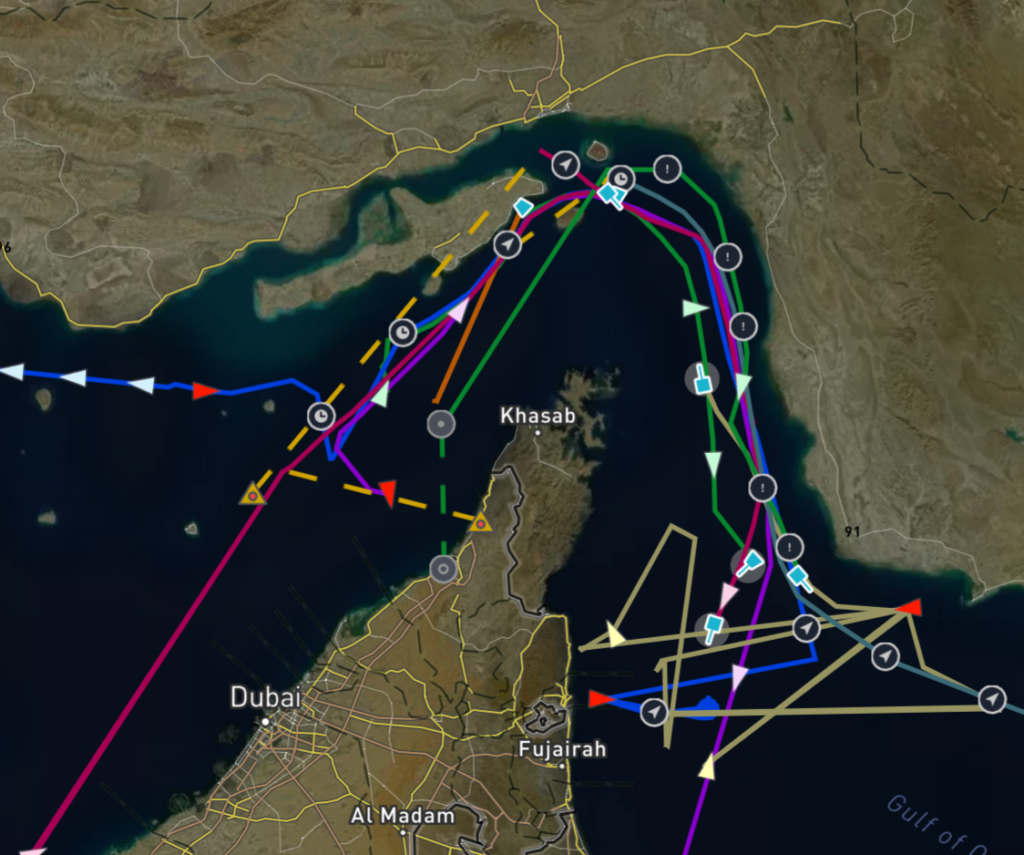
All vessels used the Northern Corridor, in place since mid-March that redirects traffic through Iranian waters and hugs the coastline instead of using the normal international channel.
A southern corridor which hugs Oman’s coastline that was used by several ships last week has not seen any further visible traffic via AIS.
CEASEFIRE DECLARED — STRAIT REMAINS EFFECTIVELY CLOSED
Hormuz traffic is unchanged in risk profile and numbers transiting since the ceasefire announcement. Five bulk carriers were tracked outbound as of 12:00 on April 8, and all appeared to be confined to the Iran Revolutionary Guards Corps-controlled corridor.
Coordination with Iranian armed forces is still required for all transits. Iran has confirmed this operates “within technical limitations” without specifying what those are but all signs are that the Islamic Republic is seeking to retain its leverage over the waterway during ceasefire negotiations.
Transit conditions, toll arrangements, and the legal framework for passage remain undefined. The strait has not reopened — it is in a supervised pause.
Iran will demand shipping companies pay tolls, Hamid Hosseini, a spokesperson for Iran’s Oil, Gas and Petrochemical Products Exporters’ Union told the Financial Times.
Fees would be paid in cryptocurrency with tariff of $1 for each barrel of oil with inbound transits at no cost, he said. Iran would require ship inspection and require approval. Radio broadcasts to tankers in the Gulf on Wednesday from Iran warned those transiting without approval would be struck.
At best, a humanitarian corridor similar to the United Nation’s Black Sea grain corridor negotiated with Russia to let grain shipments leave Ukraine can be deployed.
Mixed messages are emerging: Oman has said that it won’t pay any tolls and diplomatic engagement with Iran’s government appears key.
RISK PROFILE: SELECTIVE NORMALIZATION ONLY
Of the five bulk carriers sailing outbound on the morning of April 8, four appeared to have been awaiting transits at anchorages off UAE. No blue-chip operators are present and major oil majors are absent. One bulk carrier exited the strait less than 48 hours after entering with its AIS switched off on April 6. At 0800 GMT April 7 the St Kitts & Nevis-flagged bulk carrier did a U-turn, likely related to impending uncertainty ahead of the ceasefire. It was one of the first to sail out of the strait via Larak Island after the ceasefire announcement.
The cohort reflects the same risk-tolerant operator profile seen throughout the blockade — not a return of mainstream commercial shipping. Insurance coverage for war-risk exclusions remains a blocking constraint. ~3,200 vessels with ~20,000 seafarers remain west of Hormuz including nearly 800 tankers and cargo ships.

OUTLOOK: WEEKS NOT DAYS
8–10 April is the critical test window: if daily transits increase with zero incidents, major operators will begin risk reassessment. 11–14 April is the decision window for blue-chip operators, contingent on ceasefire extension signals, IRGC posture and US Navy escort clarity.
Even under a best-case scenario, weeks are required to move stranded gas and oil cargoes, and months for global trade to approach pre-crisis levels. Iran’s stated conditions — compensation, US military withdrawal, recognition of enrichment rights, lifting of all sanctions — remain unresolved. The IRGC retains physical control of the strait. Full normalization is not imminent.
Attack on Qingdao Star
The Qingdao Star, a 4,253 TEU Marshall Islands-flagged container vessel chartered by Maersk, was struck by a projectile approximately 25 nautical miles south of Kish Island, Iran, on 7 April — the day before the ceasefire announcement. The UK Maritime Trade Operations (UKMTO) centre confirmed the incident, reporting that all crew were safe and accounted for, with no injuries and no environmental impact recorded.
The vessel sustained hull damage above the waterline but no fire broke out, and the Qingdao Star was able to continue under its own propulsion to its next port of call for inspection. Iran’s IRGC claimed responsibility, describing the vessel as “an Israeli ship” and stating it was struck with a Qadir cruise missile. The vessel is owned by Chartworld and was previously time-chartered by ZIM, the Israeli container carrier, until October 2023 — the likely basis for the IRGC’s classification.
The attack is significant: it occurred within hours of ceasefire negotiations concluding, confirming that the IRGC was conducting strikes on commercial vessels up to — and potentially through — the ceasefire window. Blue-chip operator exposure through time-charter arrangements remains a live risk even for vessels with no current Israeli commercial connection.
Explore more
April 7, 2026: Iran War Maritime Intelligence Daily
At a Glance Operational Overview Bulk carriers in Iranian trades including those with beneficial ownership in Greece and China continue to exit the Strait of Hormuz while Iran ensures regular transits for its oil and gas shipments. Energy commodities exports from other Gulf countries are seen on an ad-hoc basis. Strait of Hormuz Transits Steady...
Read more

April 6, 2026: Iran War Maritime Intelligence Daily
At a Glance Operational Overview The Strait of Hormuz is no longer operating as a single controlled chokepoint. Between April 2 and 5, transit evolved into a dual-corridor system, combining military control with emerging diplomatic coordination. A northern route remains centered around IRGC control near Larak Island. In parallel, a southern corridor has emerged along...
Read more

Week Five of the Iran War: A Maritime Intelligence Breakdown
At a Glance The Fifth Week of the Iran War at Sea Five weeks into the conflict, the maritime system is no longer defined by simple restriction. It is being managed. Transit through the Strait of Hormuz increased over the course of the week, with movement continuing under a permission-based model that now includes both...
Read more

April 2, 2026: Iran War Maritime Intelligence Daily
At a Glance Operational Overview Three of the four bulk carriers that exited on April 1 were Greece-owned and one China-owned. This signals that EU as well as Asia shipowners are negotiating at both diplomatic and commercial levels to use the permission-based system. Strait of Hormuz Transits Rise Sanctioned, Iran-linked tankers dominated inbound transits on...
Read more