


July 5, 2026
H1 2026: The Moving Target of Maritime Sanctions Compliance


Six Essential Takeaways for Maritime Leaders from America’s New National Security Strategy
What’s inside?
At a Glance
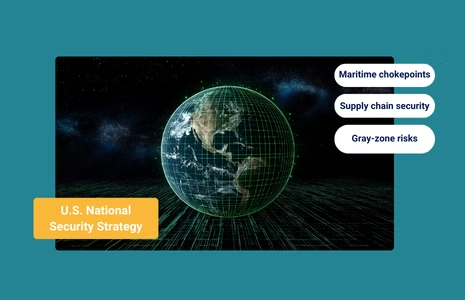
- The 2025 U.S. National Security Strategy (NSS) defines maritime security chokepoint access as a core national interest tied directly to economic stability.
- Illicit networks, gray-zone behaviors, and foreign influence in ports and logistics are now classified as national security concerns.
- The NSS calls for “real-time discovery, attribution, and response” and recognizes that traditional intelligence models cannot meet modern maritime threat tempo.
- The Western Hemisphere and Indo-Pacific emerge as priority regions for enforcement, deterrence, and supply chain protection.
- Supply chain integrity, sanctions enforcement, and transparency across maritime networks are elevated into the national security framework.
- Windward provides the persistent visibility, behavioral context, and multi-sensor intelligence the NSS identifies as essential, enabling earlier anomaly detection, clearer networked-risk mapping, and better insight into deceptive activity so organizations can align daily operations with the strategy’s call for real-time awareness and stronger maritime resilience.
A New Maritime Lens in America’s National Security Strategy
The 2025 National Security Strategy (NSS) marks a decisive shift in how the United States defines and protects its national interests. Maritime activity now sits at the center of how the U.S. approaches competition, resilience, and strategic advantage. The NSS frames the maritime domain as a primary arena where influence is exercised, vulnerabilities are exposed, and national power is tested.
This repositioning reflects two realities: geopolitical competition increasingly plays out through shipping lanes, chokepoints, ports, and critical maritime infrastructure; and disruptions across these networks reveal how essential they are to economic stability and national preparedness.
The National Security Strategy outlines how the U.S. intends to navigate these challenges, protect key maritime corridors, and counter behaviors that undermine freedom of navigation, supply chain integrity, and regional stability.
What follows is a focused breakdown of the NSS for the maritime community, highlighting the core implications that matter most for maritime operators, intelligence teams, and commercial decision-makers.

Six Things Maritime Leaders Need to Know from the 2025 National Security Strategy
1. The Maritime Domain Moves to the Center of U.S. National Security
The 2025 NSS elevates maritime security more explicitly than previous strategies. It identifies freedom of navigation, secure chokepoints, and resilient supply chains as core U.S. interests across the Indo-Pacific, Middle East, and Western Hemisphere. The Indo-Pacific is described as a decisive economic arena, with the strategy noting that roughly one-third of global shipping moving through the South China Sea is directly tied to U.S. economic stability.
The document also highlights growing concerns that competitors could gain leverage over global trade by influencing chokepoints or imposing informal “toll systems” on maritime traffic.

What this means for maritime leaders: Sea lines of communication and their surrounding infrastructure will sit at the heart of future U.S. policy, monitoring, and enforcement activity.
2. Illicit and Gray-Zone Maritime Activity Is Now a National-Security Threat
The National Security Strategy brings a wide spectrum of illicit and gray-zone maritime activity under the umbrella of national security. The strategy explicitly names drug trafficking, human trafficking, and illicit migration as priority threats. It also highlights foreign subversion, espionage, and manipulation of shipping networks through supply chains and offshore influence. In the Western Hemisphere, the strategy warns of state-backed control of critical ports and infrastructure.
Dark fleets, false flags, closely held ownership structures, covert financing routes, and unregistered port influence now intersect with state-linked activity. Rather than treating these as discrete compliance challenges, the NSS signals that Washington views them as strategic vectors that erode sovereignty, destabilize markets, and weaken alliances.
What this means for maritime leaders: Illicit and ambiguous behavior at sea will increasingly be monitored, interpreted, and acted upon through a national-security lens, not just a regulatory one.
3. The National Security Strategy Calls for Predictive, Persistent Intelligence at Scale
While the National Security Strategy does not prescribe specific intelligence technologies, it repeatedly emphasizes the need for earlier detection of threats, more reliable attribution, and stronger protection of critical networks and infrastructure. It frames these requirements within the broader goal of safeguarding supply chains, chokepoints, and access to critical materials.
The strategy also underscores the importance of working across commercial networks, where many of these threats originate or transit, and highlights the role of non-governmental partners in strengthening national resilience.

What this means for maritime leaders: Continuous monitoring, faster contextual analysis, and integrated public-private information flows become essential, not because the NSS mandates a particular architecture, but because the nature of modern risk requires it.
4. The Western Hemisphere Becomes a High-Priority Maritime Enforcement Theater
While the National Security Strategy covers global challenges, it places a focus on the Western Hemisphere. The strategy introduces what it calls a “Trump Corollary to the Monroe Doctrine,” which seeks to prevent non-hemispheric competitors from positioning military or strategic assets in the region.

To support this posture, the NSS calls for increased Coast Guard and Navy presence to maintain control of key sea lanes. It emphasizes more aggressive action against drug cartels and transnational criminal organizations, as well as hardened migration and smuggling routes at sea.
What this means for maritime leaders: These waters will face growing surveillance, more frequent at-sea enforcement, and heightened scrutiny of vessel behavior, ownership links, and cargo flows.
5. Indo-Pacific Deterrence Depends on Advanced Maritime Domain Awareness
Although the strategy spans multiple regions, its Indo-Pacific emphasis is particularly clear. The National Security Strategy identifies the Indo-Pacific as a region of heightened strategic competition, emphasizing that the sea lanes around Taiwan, the First Island Chain, and the South China Sea carry a substantial share of global shipping and are critical to U.S. economic stability. It stresses the need to prevent competitors from controlling or coercively shaping these waters.

The NSS highlights port access, maritime partnerships, and deeper situational awareness with regional allies as essential components of this approach.
What this means for maritime leaders: Increased coordination, greater transparency requirements, and stricter expectations around vessel behavior, routing decisions, and data integrity.
6. Sanctions, Supply Chains, and Economic Security Remain Firmly in the National Security Framework
The National Security Strategy connects economic resilience directly to national security in ways that carry major implications for maritime trade. It highlights U.S. intentions to counter predatory or illicit foreign practices, including supply chain manipulation, through oversight, industrial strategy, and targeted enforcement.
The document also emphasizes maintaining U.S. dollar dominance, a goal that naturally extends oversight to shipping companies, financial intermediaries, and logistics networks involved in cross-border trade.
What this means for maritime leaders: Compliance expectations will shift from vessel-level checks to network-level assessments: ownership, operators, brokers, registries, ports, and logistics corridors. Transparency and behavior, not just documentation, will matter more as economic security becomes a strategic priority rather than a regulatory one.

What to Expect and How to Prepare
Leaders across shipping, energy, compliance, and government will need to:
- Expand visibility beyond AIS and declared behavior, incorporating multi-sensor confirmation, behavioral context, and independent verification.
- Reassess risk models to account for gray-zone behavior, networked illicit activity, and strategically ambiguous operations that fall between clear legal categories.
- Prepare for tighter regulatory scrutiny across documentation, ownership structures, routing decisions, and exposure to chokepoints or politically contested infrastructure.
- Engage in earlier, more intelligence-driven decision-making, especially in regions identified as priority theaters: the Indo-Pacific and Western Hemisphere.
- Strengthen partnerships, since the NSS emphasizes that maritime awareness and security depend on shared intelligence and interoperable tools.
Frequently Asked Questions (FAQs)
How does the National Security Strategy redefine maritime security for the U.S. and its partners?
It elevates maritime security to a core national interest, linking sea-lane protection, chokepoint access, and supply chain resilience directly to U.S. economic strength and strategic stability.
Why is gray-zone maritime activity treated as a national security threat?
The NSS recognizes that illicit networks, dark fleets, port influence, and sanctions evasion now overlap with state-backed activity, creating risks that can undermine sovereignty, infrastructure, and economic security.
What practical changes should maritime operators expect in the Western Hemisphere?
Increased U.S. Coast Guard and Navy presence, more aggressive interdiction operations, and heightened scrutiny of vessel behavior, ownership structures, and transshipment routes.
How does the NSS affect maritime activity in the Indo-Pacific?
The region is a priority for deterrence, requiring persistent situational awareness, deeper cooperation with allies, and greater transparency from fleets operating near key chokepoints.
How does the National Security Strategy influence sanctions enforcement and compliance expectations?
It integrates sanctions, economic protection, and supply chain oversight into national security, meaning regulators will increasingly evaluate risk at the network level across companies, fleets, intermediaries, and logistics corridors.
How can Windward help organizations operationalize the priorities outlined in the NSS?
Windward provides the persistent visibility, behavioral context, and multi-sensor intelligence that the NSS identifies as essential. By detecting anomalies earlier, mapping networked risk, and improving understanding of deceptive activity, organizations can align daily operations with the strategy’s call for real-time awareness and stronger maritime resilience.
Explore more

What Is GPS Jamming and Why Are We Seeing So Much of It?
At a Glance What Is GPS Jamming? GPS jamming is the deliberate interference with GPS signals that disrupts the ability of receivers to determine accurate location. It operates in two primary modes. The first is signal denial, where jamming equipment overwhelms the GPS signal with radio frequency interference, preventing a receiver from establishing a positioning...
Read more

Why Russian-Linked Vessels Are Loitering Above European Subsea Cables
At a Glance Behavior With No Commercial Explanation The signature is consistent across multiple vessels in different parts of European waters. A tanker arcs off its expected route. It loiters above a cable system, sometimes for hours, sometimes for days. Its AIS goes dark for long enough to obscure precise positioning but short enough to...
Read more

Why Russia’s Sanctioned Shadow Fleet Is Bypassing the English Channel
At a Glance Russian Tankers Repeatedly Bypass the English Channel Western-sanctioned tankers loading oil at Russian Baltic ports normally transit the English Channel as part of standard voyage routing. In the past 30 days, Windward tracked 84 Western-sanctioned tankers through the Channel — 44% flagged with Sierra Leone, 19% with Cameroon, and 18% with Russia....
Read more

Why Customs Enforcement Is Moving from Document Screening to Behavioral Intelligence
At a Glance The Screening Model Customs Was Built On No Longer Holds For most of the last twenty years, customs enforcement has operated on a screening model. Cargo manifests arrive ahead of port call, risk scores are calculated against the declared origin, shipper, and route, and anomalies trigger inspection. The model worked while the...
Read more

Why Behavioral Intelligence Now Defines Subsea Cable Protection
At a Glance From Monitoring to Prevention For most of the past decade, cable protection meant monitoring. Operators watched the screen, generated alerts when a vessel of concern appeared near a cable, and responded after the fact when damage occurred. The threat landscape has shifted in ways that existing tools and protocols were not designed...
Read more