


November 24, 2026
Russia's Baltic Military Sealift Under Attack Across Two Fronts


Russia’s Baltic Military Sealift Under Attack Across Two Fronts

What’s inside?
At a Glance
- Drones struck Russian RoRo cargo ship SPARTA II in the Gulf of Finland on November 21 in an attack attributed to Ukraine.
- A day later, Ukraine said it launched sea drones to sink Russian corvette MERKURY at the Libyan port of Benghazi.
- Both vessels were part of a coordinated fleet of cargo ships integral to supplying weapons and military equipment to African countries.
- The cargo ships sailed from the Baltic via the English Channel toward the Strait of Gibraltar and switched off AIS within three days of each other.
- Three ships in a separate convoy switched off AIS off Ushant, France, within four minutes on November 12, with a French warship shadowing them.
- Russia now supplies its foothold in eastern Libya, and through it the Sahel, from the Baltic.
Russia’s Baltic Military Sealift Under Attack Across Two Fronts
The two Russian vessels struck by drones within 24 hours in the Gulf of Finland and at the Libyan port of Benghazi were part of a coordinated fleet of cargo ships integral to supplying weapons and military equipment to African countries.
Drones struck U.S.-sanctioned RoRo cargo ship SPARTA II (IMO 9160994) in the Gulf of Finland on November 21 en route to the port of Baltiysk, from St. Petersburg, in an attack attributed to Ukraine. SPARTA II had spent the past 12 months shuttling between the two ports.
A day later, Ukraine said it launched sea drones to sink Russian corvette MERKURY at the Libyan port of Benghazi, with Russian RoRo cargo ship ANGARA (IMO 9179842) also damaged.
MERKURY Likely Escorted a Fleet of Cargo Ships Into the Mediterranean
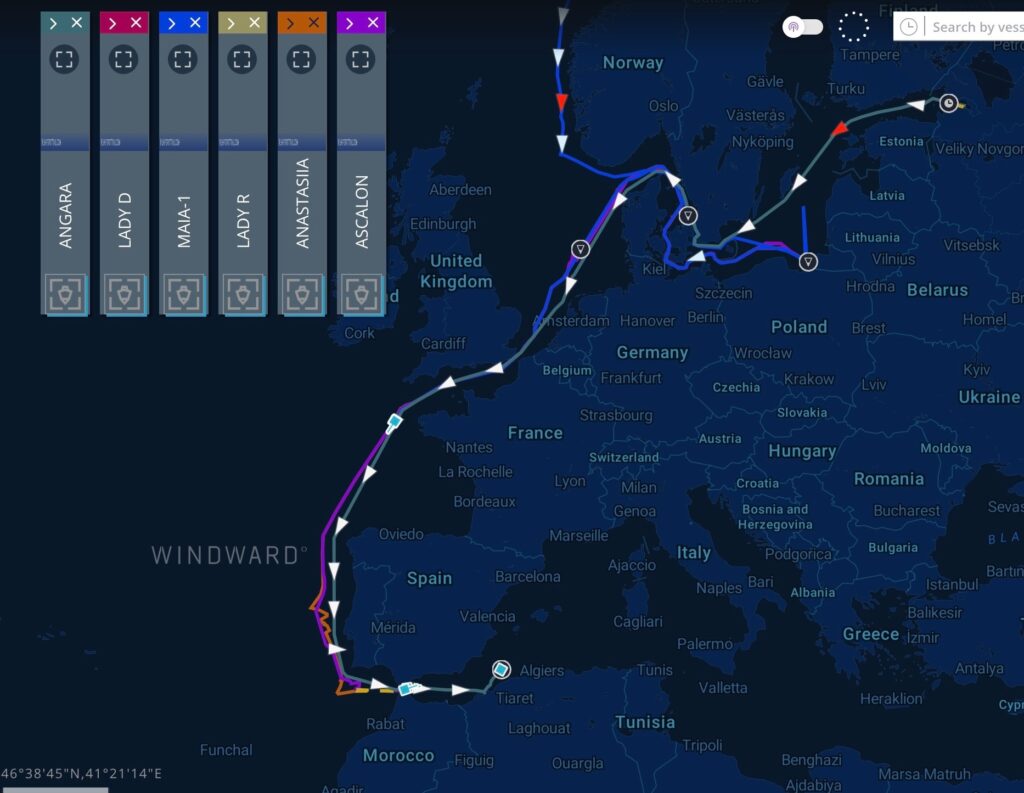
MERKURY likely escorted ANGARA and another four cargo ships used by Russia to ship military equipment through the Mediterranean earlier this month. The vessels were detected sailing from the Baltic via the English Channel to the Strait of Gibraltar and switched off their AIS within three days of each other to obfuscate their destination.

Cargo Ships Leave the Baltic and Go Dark
Between August and October, cargo vessels ASCALON (IMO 9198226), LADY R (9161003) and ANGARA were all tracked at the same anchorage at the Kronshtadt naval base near St. Petersburg.
From mid-October, ASCALON and LADY R sailed to Baltiysk, within the Russian enclave of Kaliningrad.
Another vessel in the network, ANASTASIIA (IMO 9349291), joined ASCALON to sail from Kaliningrad around October 29 via the English Channel to the Strait of Gibraltar. The pair went dark at the same minute just east of Gibraltar on November 13.
ANGARA loaded at Bronka, St. Petersburg, and left around October 26, following the same route. After a brief call at Oran, Algeria, from November 9-10, ANGARA loitered off Algeria and went dark around November 11.
A French Warship Shadows a Second Convoy Off Ushant
LADY D (IMO 9349289) and MAIA-1 (IMO 9358010) joined LADY R to leave Kaliningrad on November 5 in a separate convoy and sailed through the English Channel on November 11, and were believed to be sailing for the Strait of Gibraltar.
All three switched off their AIS off the coast of Ushant, France, within four minutes, on November 12.

Windward’s All-Source Operational Intelligence captured a French warship shadowing the three ships and a Russian navy tanker.

ANGARA‘s loitering off Algeria suggests it was likely waiting to join MERKURY and others, with eastern Libya assessed as the common destination.
The SPARTA II Strike Hands Finland a Sensitive Dilemma
The drone attack on SPARTA II provided an extraordinarily sensitive dilemma for Finland’s government after the disabled vessel drifted into its territorial waters and had to be towed from the area by Russian service vessels.
A handful of commercial ships have been targeted in Russian Baltic ports since 2023, for which Ukraine has been blamed but has not admitted responsibility. The attack on SPARTA II mirrors tactics from October 2025 through to July 2026 in the Black Sea when Ukraine used drones to target tankers calling at Russian ports to load oil.
Russia Supplies Libya and the Sahel From the Baltic
Russia moved its military sealift north after the Bosphorus Strait closed to its warships in February 2022. With Novorossiysk within drone range and access to Syria lost, Russia now supplies its foothold in eastern Libya, and through it the Sahel, from the Baltic.
Mediterranean Attacks Amplify Russia’s Vulnerability
Ukraine is also linked to regional attacks on shadow fleet tanker QENDIL (IMO 9310525) in December 2025, Russian LNG carrier ARCTIC METAGAZ (IMO 9243148) in March, and RoRo cargo vessel LADY MARIIA (IMO 9220641) in September. China-bound Russian LNG carriers discontinued transits via the Mediterranean after the ARCTIC METAGAZ attack and now sail around the Cape of Good Hope. Russia is likely to further review maritime transport logistics and divert cargoes where possible.
Related Ships Remain Potential Targets
The five cargo ships seen sailing into the Mediterranean were previously linked to shipping weapons and other military equipment to and from China, Iran, and North Korea and other West African countries.
Several related vessels in the same networks remain active between Kaliningrad and St. Petersburg. Contact Windward’s Maritime Intelligence Operations Center (MIOC) to find out which vessels are linked to Russia’s military sealift, and how Windward tracks them when they go dark.
Written by Michelle Wiese Bockmann, Windward MIOC Senior Maritime Intelligence Analyst.
Trending
- The EU’s 18th Sanctions Package Lookback Started. Trading Russian Products? You're At Risk. Nov 24, 2025
- Tanker Freight Rates Hit Five-Year High Amid Russian Oil Sanctions Shake-Out Nov 6, 2025
- Sanctioned, Stateless, and Still Sailing: Expert Insights from the Frontlines of Maritime Sanctions Nov 3, 2025
Explore more

How to Reduce False Positives in Vessel Screening Without Missing Real Risk
At a Glance Screening Alerts Are a Volume Problem Before They Are Anything Else Every compliance team that touches maritime trade runs vessels through a screening system before a transaction proceeds. The system checks the vessel against sanctions lists, looks at its recent movements, flags anything that resembles a risk indicator, and produces an alert....
Read more

A Chinese Survey Vessel Spent 53 Hours Over the SEA-H2X and EAC-C2C Cables
At a Glance Fifty-Three Hours Inside a Twenty-Nine Mile Box From October 30 to November 1, a Chinese research and survey vessel spent approximately 53 hours inside a 29 nautical mile box over the SEA-H2X and EAC-C2C cable routes in the northern South China Sea. It covered about 226 nautical miles at a median of...
Read more

Iran Expands Its Use of Fraudulent Ship Registries to Evade Sanctions
At a Glance Nearly 300 Iranian-Linked Ships Sail Under Fraudulent Flags Nearly 300 Iranian-linked ships have been tracked using fraudulent ship registries over the past 90 days to evade sanctions, an accelerating issue that triggered an OFAC alert alongside sanctions imposed on key enablers and companies. Russia has largely discontinued using fraudulent ship registries for...
Read more

Seven Shadow Fleet Tankers Spoof AIS to Hide Novorossiysk Voyages
At a Glance Sanctioned Tankers Fake Their Positions Near the Bosphorus A cluster of seven sanctioned Russian tankers were found to have routinely and deliberately manipulated AIS over the past 90 days to falsely claim they were drifting off the Black Sea close to the Bosphorus entrance. The tankers were instead identified by Windward clandestinely...
Read more