


August 6, 2026
Route Avoidance Is No Longer Enough: The Houthis Strike a Saudi Tanker Off Yanbu


Route Avoidance Is No Longer Enough: The Houthis Strike a Saudi Tanker Off Yanbu
What’s inside?
At a Glance
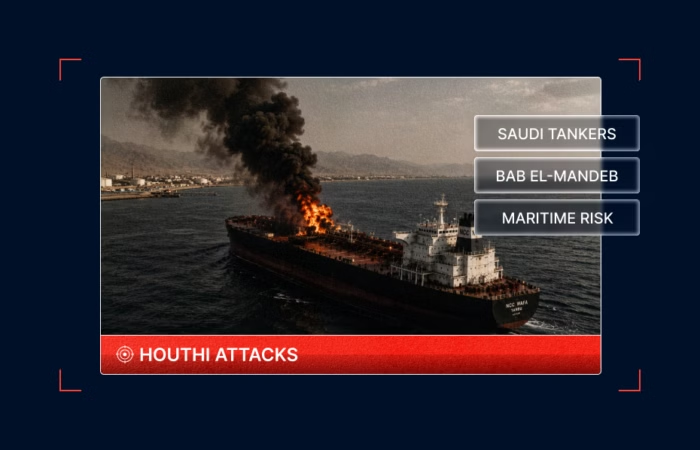
- The Houthis claimed a ballistic missile strike on NCC WAFA, a Saudi-flagged MR2 tanker, off Yanbu on August 5, hitting a vessel on a purely domestic Saudi coastal run hundreds of kilometers from the declared blockade zone.
- The Houthi statement explicitly tied the strike to Saudi tankers rerouting north to avoid Bab el-Mandeb, confirming that route avoidance is no longer sufficient mitigation.
- MINOAN PIONEER, the Liberian-flagged bulk carrier struck approximately 20 nautical miles northeast of Khasab, remains stationary and burning 48 hours after the incident, with one crew member missing.
- Two Pakistan-flagged tankers loaded Saudi crude at Yanbu and transited Bab el-Mandeb during the active Houthi blockade without incident, adding a third nationality after Chinese-affiliated vessels operating under apparent de facto immunity.
- FAIZE NOORE OLIYA, a 66-meter Indian-flagged cargo vessel, sank on August 4 after being struck by an explosives-laden boat south of Al Hudaydah, with all 14 crew rescued.
Operational Overview
The Houthi campaign has moved beyond the assumption that geographic distance provides protection. NCC WAFA was struck off Yanbu on August 5 on a purely domestic Saudi coastal run from Yanbu to Jizan, hundreds of kilometers from the declared Bab el-Mandeb blockade zone and running dark since July 19. The Houthi statement explicitly tied the strike to Saudi tankers rerouting north to avoid the chokepoint. Route avoidance, the last remaining mitigation strategy for Saudi-linked shipping short of a full Cape of Good Hope diversion, is no longer sufficient.
At Hormuz, MINOAN PIONEER remains stationary and burning 48 hours after being struck approximately 20 nautical miles northeast of Khasab, with the third engineer still missing. The strike marks the fourth reported maritime security incident near the Musandam Peninsula in five days.
Two Pakistani state-operated tankers transited Bab el-Mandeb with Saudi crude during the active Houthi blockade without incident, adding a third nationality after Chinese-affiliated vessels operating with apparent de facto immunity.
Windward assesses the operational risk environment across the Strait of Hormuz, Red Sea, Gulf of Aden, and northern Arabian Gulf as Critical, with the Houthi targeting envelope now demonstrably extending into Saudi territorial waters.
NCC WAFA Struck Off Yanbu on an Intra-Saudi Coastal Run
The Houthi military spokesman claimed a ballistic missile strike on NCC WAFA (IMO 9688348), a Saudi-flagged MR2 oil products tanker of 49,990 DWT operated by NCC and effectively controlled by Aramco Trading, off the coast of Yanbu in the northern Red Sea on August 5. Regional security sources confirmed an attack occurred but could not verify projectile impact or damage.
The vessel was dark since July 19 on a routine intra-Saudi coastal run from Yanbu to Jizan, not a Bab el-Mandeb transit, having likely U-turned northward after the July 20 blockade announcement. It was struck hundreds of kilometers from the declared blockade zone. The Houthi statement explicitly tied the strike to Saudi tankers rerouting north to avoid Bab el-Mandeb and vowed continued escalating strikes in the northern Red Sea regardless of consequences.

The strike’s significance is structural, as the vessel was not attempting to breach any chokepoint, was running dark, and was on a purely domestic Saudi coastal route with no Bab el-Mandeb exposure. With tankers diverting north to avoid the declared blockade zone, the Houthis have adapted their targeting to follow, making route avoidance an insufficient mitigation.
This is the eighth Saudi oil tanker claimed struck since the July 22 blockade began. The ballistic missile claim warrants skepticism. Hitting a moving vessel at that range with a ballistic missile lacking a terminal seeker is technically very difficult, and no independent source has confirmed the weapon type.
MINOAN PIONEER Confirmed Struck and Still Burning 48 Hours Later
MINOAN PIONEER (IMO 9471630), the Liberian-flagged bulk carrier struck approximately 20 nautical miles northeast of Khasab, Oman on August 3, has been confirmed as the vessel hit by an unidentified projectile that struck the engine room, caused a total blackout, and ignited a fire in the accommodation block. The third engineer remains missing. No group has claimed responsibility.
SAR imagery at 02:05 UTC on August 5 confirmed the vessel stationary at the same position approximately 48 hours after the strike, with satellite imagery identifying a dark approximately 211-meter bulk carrier with stern smoke matching MINOAN PIONEER‘s red deck, white bow pillar, and helipad location at medium-high confidence. The strike marks the fourth reported maritime security incident near the Musandam Peninsula in five days.

FAIZE NOORE OLIYA Sunk South of Al Hudaydah
FAIZE NOORE OLIYA (MMSI 419956572), a 66-meter Indian-flagged cargo vessel with no registered IMO number, sank on August 4 after being struck by an explosives-laden boat approximately 13 nautical miles south of Al Hudaydah, Yemen. All 14 crew were rescued without casualties. No group has claimed responsibility.

Yemen’s National Resistance Forces attributed the attack to the Houthis based on location and method, which is not independently confirmed. The vessel had been AIS-dark since June 21, stationary off Salalah, Oman for 44 days before the incident. The attack method, an explosives-laden boat, is consistent with Houthi maritime tactics documented throughout the conflict.
Pakistani Tankers Break the Houthi Blockade With Saudi Crude
Two Pakistan-flagged Aframax crude tankers loaded Saudi crude at Yanbu and transited Bab el-Mandeb during the July 20 to 28 Houthi blockade window without incident, while other Saudi-linked vessels excluding Chinese-affiliated ones were struck or forced to divert around the Cape of Good Hope.
One vessel was in port at King Fahd when the blockade was declared on July 20, departed the same day, and transited Bab el-Mandeb with AIS active throughout, carrying approximately 471,200 barrels of Saudi crude toward Karachi, per Vortexa. The second vessel arrived at King Fahd on July 22, loaded cargo, departed July 23, and transited Bab el-Mandeb on July 28, carrying approximately 419,700 barrels of Saudi crude toward Karachi, per Vortexa, also with AIS active throughout and no incident.

Pakistan’s Ministry of Foreign Affairs issued a public warning on July 22 that any hostile act against Pakistani-flagged vessels would be regarded as a grave threat to national security, with a reserved right to use force in self-defense, assessed as a likely protective factor in the vessels’ unimpeded transit.
Bab el-Maandeb Transit Picture
SAR imagery collected over Bab el-Mandeb on August 5 at 02:58 UTC identified six vessels, five matched and one dark contact, with four inbound and two outbound. Notable contacts included a Marshall Islands-flagged tanker of 182 meters inbound from Duqm, Oman, carrying approximately 309,400 barrels of finished gasoline consigned to Kamaran, Yemen, a Houthi-controlled island identified as an operational hub for Houthi maritime activity, per Vortexa. A Hong Kong-flagged Chinese-owned general cargo vessel of 199 meters was outbound from a last port call at King Fahd, Saudi Arabia, transmitting a Chinese crew and armed guard onboard signal consistent with reported Chinese-Houthi de-confliction arrangements.
A Cameroon-flagged crude tanker of 228 meters was inbound with approximately 327,300 barrels of refinery feedstock from Vadinar, India, bound for Port Said STS, Egypt. A Hong Kong-flagged Chinese-owned oil and chemicals tanker of 183 meters was inbound with approximately 204,100 barrels of biodiesel and chemicals from Indonesia bound for Adabiya, Egypt. A Tuvalu-flagged tanker of 146 meters was outbound with approximately 136,600 barrels of biodiesel from Kaliningrad bound for Mumbai. One unidentified dark tanker of approximately 180 meters was transiting inbound through the northern approach.
Every Vessel at Yanbu Is Now Running Dark
EO imagery collected on August 5 at 08:04 UTC confirmed 16 dark vessels across berths and the waiting area, 13 alongside the loading jetty and 3 in the waiting area. Six vessels remained from the August 4 collection, indicating extended port calls spanning at least two days, with seven new dark arrivals filling remaining berth slots ranging from a 103-meter product tanker to a 330-meter VLCC-class vessel. One AIS-transmitting vessel was identified among the loading berths, a Marshall Islands-flagged Panamax bulk carrier of 210 meters. Its transponder-on status against an otherwise fully dark berth line is a notable identity-correlation outlier. One dark Cyprus-flagged tanker of approximately 100 meters was confirmed via Vortexa as carrying approximately 26,600 barrels from Jeddah to Yanbu, an intra-Saudi coastal move. In the waiting area, a dark tanker of 250 meters in ballast was alongside two service vessels consistent with tug and pilot assistance ahead of a berth transfer.
The August 6 collection at 08:33 UTC showed 18 commercial-scale vessels, up from 15 on August 4, with 17 dark and one AIS-correlated. The AIS-correlated vessel is a Marshall Islands-flagged container vessel of low risk with no sanctions exposure, berthed and confirmed via AIS, the third day since July 27 on which an AIS-correlated vessel has been present at the terminal. The Panamax bulk carrier that had been the sole AIS-transmitting contact on August 4 to 5 has departed and is now sailing with its AIS active toward Suez.
Dark tankers increased to 13, 9 at the terminal berths and 4 holding in the southern waiting area. Four dark bulk and general cargo vessels remain at the northern berth line, consistent with the baseline established over the past 17 days. The recurring pair of approximately 106-meter product tankers continues to hold in the waiting area approximately 640 meters apart, both dark, with no active ship-to-ship transfer activity observed in this pass.
Hodeidah Port Throughput Continues to Rise
EO imagery collected over the Port of Hodeidah on August 6 at 07:28 UTC identified five vessels assessed as loading, four AIS-transmitting and one dark cargo vessel of approximately 109 meters. This is consistent with five vessels observed on July 28 and indicates sustained port activity. Port throughput has trended upward from three vessels on July 21 through five on July 28 to five today. Two vessels carry elevated risk flags, including a Tanzania-flagged cargo vessel of 103 meters with all management roles consolidated under a single entity operating no other vessel, and a Comoros-flagged cargo vessel of 100 meters with a blacklisted flag and Lebanon-based management. The dark vessel mirrors the single dark contact recorded on July 28 and may represent the same vessel, though this cannot be confirmed.
Kharg Island Terminals Remain Empty
EO imagery collected over Kharg Island on August 4 at 07:16 UTC showed all three terminals empty for a sustained period. The western terminal has been empty for 17 days, the LPG terminal for 8 days, and the eastern terminal since July 30. The waiting area held 16 dark tankers, down from 19 three days prior, the lowest count since early July, consistent with gradual dispersal of the waiting fleet.

Chinese Icebreakers Tracked in U.S. Arctic EEZ
Two Chinese government-operated polar research icebreakers transited the Bering Strait and entered Arctic waters on separate approach routes, one on each side of Japan, before converging toward the strait. Windward Multi-Source Intelligence shows slow-speed activity consistent with operational work inside the U.S. EEZ before both continued into Arctic waters. The U.S. Coast Guard deployed a national security cutter to shadow both vessels through the U.S. EEZ and over the extended continental shelf under Operation Frontier Sentinel, the first Chinese vessels tracked in the region this year. The two separate approach routes, convergence point, and Coast Guard response are consistent with a deliberate operational pattern rather than routine research transit.

Outlook
The Houthi campaign has crossed a structural threshold. NCC WAFA was struck on a purely domestic Saudi coastal run hundreds of kilometers north of the declared blockade zone, and the Houthi statement explicitly tied the strike to Saudi tankers rerouting north to avoid Bab el-Mandeb. Route avoidance, the last remaining mitigation strategy for Saudi-linked shipping short of a full Cape of Good Hope diversion, has been defeated by the Houthis chasing the traffic wherever it moves. Diversion around the Cape is now the only remaining option for Saudi-linked tonnage seeking geographic separation from the target set.
At Hormuz, MINOAN PIONEER burns 48 hours after being struck at the eastern approach. The concentration of risk on a single operator underscores how narrowly the shuttle trade rests on a small number of vessels willing to take the exposure.
Pakistani state-operated tankers have joined Chinese-affiliated vessels in transiting Bab el-Mandeb with apparent de facto immunity from Houthi targeting, sharpening the distinction between which flags face the campaign and which do not.
Windward assesses the operational risk environment across the Strait of Hormuz, Red Sea, Gulf of Aden, and northern Arabian Gulf as critical, with the Houthi targeting envelope now demonstrably extending beyond Bab el-Mandeb into Saudi territorial waters and the Iranian crude shuttle trade concentrated in a narrow operator base absorbing outsized kinetic risk.
Explore more

Ukraine’s Drones Reach Western Tonnage in the Black Sea as Saudi Diversions Around the Cape Widen
At a Glance Operational Overview Two parallel adaptations are now visibly reshaping the world’s crude flows. In the Black Sea, Ukraine’s drone campaign has widened beyond Russia’s own shadow fleet to Western-affiliated vessels legally operating under the G7 Oil Price Cap, with a Greek-owned tanker struck near Taman on August 1 and five Western-affiliated tankers...
Read more

A Second Qatari LNG Carrier Struck as 22 Chinese Vessels Cross the Red Sea Unharmed
At a Glance Operational Overview Two parallel escalations are shaping the maritime picture. Iran is tightening its grip on Hormuz. The Houthis are tightening theirs on the Red Sea. Chinese-linked shipping is moving freely through both. GASLOG SHANGHAI, a Bermuda-flagged LNG tanker carrying Qatari LNG, was struck by a likely Iranian projectile approximately 11 nautical...
Read more

Iranian Retaliation Reaches Damietta: A New Front Opens Beyond the Gulf and the Red Sea
At a Glance Operational Overview The conflict’s geographic footprint has expanded beyond the Gulf and Red Sea into the broader eastern Mediterranean energy corridor. A drone struck ENERGOS WINTER, a U.S.-managed LNG floating storage unit moored at Damietta, Egypt, on the evening of July 29, with fire spreading to GASLOG SALEM alongside. Iranian state television...
Read more

Two Closed Corridors: Hormuz and Bab el-Mandeb Both Effectively Shut to Tanker Traffic
At a Glance Operational Overview Both major Gulf corridors are effectively closed to normal commercial tanker traffic, for different reasons on each side. Hormuz recorded zero tanker crossings on July 27, with all six transits routing through the IRGC-controlled northern corridor. Bab el-Mandeb crossings have fallen 22% since the July 20 Houthi blockade declaration, with...
Read more