


July 30, 2026
Iranian Retaliation Reaches Damietta: A New Front Opens Beyond the Gulf and the Red Sea


Three Months Into Operation Epic Fury: How Iran Restructured Hormuz Instead of Closing It
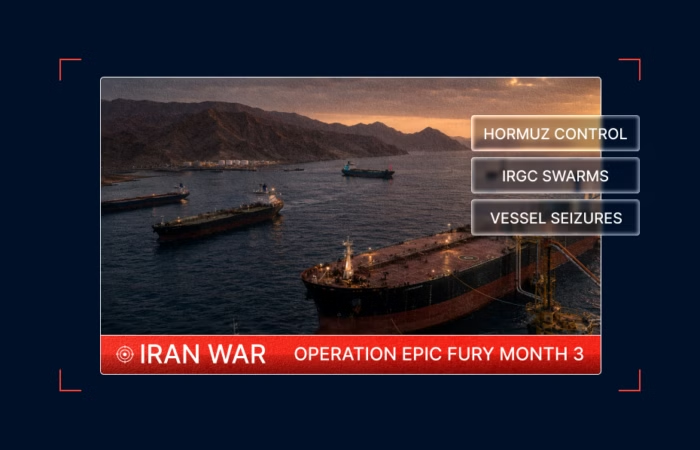
What’s inside?
At a Glance
- As of day 89 of Operation Epic Fury, commercial transit volume has collapsed approximately 94% versus the pre-conflict baseline and has not normalized.
- Iran has shifted from continuous closure to a permission-based regime, with the April 7 ceasefire resetting rhetoric but not the operational picture, and an April 17 “completely open” declaration reversing within 24 hours.
- Over 40 commercial vessels have been hit, fired upon, or seized since February 28, across approximately 42 named ships and five physical seizures.
- IRGC small-craft posture has scaled from a 27–230 baseline in early May to 668 craft on May 12 and 392 unique at sea on May 17, with the swarm geometry shifting from shore-led patrol to active strait-body presence.
- Iran’s crude export apparatus is restructuring eastward, with the Kuh Mubarak SPM lifting approximately 6.9 million barrels in five months, all China-bound, from a terminal that exported zero barrels through November 2025.
- A new sequencing yard at Bandar-e Jask was observed on May 24 with three dark VLCC-class crude tankers at anchor, the operational expression of the Goreh-Jask pipeline backdoor.
- Kharg Island went dark on May 7 after a west-side oil slick incident, broke its 13-day zero-lift gap with a single Panamax on May 20, and saw its first major load since the halt of a Suezmax at the east terminal observed yesterday.
- Iranian floating storage stands at ~39.79 million barrels across 79 tankers, down from ~150 million at the start of the war, with no meaningful Iranian crude reaching Asia in over three weeks.
Operational Overview
Hormuz transits remain at approximately 6% of their pre-conflict baseline, and the residual flow is increasingly Iranian-flagged, dark, or hugging Iranian territorial waters. IRGC small-craft counts have moved decisively off the Iranian shore and into the open strait body, with the swarm now positioned within visual range of every commercial transit lane in the corridor.
Iran’s crude export apparatus is restructuring eastward in parallel. A new Bandar-e Jask sequencing yard appeared for the first time on May 24. Kuh Mubarak loaded its first Aframax and held that vessel on station for six and a half days against a 24–36-hour standard. Kharg restarted cautiously this week after 13 days dark. Together, these observations point to a Gulf of Oman crude export channel that operates independently of the strait. Alongside this physical pivot, Iran has formalized administrative control of the strait through the Persian Gulf Strait Authority (PGSA), a state-administered transit-toll regime that went operationally live on May 18 and extended its claimed zone boundary to the UAE coast south of Fujairah on May 20.
In addition, more than 40 vessel incidents since February 28 have clarified the targeting logic. Facility strikes on the Western diversion architecture close off alternatives to Hormuz, while vessel strikes and seizures inside the strait enforce the permission-based regime.
The pattern that emerges three months into Operation Epic Fury is not de-escalation but restructuring. Iran has shifted from continuous closure to selective permission, replaced shore-led patrol with small-craft strait-body presence, and built a maturing Gulf of Oman crude export channel that bypasses Hormuz entirely. The 7 April ceasefire and the May 23 announcement that an agreement is “largely negotiated” sit on top of an operational picture that has only hardened.
The Campaign in Three Phases
The Hormuz campaign moved through three distinct phases between February 28 and the present.
Phase 1: Closure Shock and the Opening Attack Wave (Feb 28 – Mar 26)
The first was closure shock, running from February 28 through March 26. The opening attack wave came on March 1 with six near-simultaneous vessel strikes, including SKYLIGHT off Khasab, MKD VYOM struck by an IRGC drone boat off Mina Saqr, and HERCULES STAR struck near Ras Al-Khaimah.

STENA IMPERATIVE was hit twice at port in Bahrain on March 2.

By March 9, 100% of detected Hormuz transits were Iranian-flagged for a 24-hour window. By the week ending March 15, crude exports were down 87% versus pre-war, at 2.7 million bpd against the 20.1 million baseline. Carriers began the structural pivot to Salalah and Sohar, and war-risk insurance was withdrawn region-wide. The closure was absolute.
Phase 2: Selective Permission Replaces Total Closure (Mar 27 – Apr 7)
The second was selective permission, running from March 27 through the April 7 ceasefire. Iran ran a permission-based blockade in which friendly-flag vessels hugged Iranian territorial waters while the global fleet stayed frozen.

The pattern that would persist for the rest of the campaign began here. The strait was now controlled rather than closed.
Phase 3: Post-Ceasefire Fragility and the Shift to Seizures (Apr 7 – Present)
The third is post-ceasefire fragility, April 7 through the present. The political ceasefire reset rhetoric but not the operational picture. On April 17, Iran’s foreign minister declared the strait “completely open,” a posture that reversed within 24 hours when IRGC gunboats fired on outbound transits the next day. SANMAR HERALD was attacked despite holding a valid IRGC-issued transit clearance.

The April 22 seizure wave, which saw MSC FRANCESCA, EPAMINONDAS, and EUPHORIA boarded, returned approximately 28 vessels back to anchorage.

CMA CGM SAN ANTONIO was struck by a cruise missile on May 5 while transiting under U.S. Project Freedom escort, prompting suspension of the transit corridor program. The April 22 seizures and the May 14 HUI CHUAN and EDRIS boardings off Fujairah marked the shift from kinetic strikes to physical boarding-and-seizure operations.


Transits have remained at a low, episodic tempo throughout.
Commercial Activity in the Strait
The scale of the disruption is structural. Pre-campaign baseline traffic ran approximately 120 transits per day in both directions with approximately 1,065 AIS-transmitting Arabian Gulf port calls per month. The Operation Epic Fury average across the full 89-day window is approximately 6.9 transits per day, a 94% collapse. The 84% reduction in large vessels physically present in the corridor confirms real disappearance rather than transponder-off masking. Global commercial shipping has not returned, and the ceasefire has not changed that.

The composition of what remains is also unusual. On May 11, nine tankers were observed transiting with six outbound and three inbound, including two AIS dark fleet members, and four dark hulls. On May 14, only three commercial transits were observed. On May 22–23, four AIS outbound and two AIS inbound were recorded alongside one dark inbound 80-meter landing craft consistent with intra-Iran trade. A 31-nautical-mile oil slick trail was observed north of Larak Island during the same window, with two candidate tankers under assessment. The pattern that emerges is not transit traffic but holding-pattern behavior.
The corridor is functioning as an Iran-territorial-waters safe zone rather than a through-route. Iranian-trading vessels are sheltering in Iranian territorial waters and feeding berth windows at Kharg and Bandar Abbas. Persistent stations inside the corridor have become the norm rather than the exception. A Suezmax exemplifies this, as it sat at Larak NE for more than five consecutive days in mid-May. A 280-meter container vessel was also observed with containers stacked only on its starboard side, a configuration consistent with hull protection or escort use for transiting vessels. Multi-day ship-to-ship pairs, including a 230-meter and 250-meter Aframax, were observed in the corridor on May 10–12. These are not vessels passing through, but rather vessels using the strait as protected anchorage.
The flag data confirms who is still transiting. Iran-flagged vessels account for 46.4% of transits since February 28, Comoros 14.8%, Panama 10.2%, India 4.8%, and the Marshall Islands 2.8%. Western-controlled tonnage that would have made up the bulk of pre-campaign traffic is largely absent. The strait is no longer carrying global commerce. It is carrying Iranian-linked tonnage, flags of convenience, and the small bilateral lanes that have been negotiated outside the coalition framework.

The IRGC Posture Has Shifted Off the Iranian Coast
The IRGC small-craft posture is the kinetic protection layer around everything else happening in the strait, and its scaling has been the campaign’s clearest operational shift. The early-May baseline ran between 27 and 230 craft. By May 12, the count had surged to 454 across four operational zones, with the highest concentration of 240 craft in the East box. On May 17, 392 unique craft were observed at sea across five zones, with 369 concentrated in a single offshore polygon approximately 30 nautical miles northeast of Khasab, in open water rather than along the Iranian coast. The campaign peak was 668 craft on May 12, and by May 17, the density was approximately one craft per 1.7 km² across the strait body.
The geometry has shifted as decisively as the count. The North corridor along the Iranian Qeshm and Larak coast was the persistent footprint through April and early May, with 24 to 196 craft prior, and 189 on May 13. The May surge has come from the South wing and the Mid strait, with the swarm moving off the Iranian shore and into the open strait body. This shifts the operational read from “patrol screen along the Iranian coast” to “active strait-body presence,” which is most plausibly positioning to prevent southern corridor transits.
The footprint is also expanding into new geography and new vessel types. A Mid-strait and East zone covering the Bandar-Seerik and Bandar-e Jask shoreline was added to the patrol framework in mid-May. A Khasab anchorage cluster of more than 35 stationary high-speed craft was observed in Omani waters for the first time on May 23, at a volume never previously seen in that area. Two likely IRGC hovercraft were observed for the first time on May 22 in the eastern area between Larak and Qeshm Islands. This extends the IRGC’s mobility profile into shallow-water and amphibious geometries. The May 14 northeast-axis push linked the South wing to Bandar-e Jask via the North corridor, consistent with sequencing escort for the Gulf-of-Oman crude export workaround now maturing east of the strait. The IRGC presence is no longer confined to the strait, as it is positioning to protect Iran’s eastward export channel as well.

The combined coverage places IRGC small-craft within visual range of every commercial transit lane, every chokepoint anchorage, and every Iranian-territorial-waters holding queue across the strait.
Iran’s Crude Exports Pivot East
The most consequential structural development of the three-month window is the eastward restructuring of Iran’s crude export apparatus. The Kharg complex is under severe stress, and Iran is building a parallel channel out of the Gulf of Oman that bypasses Hormuz entirely.
Kharg Island, Iran’s principal export terminal, went dark on May 7 following an oil slick of approximately 80,000 barrels emanating from the western side of the facility. The cause was officially described as unknown, and the operational assessment is facility damage at the western offloading wing. The 13-day zero-lift gap was the longest of the campaign. The halt broke on May 20 with a single dark Panamax at the main T-pier loading berth, marking the first crude tanker at a loading berth in 13 days, and continued cautiously with a Handymax on May 22 and an Aframax on May 23. On May 25, a Suezmax was observed loading at the Kharg east terminal, which is the first major load since May 7. Approximately 27 vessels remained in the offshore anchorage east of Kharg as of May 21, with 18 of those VLCCs, the majority assessed as floating storage rather than active queue.

The eastward channel has matured in parallel. The Kuh Mubarak SPM exported zero barrels through November 2025 and approximately 6.9 million barrels of Iranian Heavy crude across the five months since, every barrel destined for China. Flow built progressively with ~0.9 million barrels in December, ~4.0 million in Q1 2026, and ~2.0 million in April.
On May 18, an Aframax, Guinea-flag, OFAC-sanctioned under EO 13902, made fast to the buoy in the first Aframax-class lift at Kuh Mubarak, with prior cargoes that were almost entirely VLCC+. The Aframax was still at the SPM on May 24, approximately six and a half days on station against the 24–36-hour SPM standard, indicating either materially reduced throughput or quasi-floating-storage use of the loading buoy itself.
A second node became visible on May 24, when three dark VLCC-class crude tankers were observed at anchor and one AIS-correlated Aframax at a new sequencing yard off Bandar-e Jask, approximately 50 nautical miles east of the Hormuz mouth. The yard is sized for larger tonnage than Kuh Mubarak has so far loaded. A third node, the Chabahar holding area, further east on the Gulf of Oman coast, has held continuous occupancy of 10+ days, with 14 tankers observed on May 23, comprised of six VLCCs and eight Suezmax-class, and a May 22 SAR collection showing 15 of 20 anchored vessels dark.
The architecture is the operational expression of the Goreh-Jask pipeline backdoor, which is a 1,000-kilometer line that gives Iran an export outlet entirely outside the Strait of Hormuz. The sanctioned VLCC DORE quietly departed Kooh Mobarak on March 8 with 1.77 million barrels bound for Dalian. The multi-node Gulf-of-Oman buildout since is the broader operationalization of that backdoor.
Iran-origin oil in floating storage now stands at ~39.79 million barrels across 79 tankers per Vortexa data, down from approximately 150 million at the start of the war. Approximately two-thirds of Iranian-trading tankers are constrained in the Gulf of Oman or Arabian Gulf, and the remaining third are either at ports off China or engaged in floating storage off the Riau archipelago in Malaysia’s EEZ. No Iran-trading laden crude tanker has arrived in Asia via the Malacca, Lombok, or Sunda Straits since May 4, cutting off the regime’s primary revenue lifeline, as a single VLCC cargo represents approximately $200 million in revenue at current prices.
Sirri Island Is Strategically Neutralized
Sirri Island’s terminal remains effectively non-operational. EO imagery from May 12 identified six storage tanks and zero tankers at the terminal, with operational capacity assessed at approximately 5–10% of pre-conflict levels. Two tanks are confirmed destroyed, including a large ~1 million barrel tank (T1) with roof collapse, severe burn scarring, and berm contamination, and a small ~300,000 barrel tank (T2) with collapsed roof and blast/heat damage. Three additional tanks are near-empty at ≤15%, with floating roofs resting at the bottom, consistent with either pre-emptive evacuation before the blockade tightened or burn-off during the original fire event. A single small full tank holds product assessed as likely condensate or facility fuel supply, not export-ready material.
Sirri was struck on April 7–8, with explosions reported hours after the U.S.-Iran ceasefire announcement. The cause was initially described as unknown with no immediate claim of responsibility. Satellite imagery from April 10–15 confirmed at least one large tank destroyed and multiple tanks damaged by fire. Vortexa records no departures from the terminal since February 18, a span now exceeding 86 days. No reconstruction activity is visible. Sirri will not contribute to Iranian crude exports without political resolution and a multi-month rebuild.
The Workaround Trades
The crude that does move now follows a four-step route. Vessels load at port, transit Hormuz dark, conduct ship-to-ship transfers off Fujairah or Sohar, then deliver onward to importers. Between April and May 23, Windward tracked 15 ship-to-ship transfers in waters off Fujairah or Oman after nine non-Iranian VLCCs sailed dark to and from ports west of Hormuz to load crude. Fourteen cargoes were loaded at UAE ports, and one at Iraq. Four ship-to-ship transfers occurred in waters off Fujairah after tankers loaded dark at Das Island or Zirku Island, with AIS switched off for one or both vessels involved. Seven additional tankers called at Zirku Island and transited the strait dark before conducting eleven ship-to-ship transfers in waters off Oman, primarily off Muscat, not Sohar as Vortexa data initially categorized.

May 23 EO imagery captured four ship-to-ship pairs at the Fujairah/Sohar anchorage box, with two of the four still on station at the May 24 SAR collection. The two AIS-correlated host pairs expose the geometry. A Malta-flagged VLCC loaded ~2.22 million barrels of Arab Light at Ju’aymah in Saudi Arabia on February 17–20, delivered to Taiwan in March, and on May 24 was conducting a ship-to-ship transfer to a dark VLCC at the Fujairah anchorage, a Hormuz-transit route. A Liberia-flagged Aframax loaded at Yanbu on May 3–5, the Red Sea terminus of the East-West/Petroline pipeline, 5 million bpd from the Arabian Gulf fields. It delivered 1.03 million barrels to Mundra, India, on May 15, and on May 22–24, was conducting a ship-to-ship transfer to a dark Suezmax, a Red Sea pipeline bypass route.

The two semi-dark pairs expose both Saudi export workarounds running in parallel: Hormuz transit and Red Sea pipeline bypass. The six fully dark hulls observed in the same anchorage box are presumed to be variations on the same two routes.
On April 29, ten Iran-trading U.S.-sanctioned tankers were identified spoofing their AIS to appear at anchorage areas off Basrah, Iraq, including four VLCCs, two handysize, three MR tankers, and one LPG. The practice has intensified under the U.S. embargo. Of 38 dark-transiting vessels Windward identified between March 29 and May 7, excluding Iranian-trading ships or those subject to the U.S. blockade, 17 were cargo vessels, and 20 were tankers. The majority of dark transits were stranded ships exiting the Gulf rather than re-entering.
The Targeting Logic
The 40-plus vessel attacks and five physical seizures across the campaign reveal an explicit and selective Iranian targeting logic. The pattern evolved across three operational modes.

Mode 1: Kinetic Strikes
The first mode was kinetic strikes on commercial tonnage during the opening wave and through March, with drone boats, projectiles, USVs, and missiles deployed against tankers, bulk carriers, and container vessels across the Arabian Gulf and Strait of Hormuz approaches. SKYLIGHT, MKD VYOM, HERCULES STAR, and ATHE NOVA were struck on March 1. STENA IMPERATIVE was hit twice at port in Bahrain on March 2. MAYUREE NAREE was fired upon off Qeshm Island on March 10 after the crew ignored IRGC passage warnings, ran aground, and lost three crew. ZEFYROS and SAFESEA VISHNU were set ablaze by IRGC USVs off the Iraq coast on March 11. SONANGOL NAMIBE was struck by an IRGC USV 30 nautical miles southeast of Mubarak Al-Kabeer Port in Kuwait on March 5, 800+ kilometers from the strait, indicating extended-reach USV capability.
Mode 2: Gunboat Engagements
The second mode was gunboat engagements on outbound transits through April, increasingly aimed at vessels with permission to transit. SANMAR HERALD was fired upon by IRGC gunboats on April 18 despite holding a valid IRGC-issued transit clearance. CMA CGM EVERGLADE was damaged by a rocket attack off Oman on the same day. MEIN SCHIFF 4, a cruise ship, was the subject of an IRGC threat to destroy the vessel in the same window. The April 22 seizure wave of MSC FRANCESCA, EPAMINONDAS seized, and EUPHORIA boarded and released, marked the transition to physical seizure as a recurring tactic. On May 5, CMA CGM SAN ANTONIO was struck by a cruise missile while transiting under U.S. Project Freedom escort, leaving eight crew injured, prompting suspension of the transit corridor program and demonstrating that even U.S.-escorted commercial traffic was not exempt.
Mode 3: Physical Boarding and Seizure
The third mode is physical boarding and seizure, dominant from late April through May. OCEAN KOI was seized in the Gulf of Oman on May 8 in a “special operation” framed around the alleged disruption of Iranian oil exports. BARAKAH was hit by two separate drone strikes north of Fujairah on May 7–13 and has remained stationary in the central strait since. HUI CHUAN and EDRIS were boarded off Fujairah on May 14 within the same operational window, eight to twelve hours after Iranian public warnings to the UAE. Five vessels have now been physically seized and diverted to Iranian custody since the campaign began.
The combined assessment is that Iran’s targeting logic has two components running in parallel. Facility strikes on the Western diversion architecture, including Salalah, Duqm, Khor Fakkan, Fujairah, Yanbu, and Ras Laffan, close off alternatives to Hormuz transit. Vessel strikes and seizures inside the strait enforce the permission-based regime. The bunker-fuel system across the region has been broken. The five-node container architecture of Salalah, Sohar, Khor Fakkan, Fujairah, and Jebel Ali is now structurally embedded as the operating norm.
Outlook
Day 89 is the analytical milestone, not just a date. Three months into Operation Epic Fury, the Hormuz operating environment looks structurally different from how it looked on February 28, and the difference is not closure relaxing, but closure restructuring into permission-based control, eastward export bypass, and embedded strait-body IRGC presence.
The April 7 ceasefire and the May 23 announcement that an agreement has been “largely negotiated” sit on top of an operational picture that has hardened. Iranian crude exports are at a fraction of pre-conflict volumes, but Iran has built, and is continuing to build, the channels to keep volumes moving without Hormuz transit at all. The Kuh Mubarak SPM, the Bandar-e Jask sequencing yard, the Chabahar holding area, and the Goreh-Jask pipeline together form an export apparatus that did not exist operationally three months ago. If the announced diplomatic framework materializes and the strait reopens, this architecture remains. If the framework does not materialize, the architecture absorbs an increasing share of Iranian crude flow.
The indicators to watch in the coming cycle are whether the Kharg loading cadence sustains after the May 25 Suezmax restart, whether the Bandar-e Jask sequencing yard accumulates additional VLCC-class tonnage, whether IRGC small-craft posture remains in open strait-body configuration or returns to coastal patrol, and whether the dark ship-to-ship trade off Fujairah and Muscat continues to expand its operator pool. The campaign has not de-escalated. It has restructured. The next phase will determine whether the restructuring becomes permanent.
Explore more

Iranian Retaliation Reaches Damietta: A New Front Opens Beyond the Gulf and the Red Sea
At a Glance Operational Overview The conflict’s geographic footprint has expanded beyond the Gulf and Red Sea into the broader eastern Mediterranean energy corridor. A drone struck ENERGOS WINTER, a U.S.-managed LNG floating storage unit moored at Damietta, Egypt, on the evening of July 29, with fire spreading to GASLOG SALEM alongside. Iranian state television...
Read more

Two Closed Corridors: Hormuz and Bab el-Mandeb Both Effectively Shut to Tanker Traffic
At a Glance Operational Overview Both major Gulf corridors are effectively closed to normal commercial tanker traffic, for different reasons on each side. Hormuz recorded zero tanker crossings on July 27, with all six transits routing through the IRGC-controlled northern corridor. Bab el-Mandeb crossings have fallen 22% since the July 20 Houthi blockade declaration, with...
Read more

The Red Sea Reopens as a Second Front While Saudi Crude Routes Around the Blockade
At a Glance Operational Overview The Red Sea has reopened as a second active front. The Houthis resumed attacks on July 22 following a September 2025 ceasefire, hit a Saudi Aramco refinery at Jizan on July 25, and launched missiles intercepted before reaching Yanbu. Four vessels have been hit or affected across the reporting period....
Read more

Selective Enforcement: Saudi Crude Keeps Moving Under the Houthi Blockade
A Blockade, Declared and Partly Kinetic On July 20, Houthi-aligned forces announced a full naval blockade of Saudi Arabia, framed as retaliation for Saudi strikes on Sanaa airport. The declaration named Saudi, Israeli, and U.S.-linked tonnage as targets. Within days, Houthi channels claimed strikes on two Saudi tankers. One is corroborated: UKMTO logged a projectile...
Read more

Two Days After the Houthi Blockade Announcement, the Red Sea Split in Two
The Houthis declared a naval blockade against Saudi Arabia on July 20, escalating threats across the Red Sea corridor while Iranian forces struck three tankers in the Strait of Hormuz within 48 hours. That ambiguity is doing real work. Within a day, Windward tracked the market splitting into two opposite flows: commercial tonnage pulling back...
Read more