


July 12, 2026
Iran Formally Closes the Strait of Hormuz as the U.S. Launches a Third Round of Strikes


Iran Consolidates Control Over Hormuz Strait as Zombie Ship Transits New Corridor
What’s inside?
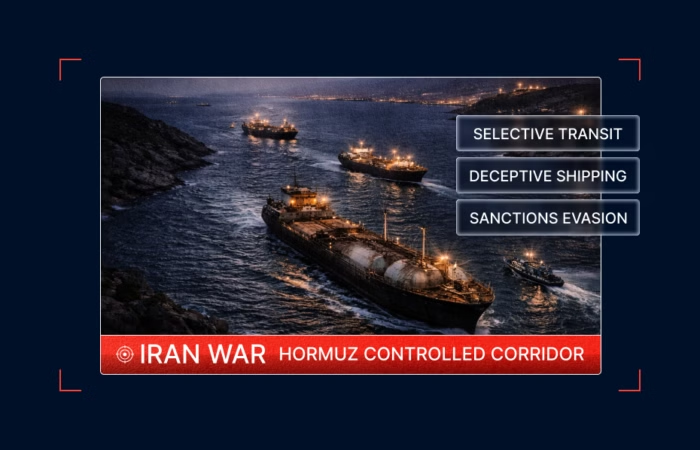
Ships linked to China, India, or those supplying agricultural products to Iran or transporting its energy commodities safely transited the Strait of Hormuz over the past three days via an IRGC-controlled corridor through the Iranian territorial waters.
Among the dozen or so vessels tracked using this newly established route, rather than the standard international navigation channels, was a zombie liquefied natural gas carrier, two liquefied petroleum gas carriers, and a sanctioned tanker supplying the Houthis in the Red Sea.
The transits reinforce Iran’s effective control over the Strait of Hormuz, through which 20% of the world’s oil and gas flows, and which has remained effectively closed for more than three weeks.
Selective Transit Through a Controlled Corridor
Two India-flagged LPG carriers began transiting in convoy on Monday morning, broadcasting that Indian crew were on board. A small containership signaling “all crew China” transited on Sunday afternoon.

Three bulk carriers also moved through the corridor, including one westbound vessel signaling “cargo food for Iran,” indicating that agricultural supply flows into Imam Khomeini port are being maintained under controlled conditions.
Select energy commodities for Pakistan and India, along with crude flows to China and the Houthi-linked destinations in Yemen, are also receiving transit authorization.
Zombie Vessel Transits the Strait
Transits also highlighted the continued use of deceptive shipping practices.
A 26-year-old LNG carrier, identified as a zombie vessel, transited the Strait on March 20 while signalling an unknown destination, before going dark.
Zombie vessels assume the identity of defunct ships. In this case, the IMO number of the LNG carrier corresponds to a vessel listed as “broken up” in the Equasis database.
The vessel’s first signal in the region appeared on March 13 at the Hamriyah anchorage in the UAE, despite records indicating it had been sent to Alang for shipbreaking in October.

Sanctioned and High-Risk Vessels Continue to Move
Sanctioned vessels were also observed transiting through the corridor.
The LPG gas carrier Meda (IMO 8818219), which regularly calls at a Houthi-controlled port, transited on Sunday. Another U.S.-sanctioned tanker, Barbados-flagged, North Star (IMO 9299563), sailed eastbound toward Asia.
North Star’s cargo is currently covered under a temporary U.S. sanctions waiver for Iranian-origin oil already in transit, issued on Friday. The vessel itself was designated less than a month ago.

A Controlled Strait, Not a Closed One
Taken together, these movements point to a clear operating model.
The Strait of Hormuz is not fully closed, but access is tightly controlled. Transit is being granted selectively, based on cargo type, destination, and geopolitical alignment, while high-risk and deceptive actors continue to operate within the same constrained environment.
The result is a managed corridor rather than an open waterway, where movement continues, but only under defined and non-transparent conditions.
Explore more

The Ceasefire Collapses: 80+ Strikes, a Revoked Oil Waiver, and a 1.95-Million-Barrel U-Turn
At a Glance Operational Overview The Strait of Hormuz is once again operating under full conflict conditions. Overnight into July 8, U.S. Central Command struck more than 80 targets inside Iran in direct response to Iranian attacks on three commercial vessels transiting the Strait. Iran retaliated against U.S. military sites in Bahrain and Kuwait, President...
Read more

Hormuz’s NCAGS Corridor Under Attack: Two Laden Tankers Struck Overnight
At a Glance Operational Overview The Strait of Hormuz is functionally contested again. Overnight into July 7, the IRGC struck two laden tankers running dark on the NCAGS-approved outbound route, hitting a Qatari LNG carrier and a Saudi-owned ULCC in a single window. Six vessels rerouted from the southern corridor to the central corridor in...
Read more

Hormuz’s Stalled Recovery: Two Strikes and Suspended Evacuation
At a Glance Operational Overview The Strait of Hormuz is technically open, but it is not functioning as commercial infrastructure. Two kinetic incidents in 72 hours, an IMO evacuation corridor suspended without a resumption date, and total daily transits averaging approximately 13, roughly 90% below pre-war levels, collectively describe a corridor that is open in...
Read more

IRGC Orders Vessels to Turn Back: The Southern Corridor Reversal Stalls the Hormuz Recovery
At a Glance Operational Overview A week of widening commercial confidence in the Strait of Hormuz has run into the first significant test of the post-MoU operating environment. On June 25, the IRGC published a Telegram claim that vessels in the southern corridor had been ordered to turn back, with Windward identifying five vessels exhibiting...
Read more

Hormuz Re-Closure Meets Market Resistance as Traffic Returns
At a Glance Operational Overview The June 18-22 reporting period captures a rapid shift from cautious normalization to renewed uncertainty. Following the June 17 Memorandum of Understanding (MoU) and the formal lifting of the blockade on June 18, commercial shipping responded immediately. Transit volumes rose above 20 crossings per day, Chinese-affiliated and European-owned vessels resumed...
Read more