


October 1, 2026
Vessels Loiter Over Subsea Cables and Pipelines Across Five Theaters


One Month Into the Ceasefire: A Maritime Intelligence Breakdown

What’s inside?
At a Glance
- One month after the ceasefire, maritime visibility across Hormuz remains severely degraded.
- Dark vessel activity surged nearly 600% between April 19 and May 3.
- Satellite imagery identified multiple likely dark commercial transits through Hormuz despite near-zero AIS-visible traffic.
- Kharg Island continued covert VLCC loading operations throughout the reporting period.
- GPS jamming impacted approximately 470 vessels near Fujairah and Khor Fakkan within a 24-hour window.
- U.S. enforcement activity continued after the partial suspension of Project Freedom, which was later paused, including the disabling of the Iran-flagged tanker M/T HASNA.
- Iran-linked routing increasingly shifted toward Lombok and Sunda to avoid visibility around Malacca.
- Commercial operators now face simultaneous military, electronic, and compliance pressure across the Strait.
One Month Later, Hormuz Remains Operationally Unstable
One month after the ceasefire, the Strait of Hormuz remains operationally unstable.
Although Project Freedom was partially suspended following reported diplomatic progress, the maritime environment never returned to normal conditions. Instead, commercial shipping across Hormuz and the Gulf of Oman has continued operating under a combination of military enforcement, GPS jamming, AIS suppression, dark fleet adaptation, and targeted pressure on regional energy infrastructure.
The clearest shift over the past month has been the collapse of maritime visibility. AIS-visible commercial traffic through Hormuz dropped sharply, while satellite imagery increasingly revealed substantial vessel movement continuing under dark conditions. Windward identified large concentrations of non-transmitting vessels near Larak Island, Kharg Island, Bandar Abbas, Fujairah, and the northern Strait corridor, including likely inbound and outbound commercial transits operating entirely without AIS.
At the same time, the security environment became increasingly militarized. Iran-linked attacks on commercial shipping and energy infrastructure in Fujairah, IRGC fast craft deployments, expanding VHF transit warnings, and continued U.S. interdiction activity reinforced that Hormuz remains an active operational pressure zone despite the ceasefire.
The result is a maritime environment where commercial movement continues, but increasingly outside traditional visibility frameworks, forcing operators to balance navigational safety, military risk, sanctions exposure, and commercial continuity simultaneously.
Dark Commercial Transit Through Hormuz Accelerates
Satellite imagery collected on May 7 at 02:22 UTC over the northern corridor of the Strait of Hormuz near Larak Island showed a notable increase in likely commercial traffic operating without AIS transmission.
Windward identified:
- 5 likely outbound dark commercial vessels above 150 meters.
- 4 likely inbound dark commercial vessels above 150 meters.
The outbound group included one VLCC, one large container vessel, and three oil or chemical tankers. The inbound group included two VLCCs, one container vessel, and one bulk carrier.
This is operationally significant because AIS-based transit monitoring over the past several days showed almost no visible commercial movement through the Strait. Windward’s analysis now indicates that transit is continuing, but increasingly under fully dark conditions.
Why Commercial Vessels Are Disappearing From AIS
One possibility is that some vessels are directly linked to Iranian trade networks and are attempting to evade detection under the ongoing U.S. blockade environment.
A second possibility is that some vessels may not be Iran-linked at all, but are suppressing AIS to reduce commercial exposure, avoid scrutiny around potential transit tolls, or conceal cargo routing.
A third possibility is that some operators are disabling AIS for safety reasons as the operating environment becomes increasingly militarized and targeting risks rise.
These categories are becoming increasingly difficult to distinguish using AIS data alone. Windward is continuing to monitor reappearance patterns for vessels that go dark inside the Gulf and later reactivate AIS outside the region after extended blackout periods.
Visibility Across Hormuz Continues to Deteriorate
Maritime visibility across Hormuz and the Gulf of Oman deteriorated sharply throughout the week as AIS suppression and GPS jamming increasingly obscured commercial vessel movement.
Windward observed dark activity increase by approximately 600% between April 19 and May 3, with dark incidents peaking at 671 on May 2 and the seven-day rolling average reaching approximately 470 incidents per day.

At the same time, approximately 470 vessels were impacted by GPS jamming near Fujairah and Khor Fakkan within a 24-hour period.


Satellite imagery increasingly showed a disconnect between AIS-visible traffic and actual vessel presence in the region. On May 5, Windward Multi-Source Intelligence identified 167 commercial-size vessels across the Strait of Hormuz area, including 146 operating dark.


A separate May 6 SAR collection identified 97 vessels near the northern Hormuz corridor, with only 3 transmitting AIS.
Together, the data indicates that commercial vessel activity in and around Hormuz is becoming increasingly disconnected from AIS visibility, requiring satellite-based monitoring to maintain operational awareness.
Large Dark Vessel Clusters Persist Near Larak and Qeshm
EO imagery collected on May 6 at 13:50 UTC identified 77 vessels operating without AIS transmission in the northern Strait of Hormuz corridor near Larak Island. Windward assessed 14 commercial vessels within the collection area, including one crude oil tanker, seven oil or chemical tankers, five general cargo vessels, and one container vessel. Only one vessel, an oil tanker, showed indications of inbound movement, while the remaining commercial vessels appeared stationary. A crude tanker remained stationary west of Larak Island throughout the collection window. The imagery also identified 66 high-speed crafts with no observable formation pattern.
Earlier SAR imagery collected at 05:31 UTC identified 97 vessels in the same broader operating area, including 84 operating without AIS. The scene included five VLCC-class vessels, one Suezmax, seven Aframax-class tankers, five Panamax-class vessels, ten bulk carriers, 22 general cargo vessels, and nine coaster-class vessels concentrated near the northern Hormuz islands. Windward also identified a probable dark ship-to-ship transfer configuration north of Larak Island, where overlapping vessel signatures suggested a VLCC-on-Aframax raft. Despite the large tanker presence, vessel movement throughout the collection area remained limited, with minimal confirmed wake activity observed.

U.S. Enforcement Operations Continue Despite Diplomatic Pause
On May 6, U.S. forces intercepted and disabled the Iran-flagged tanker M/T HASNA after the vessel reportedly ignored multiple warnings while transiting toward an Iranian port.
According to U.S. Central Command, the vessel’s rudder was disabled using 20mm cannon fire from a U.S. Navy F/A-18 launched from USS Abraham Lincoln. The tanker was reportedly unladen at the time of the incident. The action took place under ongoing U.S. blockade enforcement operations and reinforced that, despite the temporary pause of Project Freedom, U.S. enforcement activity against Iran-linked maritime operations remains active.
Commercial Shipping Faces Growing Military Pressure
Windward assesses that the May 4 attack on the South Korea-affiliated container vessel HMM NAMU was likely deliberate. Prior to the incident, the IRGC issued direct VHF warnings to vessel masters operating near Mina Saqr and Ras Al Khaimah, explicitly identifying the anchorage zone where the vessel was positioned. HMM NAMU remained stationary in the area for more than 32 hours following the warning, making it a visible and trackable target.

The timing of the attack is operationally significant. The incident occurred during the same operational window as the drone strike on the VLCC MV BARAKAH (IMO 9902615) and the attacks on Fujairah energy infrastructure, indicating coordinated pressure against allied shipping and UAE-linked energy assets rather than isolated incidents. The attack also coincided with Iran’s expanded self-declared maritime control zone covering Umm Al Quwain, suggesting increasingly assertive enforcement activity across the southern Gulf approaches.
Separately, a bulk carrier anchored near the Ras Al Khaimah and Mina Saqr corridor caught fire on May 4, approximately 14 nautical miles west of Mina Saqr. Windward identified a likely Panama-flagged bulk carrier candidate whose AIS transmission stopped approximately 2.5 hours before the fire was reported and roughly 15–16 nautical miles from the incident location.

The vessel had remained anchored inside the IRGC warning zone since April 27. The AIS loss prior to the incident is consistent with either a casualty event affecting onboard systems or deliberate transmission loss during the operational event.
The incidents reinforce the growing operational challenge for commercial shipping in the region, where vessel exposure increasingly appears linked to location, visibility, and geopolitical signaling rather than sanctions status alone.
Fujairah Export Activity Remains Severely Disrupted
Following the May 4 and 5 attacks on the UAE’s primary oil export terminal on the Gulf of Oman, wet cargo departures from Fujairah fell from typical levels of approximately 3.5–4 million barrels per day to roughly 500,000 barrels by May 5. By May 6, UAE crude exports remained significantly below seasonal norms at approximately 1.35 million barrels per day, compared to a 10-year seasonal average of 3.25 million barrels per day.

The Fujairah strike occurred during the same operational window as the drone strike on the ADNOC-operated VLCC MV BARAKAH while transiting Hormuz in ballast. Together, the incidents indicate coordinated pressure on the UAE’s energy export chain rather than isolated attacks.
At the same time, more than 100 vessels accumulated in congested anchorage conditions near Fujairah, while only approximately 10 vessels remained AIS-visible in some anchorage areas by May 6. Windward observed severe AIS degradation, intensified GPS jamming, reduced loading activity, and disrupted export cycles across the broader Fujairah operating area.

Satellite imagery also showed reduced tanker movement at key loading berths and shifting SPM utilization patterns following the attacks. The combination of infrastructure disruption, electronic interference, and anchorage congestion significantly degraded both navigational visibility and commercial operations near Fujairah.
IRGC Fast Craft Activity Expands Near Commercial Corridors
Imagery collected on May 6 identified a formation of 39 IRGC fast craft moving westward through the eastern Strait of Hormuz corridor at estimated speeds of 18–25 knots. The group was assessed as operating from the Iranian coastline near Seerik toward the southern commercial corridor of the Strait.

The concentration and coordinated movement of fast craft in the eastern corridor increases operational pressure on commercial shipping during a period of already degraded maritime visibility.
Kharg Island Maintains Covert Loading Operations
Kharg Island remained operational throughout the week under sustained concealment conditions, with no AIS-correlated tanker activity observed during the reporting period. Windward identified continued dark VLCC loading cycles, offshore tanker queuing, and sustained tanker staging despite ongoing blockade pressure.
Satellite imagery from May 1 had identified 23 dark vessels in the eastern waiting area, including 12 VLCC-class hulls, representing the highest tanker concentration observed during the reporting window.

By May 3, imagery identified 20 dark tankers operating near Kharg Island, including six VLCCs and two Suezmax vessels, confirming that the offshore export queue remained active.

On May 5, imagery identified four vessels, two VLCCs at berth alongside additional Aframax and Panamax vessels, operating in holding patterns near the island.

One VLCC remained at the eastern T-jetty for more than 24 hours while another newly arrived at the western Sea Island Terminal, indicating that crude loading operations continued throughout the week despite heightened enforcement and degraded regional visibility.
Windward also identified the sanctioned VLCC MT VIRGO loading at Kharg Island’s eastern terminal. The vessel, operating under a fraudulent Botswana flag, has remained dark since April 23 and previously conducted Kharg-to-Asia ship-to-ship transfer activity near Singapore and Riau. It should be treated as a potential blockade breaker.
Iran-Linked Tankers Shift Toward Lower-Visibility Routes
Windward identified continued routing adjustments by Iran-linked tankers as vessels increasingly avoided the more visible Strait of Malacca in favor of Indonesia’s Lombok and Sunda Straits.
On May 3, the Iran-flagged VLCC HUGE (IMO 9357183) reappeared near Lombok broadcasting AIS for the first time since March 20 while signaling laden status, before disabling AIS again within 24 hours. A second Iran-flagged VLCC, DERYA (IMO 9569700), arrived in the same area on May 4 following a port call at Sikka between April 15–19.

These were the first Iranian tankers tracked arriving in Asia since April 24 and the first confirmed use of the Lombok routing since the conflict began. Earlier, between March 5 and April 18, Windward identified three VLCCs and one Suezmax transiting via the Sunda Strait under similar reduced-visibility patterns.
Windward also tracked an additional LPG tanker transiting the Sunda Strait after likely spoofing its location to conceal loading activity near Iran following the April 13 blockade. The vessel later transited Hormuz on April 17-18 under reduced visibility conditions while signaling China as its destination.
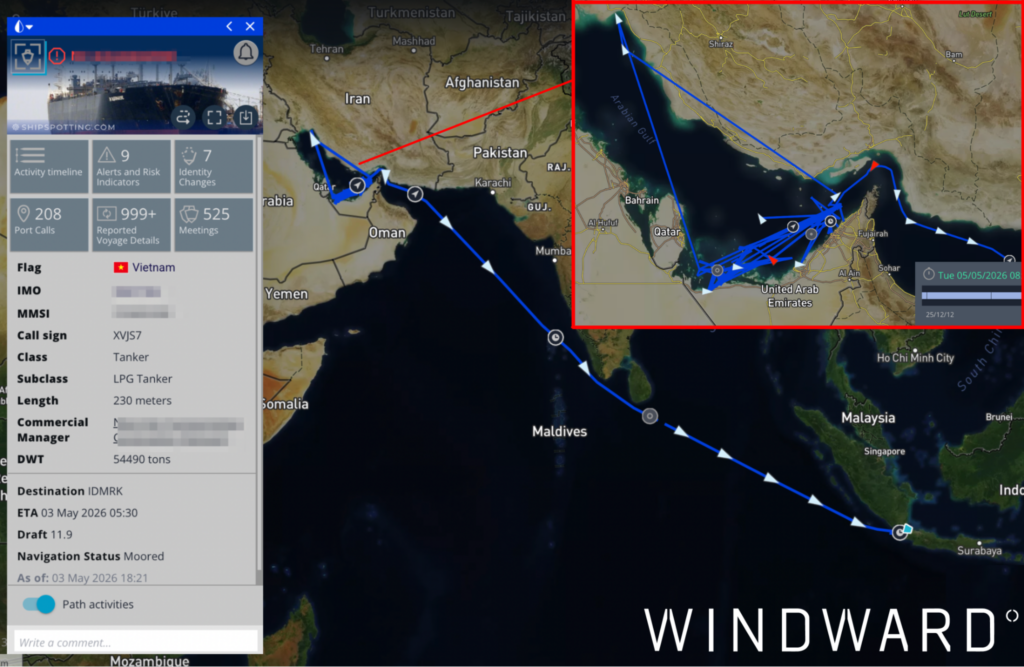
The routing shift indicates increasing operational adaptation by Iran-linked maritime networks seeking to reduce exposure to AIS monitoring, sanctions scrutiny, and visibility pressure around traditional Asian transit corridors.
Outlook
One month after the ceasefire, the Strait of Hormuz remains defined by degraded visibility, constrained commercial movement, and persistent military pressure rather than normalization.
AIS suppression, GPS jamming, and dark vessel operations continue to limit reliable maritime awareness across key corridors. At the same time, commercial shipping behavior is adapting. Operators increasingly appear willing to transit under reduced visibility conditions, while Iran-linked networks continue relying on covert loading, ship-to-ship transfers, alternative Asian routing, and extended AIS blackouts.
Although Project Freedom has been partially suspended, enforcement activity against Iran-linked maritime operations remains active, reinforcing that the operational environment has not materially stabilized.
The growing disconnect between AIS-visible traffic and satellite-detected vessel movement suggests that Hormuz is entering a longer-term phase where commercial shipping continues to operate, but increasingly outside traditional monitoring frameworks.
Satellite-based monitoring and multi-source intelligence are now becoming critical operational requirements rather than supplemental visibility tools.
Explore more

Is Iran Losing Its Grip on Strait of Hormuz Traffic?
Iran has demanded that all Strait of Hormuz transits use the northern corridor through its territorial waters. Rising volumes of Saudi, Iraqi, and Kuwaiti crude, along with UAE volumes that cannot reach Fujairah by pipeline, are instead moving through the southern corridor, which remains under USCENTCOM air defense and naval support. Windward MIOC assesses that...
Read more

77 Ships Blacklisted, None Deterred: Inside Iran’s Failing Hormuz Toll Regime
At a Glance Operational Overview Iran’s Persian Gulf Strait Authority opened in mid-May to oversee transits and toll payments through the Strait of Hormuz. It has since released three tranches of blacklisted vessel names, on August 24, September 2, and September 14. Windward analysis of all 77 vessels finds that every one used the “unauthorized”...
Read more

The Houthis Take Perim and Petroline Is Hit as Freight Rates Cross $1 Million a Day
At a Glance Operational Overview Saudi Arabia’s workaround to the partial closure of the Strait of Hormuz came under direct attack last week. Saudi Arabia diverted crude to the Red Sea port of Yanbu via the East-West pipeline. On September 10, a pumping station on the pipeline was attacked and preemptively shut down. On the...
Read more

A Fatal Strike and the First Seizure Since June as Iran’s Transit Rules Take Effect
At a Glance A Chief Engineer Killed Aboard a Bulk Carrier Exiting Hormuz MINOAN DIGNITY (IMO 9294484), a Liberia-flagged bulk carrier of 225 meters and 76,801 DWT, was struck by an unknown projectile in its engine room while transiting outbound through the Strait of Hormuz southern corridor overnight on August 17 to 18. The vessel’s...
Read more

A Second ADNOC Strike in a Week as Koh-e-Mubarak Hardens Into an Evasion Hub
At a Glance Two ADNOC Tankers Strcuk by Iranian UAVs The UAE Ministry of Foreign Affairs condemned what it described as a hostile Iranian attack on two ADNOC-affiliated vessels struck by UAVs while transiting the Strait of Hormuz on August 14, with no injuries reported. The UAE called it a violation of UN Security Council...
Read more