


October 26, 2026
Shadow Fleet Interdiction Starts With Flag Verification


REPORTS
Counter Narcotics Intelligence Report June 2026
What’s inside?
Executive Overview
Narcotics trafficking at sea rarely announces itself through one definitive act. Smugglers exploit routine commercial traffic, switch identities, suppress AIS, enter unfamiliar corridors and transfer cargo to smaller craft near shore.
In June, dark activity affected nearly one-third of the monitored population in this report, but only 10.4% of those vessels were rated Smuggling / Border Security High Risk by Windward. By contrast, every vessel detected manipulating its identity or location was High Risk. For counter-narcotics teams, the distinction is critical: broad concealment behavior creates leads, while identity and location tampering should trigger immediate prioritization.
June’s data shows how maritime narcotics trafficking is embedded inside legitimate shipping rather than confined to a single vessel class or route. The strongest leads emerge when repeated evasion, identity instability, first-time visits and near-shore transfer behavior intersect.

Identifying Key Behavioral Indicators for Narcotics Interdiction
Not all behavioral anomalies carry the same weight. This table separates routine maritime noise from high-conviction indicators, allowing teams to triage vessels based on their objective risk profile.
| INDICATOR | VESSELS | HIGH-RISK SHARE | ASSESSMENT |
| Base Population | 3,462 | 15.2% | Reference rate |
| ID / Location Tampering | 27 | 100% | Immediate priority |
| MMSI Changes | 140 | 17% | Context-dependent |
| Dark Activity | 1,140 | 10.4% | Broad screening signal |
| First-Time Visits | 185 | 10.3% | Leading indicator |
Narcotics Exposure Is Distributed Across the Commercial Fleet
The June population tracked by Windward comprised 3,462 vessels assessed as carrying Moderate or High Smuggling Risk: 2,936 Moderate and 526 High.
General cargo ships and bulk carriers dominate the mix, but the wider population also includes tugs, supply vessels, fishing vessels, yachts and livestock carriers. This diversity reflects the trafficking model. Narcotics can be concealed inside legitimate cargo, carried aboard smaller commercial vessels, transferred offshore or moved ashore by daughter craft. Counter-narcotics screening therefore cannot be confined to one fleet segment.

Flags Recurring Across Trafficking Indicators
For narcotics investigations, the most useful flag signal is not prominence in one chart but recurrence across different concealment and routing behaviors. Comoros is the clearest example: it is prominent in dark activity, MMSI changes and first-time visits, and also appears in the identity-tampering population. Saint Kitts and Nevis and Panama show a similar, though less consistent, cross-indicator presence. These patterns do not prove trafficking, but they can sharpen prioritization when paired with route, ownership and behavioral evidence.
AIS Silence Is a Common Smuggling Tactic, But Not Proof of Trafficking
A total of 1,140 vessels went dark during June, generating 2,499 events. That is 32.9% of the monitored population. AIS silence can conceal offshore loading, rendezvous activity, route deviations or near-shore handoffs used in narcotics trafficking. Yet its scale also makes it a noisy standalone signal: only 118 of the vessels involved, or 10.4%, were High Risk. Its value lies in identifying where concealment coincides with trafficking corridors, repeated behavior or other identity anomalies.
Duration Profile
| DARK PERIOD | SHARE OF EVENTS | INTERPRETATION |
| < 12 hours | 9.8% | Short interruption; requires context. |
| 12-14 hours | 27.5% | Largest single duration band. |
| 1-2 days | 17.4% | Operationally significant concealment. |
| 2-7 days | 23.5% | Extended loss of visibility. |
| 1-4 weeks | 17% | Sustained concealment. |
| > 1 month | 5% | Persistent disappearance from AIS. |
Bulk carriers accounted for 15 of the 27 vessels, or 56%. Panama represented 11 vessels, equivalent to 41% of the population. The longest manipulation episode lasted 2,078.5 hours, approximately 86.6 days, indicating that the behavior can be sustained rather than momentary.
MMSI Changes: Identity Disruption That Matters When Paired With Trafficking Context
MMSI changes were more common: 190 events across 140 vessels, equal to 4% of the tracked population. Twenty-four vessels were High Risk, a 17% share that sits only modestly above the 15% baseline. On its own, an MMSI change does not strongly distinguish narcotics trafficking from legitimate re-registration. Paired with a flag change, dark activity, suspicious ownership or entry into a known cocaine corridor, however, it can indicate an attempt to sever the vessel’s current movement from its prior record.
| REGION | EVENTS | VESSELS | WHAT STANDS OUT |
| East & Southeast Asia | 86 | 66 | Largest volume; driven by China. |
| Middle East / Arabian Gulf | 39 | 21 | 48.7% High Risk. |
| Red Sea / Horn of Africa | 7 | 3 | 85.7% High Risk; very small sample. |
| Black Sea / Ukraine | 3 | N/A | Nearly absent, unlike dark activity. |
First-Time Atlantic Crossings Align with the Cocaine Supply Chain
First-time corridor visits involved 185 vessels and 261 events. The behavior is not intrinsically suspicious: only 19 vessels, or 10%, were High Risk. Its counter-narcotics value comes from route alignment and novelty: vessels with no prior recorded history entering maritime lanes used to move cocaine from South America toward West Africa and Europe.

Together, the North and South Atlantic accounted for 94% of all first-time visit events. More strikingly, 74 of the 185 vessels entered both corridors during the same window. That pattern is consistent with a complete first recorded transatlantic crossing along the principal South America-Europe / West Africa cocaine route. It does not establish that the vessels carried narcotics, but it identifies a tightly defined population for enhanced screening, ownership review and voyage reconstruction.
Fleet Composition Points Beyond Conventional Ocean Carriers
General cargo ships led the population, followed by bulk carriers and tugs. Offshore and support types — including tugs, supply vessels, anchor handlers, landing craft and crew boats — represented roughly 30% of the vessels, a higher share than in the other behavioral categories. Their prominence widens the investigative lens beyond deep-sea cargo ships.
Comoros accounted for 57 vessels, or 30.8%, the highest concentration of the flag in any behavioral category. Panama followed with 41 vessels and Saint Kitts and Nevis with 22Mother-Daughter Matching Targets At-Sea Narcotics Drop-Offs
At-sea drug drop-off analysis targets a well-established trafficking method: an ocean-going mother vessel transports narcotics across the main route, then transfers the consignment to a smaller daughter craft for covert delivery near shore. The analysis cross-references mother-vessel transits with small craft that go dark close to the coast. The June focus area covered the Eastbourne-area chokepoint associated with the recent NEW HORIZON interception.

The strongest convergence placed a mother and daughter candidate 2.7 km apart, separated by only 4.4 hours — the type of tight space-time overlap that can expose an at-sea narcotics handoff. A second case identified a small craft that remained dark for about 24 hours, with six mother-vessel candidates passing within 9-19 km during the preceding 13-28 hours. These are investigative leads rather than confirmed transfers, but they narrow thousands of movements into a small set of reviewable encounters.
Risk Scores Play Different Roles Across the Two Populations
Among 433 mother-vessel candidates, 4.4% were Moderate or High Risk. Elevated-risk shares varied by flag, with Antigua and Barbuda, the Marshall Islands, Panama and Cyprus warranting greater scrutiny. The 2,804 daughter-vessel candidates were almost entirely Low risk, meaning the flag was not predictive; the smuggling-risk score itself was the only meaningful signal, and it was rare.
Port Spotlight — Guayaquil: Legitimate Export Scale Creates Concealment Opportunity
Guayaquil is Ecuador’s largest port and primary maritime export hub, and a recurrent departure point in the cocaine supply chain. It sits downstream of major Colombian and Peruvian coca-producing regions, while high container and reefer throughput — particularly banana and commodity exports — provides traffickers with volume, routing diversity and natural cover for concealment inside legitimate trade.

The port profile is a baseline, not an allegation against the 124 vessels that called at Guayaquil in June. Container vessels were the largest subclass with 54 calls, followed by bulk carriers with 28; reefers accounted for 10 vessels. These are precisely the trade flows in which cocaine is frequently concealed, but port presence alone is not discriminating. The intelligence task is to identify which calls combine unusual routing, ownership risk, identity changes, dark activity or anomalous cargo behavior.
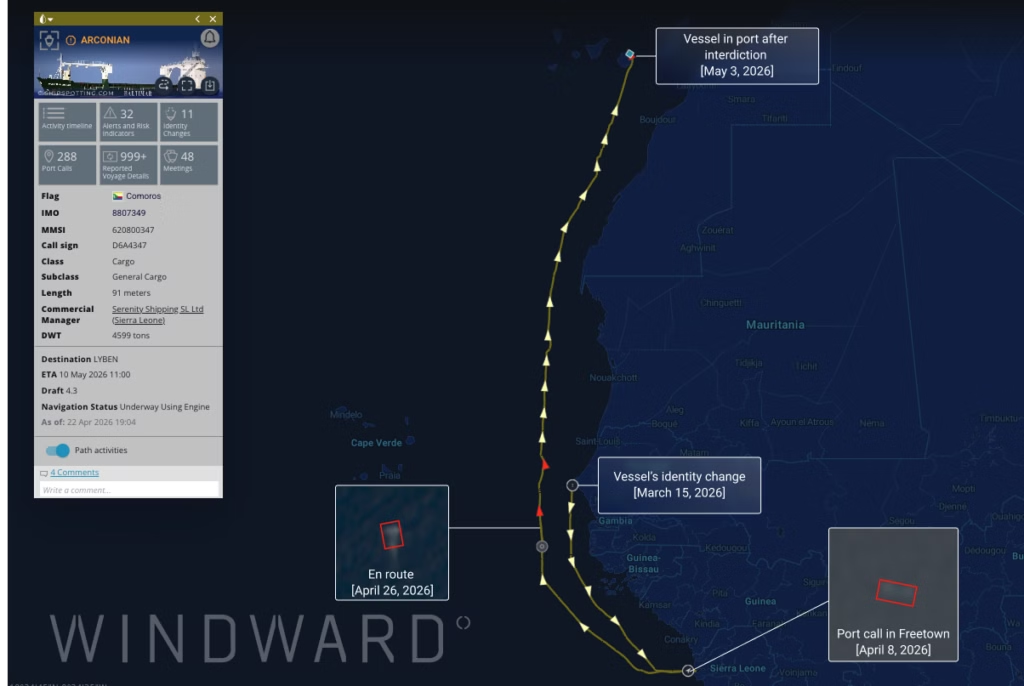
Case Study — The ARCONIAN: How a Cocaine Seizure Emerges from Converging Signals
The ARCONIAN case shows how a maritime narcotics investigation can develop before interdiction. A recent identity change, West African port activity, declared routing and external imagery combined around a vessel already assessed as carrying elevated smuggling risk. The vessel is named here because the cocaine seizure is already a matter of public record.

What the Case Demonstrates
The sequence did not depend on one definitive clue or a single ‘drug vessel’ signature. It combined a recent identity and flag change, a West African port call, declared routing, EO confirmation and a risk profile elevated months earlier. The subsequent seizure of 30-45 tons of cocaine demonstrates the practical value of multi-source maritime intelligence: it connects individually ambiguous maritime behaviors into a coherent trafficking hypothesis that law enforcement can test and act upon.
Where Narcotics Smuggling Risk Concentrates
Taken together, the June data shows that narcotics smuggling risk is rarely defined by a single vessel behavior. Dark activity is widespread, first-time corridor entry is often benign, and identity changes can reflect legitimate operational shifts. The strongest intelligence emerges when these signals converge: a vessel with an elevated risk profile enters a known trafficking corridor, suppresses or manipulates its position, changes identity, or approaches smaller craft near a likely transfer point. That convergence is where maritime data becomes operationally useful, helping authorities narrow large vessel populations into a smaller set of cases that warrant investigation, surveillance, or interdiction.
Methodology and Interpretation
This report summarizes a monthly monitoring universe of 3,462 vessels assessed as carrying Moderate or High Risk of involvement in maritime narcotics smuggling. The base query underlying this universe is already built to reflect the known characteristics of drug smuggling vessels, based on years of counter-narcotics research and domain expertise: tankers and passenger vessels are excluded, as they are not commonly associated with this activity, and the query is limited to vessels sailing under flags of convenience or fraudulent flags, built before 2016, and under 200 meters. The assessment does not mean that every vessel is carrying drugs; it defines the population requiring enhanced counter-narcotics scrutiny based on behavioral, identity, ownership and routing signals. Unless otherwise stated, percentages use that population as the denominator. Activity categories overlap, and a vessel may appear in more than one indicator. Aggregate sections do not identify vessels by name or IMO. The ARCONIAN case study and the NEW HORIZON reference are the exceptions because both concern publicly reported interdictions.
The indicators are designed to support counter-narcotics triage, not automatically attribute criminal conduct. Dark activity, MMSI changes and first-time visits can have legitimate explanations. Their value rises when they align with known cocaine routes, suspicious port sequences, ownership anomalies, repeated concealment or mother-daughter proximity. ID/location tampering carries greater weight because every vessel in the June population was already rated High narcotics-smuggling risk.
Data and analysis compiled by Manuel M.B. Assis Teixeira, Windward MIOC Maritime Intelligence Analyst and Noam Rabinovich, Director of Product Marketing, Windward
Disrupt Narcotics Smuggling at the Source