
MIOC INTELLIGENCE

Belgium’s Seizure of Sanctioned Tanker Ethera

What’s inside?

    MIOC Logo

    This analysis was produced by Windward’s Maritime Intelligence Operations Center (MIOC) — a mission-critical operations center powered by Windward’s maritime intelligence experts, operating as a seamless extension of your team. This is a sample of what we deliver. For intelligence tailored to your operational theater, visit the MIOC page.


    On 1 March 2026, Belgian special forces, supported by French naval helicopters, boarded and seized the oil tanker M/T Ethera (IMO 9387279) in the North Sea near Ostend. The vessel, assessed as part of Russia’s shadow fleet, was operating under a fraudulent Guinean flag and was declared effectively stateless during inspection. It was subsequently escorted under armed guard to Zeebrugge under EU sanctions enforcement authorities.

    Windward assesses Ethera as a sanctioned, high-smuggling-risk tanker embedded within both Russian and Iranian sanctions networks. This operation marks a shift from designation to direct interdiction, signaling that shadow fleet vessels operating in European waters now face credible kinetic enforcement.

    What Happened

    On 1 March 2026, Belgian elite forces conducted the country’s first-ever military boarding operation at sea, targeting M/T Ethera within Belgium’s EEZ

    Upon inspection:

    • The vessel was found to be sailing under a fraudulent Guinean flag.
    • Registry documentation discrepancies allowed authorities to treat the vessel as stateless.
    • The ship was already designated under the EU, U.S. (OFAC EO13902 – Iran), and UK sanctions regimes.
    • It was escorted to Zeebrugge for seizure under the EU Regulation 833/2014 enforcement authority.

    Windward had flagged Ethera as high risk for smuggling activity since August 2025, due to its persistent suspicious behavior. Over the preceding 12 months, the vessel recorded seven dark activity periods, totaling approximately 141 hours, primarily concentrated around approaches to and departures from Russian crude export terminals. It also conducted more than 40 documented ship-to-ship (STS) meetings with Russian-linked tankers and made repeated port calls at Primorsk, Ust-Luga, Novorossiysk, Vysotsk, and St. Petersburg, embedding it firmly within Russia’s core crude export network.

    The Ethera’s compliance and border security risk assessments. Source: Windward Maritime AI™ Platform.
    The Ethera’s compliance and border security risk assessments. Source: Windward Maritime AI™ Platform.

    Ethera’s registered owner is a Marshall Islands single-purpose vehicle (SPV) consistent with opaque beneficial ownership patterns. The vessel’s ownership and management structure reflects a typical shadow fleet configuration, and an additional layer of risk is evident. Its commercial manager and operator is Zulu Ships Management, a UAE-based company designated by the U.S. Office of Foreign Assets Control (OFAC) on 31 July 2025 under Executive Order 13902 for Iran-related sanctions activity. 

    The vessel is further linked to a commercial tanker network associated with Mohammad Hossein Shamkhani, the son of senior Iranian political figure Ali Shamkhani, who until recently served as chief political advisor to Iran’s Supreme Leader Ayatollah Ali Khamenei and was reportedly killed in the recent bombings.

    This interdiction occurred within the broader operational environment of Operation Epic Fury, where maritime enforcement posture has already escalated, and sanctions designations are increasingly translating into direct, at-sea interdictions.
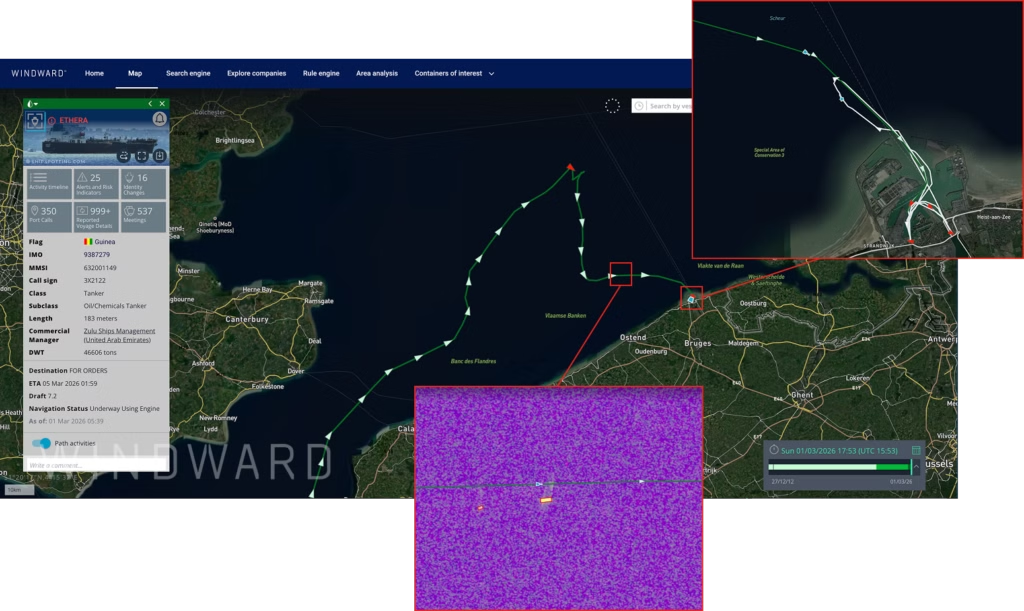
    The Ethera was captured via SAR image on March 1, 2026, at 6:06 am UTC. It is being tailed by a non-transmitting vessel, possibly a military escort. The Ethera is then seen being escorted to Zeebrugge Port by a Belgian military vessel. Source: Windward Maritime AI™ Platform.
    The Ethera was captured via SAR image on March 1, 2026, at 6:06 am UTC. It is being tailed by a non-transmitting vessel, possibly a military escort. The Ethera is then seen being escorted to Zeebrugge Port by a Belgian military vessel. Source: Windward Maritime AI™ Platform.

    What It Signals

    1. Sanctions enforcement has entered a kinetic phase in European waters. Belgium’s action operationalizes prior North Sea and Baltic warnings that high-risk, multi-flag vessels may be treated as stateless and detained. Designation is no longer symbolic and may now result in military boarding.
    2. False flag and stateless doctrine is becoming an enforcement tool. The fraudulent Guinean registry provided a legal pathway for interdiction under maritime law. Expect expanded scrutiny of registry authenticity for shadow fleet vessels transiting EU EEZs.
    3. Convergence of Russian and Iranian sanctions networks. The Ethera’s linkage to Russian crude export nodes, an OFAC-designated UAE management company, and the broader Shamkhani-linked tanker ecosystem demonstrates increasing operational overlap between Russian oil export logistics and Iranian sanctions evasion architecture.
    4. Strategic escalation context. The reported killing of Ali Shamkhani adds geopolitical sensitivity to enforcement actions against vessels tied to his son’s commercial network. The timing of this interdiction aligns with broader geopolitical and enforcement developments underway. 

    What to Monitor

    In the wake of the Ethera interdiction, immediate reaction patterns may emerge across the shadow fleet ecosystem. Shamkhani-linked or Zulu-managed vessels could respond with dark activity, rapid reflagging, MMSI changes, or accelerated transfers into newly formed SPVs in jurisdictions such as the Marshall Islands, Hong Kong, or mainland China to dilute sanctions exposure.

    Regionally, this action may foreshadow expanded enforcement in the North Sea and Baltic, including additional boardings of sanctioned vessels operating under weak flags, greater G7/Nordic coordination, and stricter registry verification at EU ports.

    Within the Iranian-linked tanker network, vessels may shift away from European waters toward alternative discharge markets, with increased ship-to-ship clustering outside EU EEZs. In the broader context of Operation Epic Fury, hybrid responses such as AIS manipulation or GPS interference, intensified legal pushback narratives, and widening insurance or P&I withdrawals could further reshape the operating environment for high-risk tankers.

    The seizure of M/T Ethera is not an isolated enforcement action. It is a demonstrative proof-of-concept: intelligence-driven vessel risk profiling can now translate directly into military interdiction inside European waters. For sanctioned shadow fleets, particularly those bridging Russian and Iranian export networks, the operating environment has materially changed.


    Mission-Ready Intelligence, at Your Service

    Detecting patterns like these requires more than static monitoring. Windward’s MIOC integrates multi-sensor intelligence with Agentic AI to detect, collect, and analyze threats in real time.

    To discuss ongoing intelligence coverage or ad-hoc forensic deep dives tailored to your operational theater, get in touch below.