


January 22, 2026
False Flags and Fraudulent Registries: The Hidden Threat to Global Shipping


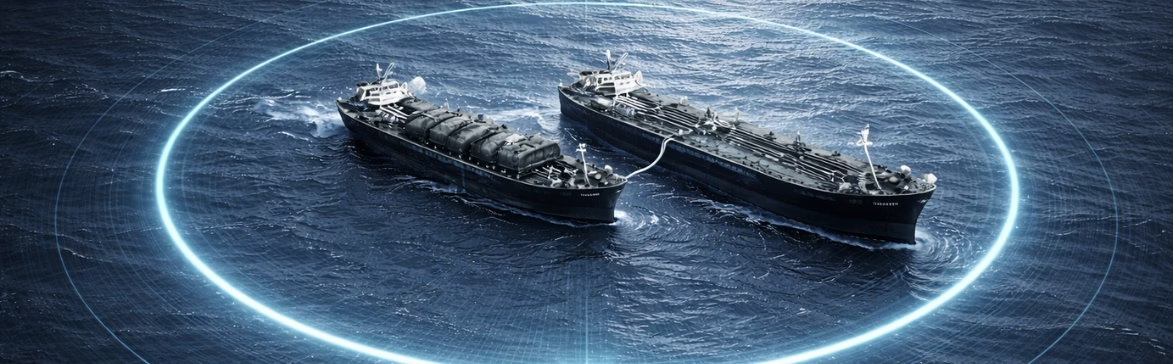
VBSS (Visit, Board, Search, and Seizure)
What Is VBSS?
VBSS (Visit, Board, Search, and Seizure) refers to a set of maritime enforcement operations conducted by naval and coast guard forces to board vessels at sea, inspect cargo and documentation, and seize vessels or goods when legal thresholds are met. VBSS is a core tactical mechanism used in sanctions enforcement, counter-smuggling, counter-proliferation, and broader maritime security operations.
VBSS operations are not routine inspections. They are intelligence-led interventions, typically executed when authorities assess that a vessel may be involved in illicit activity such as sanctions evasion, arms trafficking, drug smuggling, or violations of international maritime law. In practice, VBSS sits at the point where maritime intelligence becomes physical enforcement.
Key Takeaways
- VBSS (Visit, Board, Search, and Seizure) is a maritime enforcement operation in which naval or coast guard forces board a vessel to inspect cargo, documentation, and crew, and seize assets when legal thresholds are met.
- VBSS is a tactical enforcement practice that translates maritime intelligence into physical action at sea.
- VBSS is authorized under specific legal conditions and is most commonly used for sanctions enforcement, counter-smuggling, and maritime security missions.
- Targeting decisions for VBSS are intelligence-led, relying on behavioral risk, identity indicators, and multi-source validation rather than AIS data alone.
- For commercial operators, VBSS represents a high-impact operational risk, potentially resulting in delays, detention, or seizure even when compliance is assumed.
- Modern VBSS operations depend on fused intelligence and real-time risk assessment to ensure actions are proportionate, defensible, and effective.
VBSS in Sanctions Enforcement and Maritime Security
For governments and maritime enforcement authorities, VBSS is the point where intelligence becomes lawful action. It is the mechanism used to translate risk assessments, sanctions analysis, and surveillance findings into controlled intervention at sea.
VBSS operations are typically authorized when corroborated intelligence suggests a vessel may be carrying sanctioned cargo, engaging in smuggling, operating under false documentation, or supporting illicit or hostile networks. Because boarding a vessel carries legal, diplomatic, and escalation risks, authorities rely on multi-source intelligence to justify action.
In a high-profile example, U.S. forces executed coordinated VBSS operations on two sanctioned tankers, the Russian-flagged Bella 1 (renamed Marinera) in the North Atlantic and the Sophia in the Caribbean Sea. The Marinera was pursued across thousands of nautical miles after evading an interception near Venezuela and ultimately seized through joint naval and airborne support from U.S. and allied forces, including the U.S. Coast Guard, Navy special forces, and partnering maritime patrol assets. A second vessel, the Sophia, was also boarded and seized off the coast of Venezuela. These operations were conducted in support of broader maritime interdiction efforts linked to sanctions enforcement around Venezuelan oil shipping.

What is VBSS, and when is it authorized under maritime law?
VBSS refers to Visit, Board, Search, and Seizure operations conducted by authorized naval or coast guard forces. It is permitted under international law when there is legal authority based on flag-state consent, sanctions regimes, counter-smuggling mandates, or the right of visit under UNCLOS in specific, narrowly defined circumstances.
How do naval forces decide which vessels to target for VBSS operations?
Targeting decisions are intelligence-led. Authorities assess behavioral anomalies, sanctions exposure, ownership and registry risk, cargo indicators, and corroborating sensor data to determine whether a vessel meets the threshold for boarding.
What intelligence is used to support VBSS decision-making before boarding?
VBSS decisions rely on a fusion of AIS and voyage data, behavioral analytics, ownership and sanctions intelligence, Remote Sensing Intelligence, and network analysis linking vessels to known illicit actors or patterns.
VBSS and Commercial Shipping Risk
For commercial organizations, VBSS presents a comprehensive operational risk beyond isolated compliance flags. In addition to direct sanctions enforcement actions, boarding and inspection can occur due to:
- Complex ownership structures that are later linked to high-risk entities.
- Cargo declarations that diverge from manifest or sanction authorities’ expectations.
- Behavioral risk signals such as evasive routing, repeated AIS shutdowns, or identity changes.
- Rapid regulatory shifts that expand interdiction authorities in a given region.
This means firms must go beyond point-in-time screening and maintain continuous, real-time monitoring of vessel status, identity changes, and risk indicators throughout a voyage to avoid surprise VBSS actions, detention, or reputational exposure.
Why might a commercial vessel be subject to a VBSS operation?
For commercial operators, VBSS represents a high-impact operational risk, even when a company believes it is compliant. Vessels may be boarded due to suspected sanctions exposure, cargo discrepancies, prior associations, or intelligence linking them indirectly to higher-risk networks.
What happens during a VBSS boarding, and how long can it delay a voyage?
A VBSS operation typically involves armed boarding teams inspecting cargo, documentation, and vessel systems. Depending on findings, a boarding can result in temporary delays, extended detention, diversion to port, or full seizure of the vessel and cargo. Even short boardings can trigger insurance, contractual, and reputational consequences.
How can shipping companies reduce the risk of being targeted for VBSS?
Risk mitigation depends on proactive exposure management rather than reactive response. This includes continuous vessel screening, monitoring counterparties and voyage changes, and identifying behavioral or registry-related risk signals before a vessel enters sensitive waters.
The Technology Behind VBSS Targeting
VBSS targeting hinges on intelligence accuracy and risk prioritization. AIS data alone are insufficient, because they are cooperative and can be manipulated. To support enforcement authorities and reduce unnecessary boardings, modern targeting processes integrate multiple data sources and analytics.
Intelligence Inputs That Support VBSS Decisions
VBSS begins long before boarding, with intelligence validation and prioritization. The table below shows how different intelligence layers contribute to VBSS targeting, legal justification, and execution.
| Intelligence Layer | Role in VBSS Operations |
| AIS and voyage data | Establish declared identity, route, and destination claims. |
| Behavioral analytics | Identify deviations from the normal “pattern of life” that indicate intent. |
| Ownership and registry intelligence | Surface links to sanctioned, opaque, or high-risk entities. |
| Sanctions and legal datasets | Determine legal authority and enforcement thresholds. |
| Remote Sensing Intelligence (SAR, EO, RF) | Verify vessel presence, activity, and deception claims. |
| Network and link analysis | Expose connections to known illicit fleets or facilitators. |
Together, these inputs reduce the risk of misdirected boardings, strengthen legal justification, and help commanders decide if, when, and where a VBSS operation should occur.
Why Intelligence-Led VBSS Matters
Without intelligence fusion, VBSS becomes reactive and inefficient, increasing the likelihood of boarding compliant vessels while missing higher-risk targets. Modern enforcement environments demand precision due to limited assets, high traffic volumes, and escalating geopolitical sensitivity, leaving little margin for error.
By grounding VBSS decisions in validated, multi-source intelligence, authorities can:
- Prioritize vessels that pose the highest legal and security risk.
- Avoid unnecessary disruption to legitimate commercial traffic.
- Support proportional, defensible enforcement actions.
- Maintain operational credibility in contested or politically sensitive waters.
This intelligence-first approach is what distinguishes modern VBSS from routine vessel inspection.
How does intelligence analysis support VBSS targeting decisions?
Analysts combine vessel identity data, ownership records, behavioral indicators, and sensor feeds to assess whether a vessel exhibits risk patterns consistent with illicit activity before sending a boarding team.
Why is AIS data alone insufficient for VBSS operations?
AIS is subject to manipulation, disabling, and spoofing, meaning it cannot reliably indicate intent or compliance without corroboration from independent sensor data and historical behavior benchmarks.
How do multi-source intelligence and behavioral analytics improve VBSS accuracy?
Fusing AIS with satellite imagery (SAR/EO), RF detection, and behavioral models helps validate vessel presence, detect deceptive patterns, and reduce false positives, enabling authorities to target the right vessels with higher confidence.
How Windward Supports VBSS Decision-Making
Windward supports VBSS decision-making by enabling intelligence-led prioritization rather than reactive enforcement. The Maritime AI™ platform combines vessel tracking, behavioral risk models, Remote Sensing Intelligence, and Visual Link Analysis to assess which vessels present credible enforcement or compliance risk.
For government and maritime enforcement authorities, this intelligence helps identify vessels that meet the legal and operational thresholds for boarding, reducing unnecessary VBSS actions while strengthening the evidentiary basis for those that proceed.
For commercial operators, the same intelligence provides early visibility into VBSS exposure by surfacing risk signals – such as sanctions links, identity manipulation, or behavioral anomalies – before a vessel enters high-risk waters. This allows companies to adjust routing, counterparties, or contractual decisions proactively, reducing the likelihood of surprise boarding, detention, or seizure.
By contextualizing vessel behavior, identity changes, and network associations, Windward helps both authorities and commercial teams make defensible, proportionate decisions in environments where VBSS risk is evolving in real time.
Book a demo to see how Windward supports confident VBSS risk assessment across government and commercial operations.
Explore more

Sanctions Evasion
What Is Sanctions Evasion? Sanctions evasion refers to deliberate efforts by states, companies, or individuals to bypass economic restrictions imposed by governments or international bodies. In the maritime domain, sanctions evasion most often involves manipulating how vessels, cargoes, and ownership structures appear on paper versus how they operate in reality. Rather than openly violating sanctions,...
Read more

Maritime Interdiction
What Is a Maritime Interdiction? Maritime interdiction is an enforcement activity used by navies, coast guards, and maritime authorities to intercept, inspect, divert, or seize vessels suspected of illegal, sanctioned, or hostile activity. Unlike general patrolling, maritime interdiction is a targeted operation often involving Visit, Board, Search, and Seizure (VBSS) tactics. It serves as the...
Read more

Naval Blockade
What Is a Naval Blockade? A naval blockade is a strategic military and economic tool used to restrict maritime access to a coastline or region, typically to sever an adversary’s primary sources of revenue and supply. In practice, this involves deploying a concentrated military force – often including aircraft carriers, guided-missile destroyers, and amphibious assault...
Read more

Maritime Smuggling
What Is Maritime Smuggling? Maritime smuggling refers to the covert movement of goods, people, or resources across maritime borders in violation of national or international law. It encompasses a wide range of illicit activities, including drug trafficking, weapons smuggling, human trafficking, wildlife crime, fuel theft, and sanctions evasion, all conducted via sea routes. Unlike isolated...
Read more