


March 18, 2026
March 18, 2026: Iran War Maritime Intelligence Daily


Venezuela on Notice: What Comes Next for Dark Fleet Enforcement
What’s inside?
At a Glance
- The seizure of Skipper and the announced U.S. blockade mark a shift from monitoring dark fleet activity to sustained enforcement pressure.
- The United States and Ukraine are converging on selective, intelligence-led interdiction of sanctioned tankers.
- Dark fleet activity is accelerating, not receding, particularly in the Caribbean and Black Sea.
- Enforcement actions are escalating without formal declarations of war, creating legal and operational ambiguity.
- Future success will depend on predictive intelligence that anticipates adaptation, not just detects violations.
From Seizure to Sustained Pressure
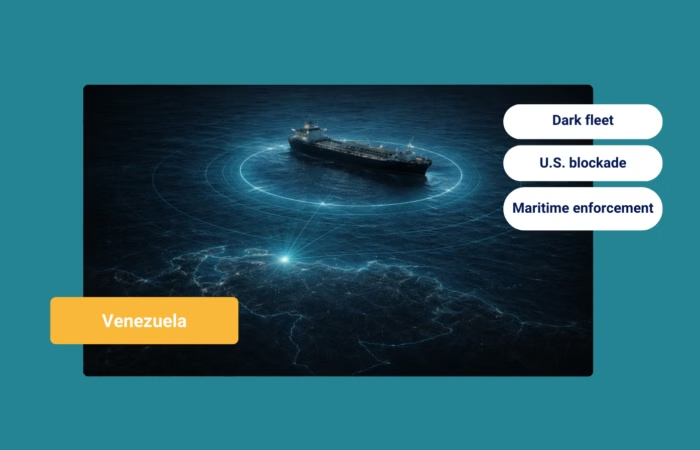
The seizure of the VLCC Skipper off Venezuela was not an isolated enforcement action. It marked the opening move in a broader escalation of pressure against sanctions-evading tanker networks.

Within days of the seizure, the United States announced a blockade on sanctioned oil tankers entering and leaving Venezuela. The administration simultaneously surged naval assets into the Caribbean, deploying warships and thousands of troops to the region. While the legal mechanics of the blockade remain undefined, the intent is clear. Sanctioned oil flows are no longer being treated as a compliance challenge alone. They are now a strategic target.
This shift is already producing effects beyond enforcement headlines. Oil prices rose immediately following the announcement, reflecting market uncertainty around Venezuelan exports. Vessel operators began reassessing exposure to Venezuelan trade, with some tankers declining calls altogether. The message to dark fleet operators is no longer limited to designation risk. It now includes the possibility of physical interdiction.
Signals from the United States and Ukraine
U.S. actions in the Caribbean are mirrored by developments in the Black Sea, where Ukraine has expanded direct action against Russia-linked dark fleet tankers.

Recent Ukrainian naval drone strikes targeted vessels that were sanctioned, falsely flagged, and effectively stateless. These ships lacked valid insurance and recognized classification, complicating salvage and liability once attacked. In at least one case, a damaged tanker had to be towed across maritime boundaries, triggering disputes over responsibility for repair and environmental risk.

Together, these actions reflect a shared logic. Authorities are prioritizing vessels where sanctions exposure, deceptive shipping practices, and legal vulnerability converge. Rather than attempting to interdict every suspicious tanker, enforcement is becoming more selective, intelligence-led, and operationally decisive.
Dark Fleet Activity Is Accelerating, Not Retreating
Enforcement pressure is rising at the same time that dark fleet activity is expanding.
Recent intelligence shows a sharp increase in sanctioned and high-risk tanker presence in the Caribbean, with area visits up nearly 95% year-on-year. More than one hundred vessels linked to Iran, Venezuela, or Russia have operated in the region in the past month alone. A significant share are sanctioned, falsely flagged, or classified as high risk based on behavior and ownership indicators.
At the same time, OFAC sanctioned six shipowners whose VLCCs were engaged in Venezuelan oil trade. According to U.S. Treasury disclosures, four of those vessels manipulated AIS signals to conceal port calls and movements over multiple months. Notably, several maintained Western insurance coverage, underscoring how sanctions evasion networks continue to penetrate mainstream maritime services.
This combination of increased activity and escalating enforcement underscores a central reality. Dark fleet operators are not withdrawing. They are adapting faster than traditional monitoring frameworks can respond.
Escalation Without War
What distinguishes the current phase of enforcement is how far it has progressed without crossing formal thresholds of armed conflict.
Blockades, drone strikes, and vessel seizures are traditionally associated with wartime authorities. Yet today, these tools are being applied through sanctions enforcement, maritime law, and selective military presence rather than declared hostilities. Legal scholars have already raised questions about how these actions fit within international law frameworks, particularly when blockades are imposed absent a recognized state of war.
Despite that ambiguity, the geopolitical consequences are real. Shipping routes are being disrupted. Insurance risk is rising. Flag states and coastal authorities are being drawn into enforcement outcomes they did not initiate. Precedents are being set that other regions are already beginning to follow.
This is escalation conducted deliberately below the threshold of war, but it is escalation nonetheless.
Likely Dark Fleet Adaptions
Dark fleet networks have proven resilient precisely because they are adaptive.
Early indicators suggest operators are already adjusting behavior. Some vessels are avoiding Venezuelan ports altogether. Others are increasing reliance on false flags or operating without a nationality to complicate the boarding authority. Ownership structures continue to fragment, while routing patterns shift toward jurisdictions with weaker oversight or slower coordination.
At the same time, sanctioned states are reconfiguring logistics. Russia’s increased delivery of diluent to Venezuela following U.S. supply disruptions illustrates how energy networks adjust under pressure, even as enforcement intensifies.
These adaptations reinforce a core lesson. Reactive enforcement alone will always trail behavior. The next phase of dark fleet operations will depend on anticipating how networks evolve under pressure, not just identifying violations after they occur.
What Readiness Looks Like Now
For governments, defense agencies, and intelligence organizations, readiness now means more than expanded monitoring or larger watchlists.
Effective enforcement requires the ability to surface seizure-grade risk before vessels enter contested waters or complete cargo transfers. That depends on understanding how vessels connect through ownership, flags, routing behavior, and shared operational patterns over time.
Predictive intelligence plays a critical role here. By combining behavioral analytics, ownership intelligence, and remote sensing confirmation, authorities can identify which vessels are moving toward enforcement thresholds and which are likely to adapt before pressure is applied.
The next phase of dark fleet enforcement will not be defined by a single seizure or blockade. It will be shaped by whether governments can stay ahead of adaptation in an environment where maritime activity is increasingly used as a strategic tool.
Explore more

Maritime Defense Weekly: Energy Flows and Infrastructure Risk
Week in Focus Russian Diesel Cargo Signaling Arrival in Cuba A Hong Kong-flagged medium-range tanker is signaling arrival in Cuba on March 2 after multiple AIS destination revisions. The vessel initially broadcast Havana, then shifted to “Caribbean Sea,” and later to “Gibraltar for orders,” despite already transiting the strait. Windward’s assessment indicates the tanker likely...
Read more

Maritime Defense Weekly: Offshore Enforcement and Baltic Exposure
Week in Focus Sanctions Enforcement Moves Further Offshore The United States intercepted and boarded Aquila II (IMO 9281152) in the Indian Ocean, nearly 1,000 nautical miles from where it fled a Venezuelan quarantine zone in January. The 22-year-old Suezmax had falsely broadcast under the Panamanian flag and has a history of extended dark activity and...
Read more

Enforcement Shock Accelerates Dark Fleet Reflagging to Russia
At a Glance A Structural Shift in Russia’s Shadow Fleet At least 120 falsely flagged, sanctioned tankers are likely to reflag to Russia’s registry in the coming months, as Western interdictions of stateless shadow fleet vessels accelerates a structural shift in Russia’s oil export logistics. All ships fit the profile and trading pattern of tankers...
Read more

Maritime Defense Weekly: Enforcement Tightens Across Global Shipping
The Week in Focus Maritime Enforcement Is Shifting From Designation to Constraint Maritime enforcement is increasingly focused on restricting how vessels operate in practice, not just on whether they appear on a sanctions list. Rather than relying solely on designations, recent actions are targeting the services and access that make maritime trade possible, including insurance,...
Read more

Tracking RAIDER: How Long-Term Vessel Behavior Uncovered a Pacific Drug Operation
At a Glance How a Dormant Vessel Triggered a Major Seizure In January 2026, French naval forces interdicted the MV RAIDER, a 41-meter pontoon vessel, in French Polynesian waters, seizing nearly five tonnes of cocaine, with an estimated value of nearly $150 million. Although the vessel was released without charges, its risk profile illustrates how...
Read more