


March 13, 2026
Two Weeks Into the Iran War: A Maritime Intelligence Breakdown


Two Weeks Into the Iran War: A Maritime Intelligence Breakdown
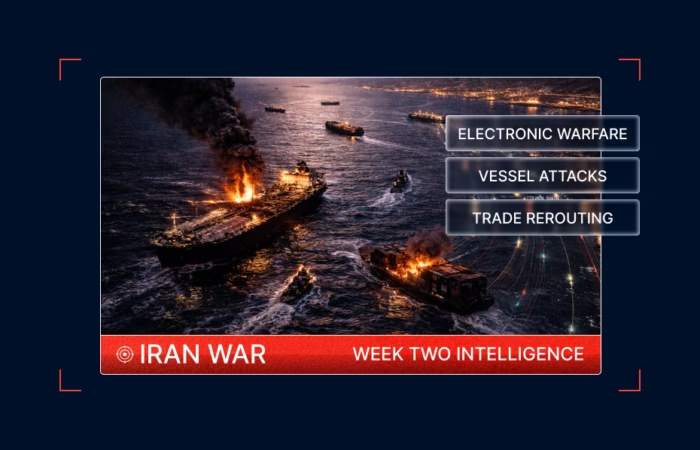
What’s inside?
At a Glance
- Commercial traffic through the Strait of Hormuz remained near a standstill during the week, with only 10 vessel crossings recorded between March 7 and March 11, compared to a typical daily average of 70-80 crossings.
- Maritime attacks intensified across the Gulf, bringing the total number of vessels struck since the start of the conflict to at least 16 ships across multiple maritime zones.
- Remote Sensing Intelligence detected dark vessel presence inside the Strait, suggesting limited transit activity continues under partially visible or non-transmitting conditions.
- Electronic interference expanded sharply, with more than 1,650 vessels experiencing GPS and AIS disruption across the Gulf region.
- Global shipping routes continued to adjust to the disruption, with Cape of Good Hope diversion traffic remaining elevated while Bab el-Mandeb and Suez Canal volumes fluctuated.
- Saudi Arabia accelerated its Petroline export workaround, redirecting crude shipments toward the Red Sea port of Yanbu, where a fleet of 27 VLCCs is now arriving to load cargoes.
- Energy supply disruption deepened across the region as Iraqi production collapsed, Asian refiners reduced operations, and global tanker freight rates surged.
- Dry bulk commodity flows through the Gulf also collapsed, leaving hundreds of bulk carriers stranded and disrupting key global metals and fertilizer supply chains.
- Sanctions and oil-flow dynamics also shifted beyond the Gulf, as OFAC temporarily allowed Russian crude already at sea to complete delivery while Swedish authorities boarded the sanctioned tanker SEA OWL I in European waters.
The Second Week of the Iran War at Sea
Two weeks after the launch of Operation Epic Fury, the maritime conflict in the Gulf has shifted from immediate disruption to sustained systemic stress across global shipping networks.
The initial days of the conflict triggered a rapid collapse in commercial confidence in the Strait of Hormuz as vessel strikes, missile threats, and insurance withdrawals pushed operators out of the corridor. By the start of the second week, routine commercial traffic had largely disappeared.
Vessel attacks expanded geographically, electronic interference intensified, and global shipping routes began redistributing trade flows away from Gulf transit corridors.
Major powers also expanded their monitoring posture in the region. China deployed the Liaowang-1 signals intelligence vessel to the Gulf of Oman, placing a large maritime surveillance platform within observation range of the conflict theater. Regional governments have also begun intervening directly in maritime security. Pakistan launched a naval escort mission, Operation Muhafiz-ul-Bahr, to protect merchant vessels transporting critical cargoes to Karachi.
Energy supply chains also began restructuring. Saudi Arabia accelerated exports through its Red Sea pipeline bypass, while Iraqi exports collapsed as tanker access to southern terminals became constrained.
Nearly two weeks after the initial maritime shock, the conflict is now reshaping shipping behavior, global trade routes, and energy logistics simultaneously.
Hormuz Traffic Remains Suppressed
Commercial activity through the Strait of Hormuz remained extremely limited throughout the second week of the conflict.
Only 10 commercial vessel crossings were recorded between March 7 and March 11, compared with a typical daily average of roughly 70–80 crossings through the Strait of Hormuz.
Daily transit levels fluctuated between one and three vessel crossings, with several days recording no inbound movements.
In many cases, the vessels that continued to transit were Iranian-flagged ships or vessels with elevated compliance risk profiles, including sanctioned or high-risk operators.
Windward analysis shows that 44% of vessels transiting during the crisis carried elevated compliance risk, highlighting that the ships continuing to operate in the corridor are not typical risk-averse commercial operators.
Defensive AIS Messaging Emerges in the Strait
A significant share of vessels continuing to operate near the Strait appear to be linked to shadow fleet networks or non-Western operators. Windward identified 36 vessels broadcasting nationality signals through AIS destination fields, an unusual behavior pattern that emerged during the week.
23 of these vessels were Chinese-linked ships, broadcasting standardized messages such as “CHINESE CREW OWNER,” “CHINA OWNER & CREW,” and “CHINESE VSL AND CREW.” Additional vessels transmitting similar identity signals included five Iraqi-linked ships broadcasting messages such as “IRAQI OWNER” or “IRAQI PORTS,” and one Turkish vessel transmitting “TRIST-TURKISH CREW.”

The vessels using these signals were primarily commercial cargo ships and tankers, including 22 cargo vessels and 11 tankers, operating under flags led by Panama (11 vessels), Liberia (6), Hong Kong (5), and Norway (3).
Dark Vessel Activity Detected Inside Hormuz
Remote Sensing Intelligence also indicates that AIS-visible traffic does not capture the full level of vessel presence in the Strait. Satellite imagery detected eight large vessels inside Hormuz operating without AIS transmission, including one vessel roughly 330 meters long, consistent with a VLCC positioned near the Iranian side of the waterway.

These observations suggest that limited dark or partially visible vessel movement may be occurring alongside the few confirmed AIS-tracked crossings, indicating that the true level of traffic inside the Strait may be higher than visible tracking alone suggests.
Taken together, these signals suggest that the Strait has shifted from a routine commercial corridor to a highly restricted maritime zone where transit remains possible only under exceptional conditions.
Vessel Attacks Expand Across Maritime Zones
Maritime attacks continued to intensify throughout the second week of the conflict.
By March 11, at least 16 vessels had been struck since February 28, spanning a wide geographic arc across the Strait of Hormuz, the Gulf of Oman, UAE coastal waters, and Iraqi export zones.
Several of the most serious incidents occurred on March 11, when multiple vessels were targeted across the region.
The Thai-flagged bulk carrier MAYUREE NAREE was struck north of Oman, triggering an engine-room fire that disabled propulsion and forced the crew to abandon ship.

The Japanese container vessel ONE MAJESTY was struck northwest of Ras Al Khaimah, sustaining minor hull damage but remaining seaworthy.

The Marshall Islands-flagged bulk carrier STAR GWYNETH was hit by a projectile northwest of Dubai, suffering structural damage to its cargo hold and ballast tank.

Two crude oil tankers, SAFESEA VISHNU and ZEFYROS, conducting a ship-to-ship transfer operation near the Basra offshore STS zone, were also attacked by explosive-laden Iranian unmanned surface vessels, triggering major fires and forcing Iraqi authorities to suspend export terminal operations.

The distribution of these incidents suggests a deliberate strategy aimed at generating widespread disruption across maritime logistics rather than targeting a single chokepoint or vessel category.
Across the broader conflict period, at least 16 vessels have now been struck, including Skylight, MKD Vyom, Sea La Donna, Hercules Star, Stena Imperative, Athe Nova, Ocean Electra, Safeen Prestige, Sonangol Namibe, Prima, and the tug Musaffah 2, highlighting the widening geographic scope of maritime targeting.
GPS Jamming and AIS Disruption Intensify
Electronic interference across the Gulf expanded significantly during the second week of the conflict.
Windward identified more than 1,650 vessels affected by GPS and AIS disruption, representing a major increase compared with the first week of the war.
AIS signals were falsely projected across locations stretching from Kuwait through the Arabian Gulf and into the Gulf of Oman.

More than 30 jamming clusters were detected across Saudi Arabia, Kuwait, the UAE, Qatar, Oman, and Iran.
Interference patterns also evolved. Early circular spoofing distortions were increasingly replaced by zig-zag displacement patterns, where vessel signals jumped across multiple locations within a single day.

This environment complicates both navigation and compliance monitoring. Vessels may appear hundreds of kilometers from their actual positions, while other ships disappear entirely from AIS tracking despite remaining physically present in the water.
Naval Mine Threat Raises Risk for Full Strait Closure
U.S. intelligence officials believe Iran has begun preparing to deploy naval mines in the Strait of Hormuz. Initial deployment may involve several dozen mines, though Iran is estimated to possess an inventory of roughly 2,000 naval mines and retains significant minelaying capability despite recent strikes on Iranian maritime assets.
Even a limited number of mines could render the Strait unsafe for commercial shipping for days or weeks. Mine clearance operations require specialized countermeasure vessels, extensive seabed surveying, and coordinated naval protection, meaning that the mere presence of mines could effectively halt traffic through one of the world’s most critical energy chokepoints.
U.S. naval forces have already begun targeting suspected Iranian minelaying assets in the region. According to U.S. Central Command, several vessels believed capable of deploying naval mines were destroyed near the Strait during recent operations, indicating that counter-mine efforts are already underway.
Markets reacted quickly to the reports, with oil prices briefly rising by roughly $10 per barrel as traders assessed the possibility of a broader disruption. Even limited mining would carry strategic consequences: a small number of mines can force insurers and shipping operators to treat the entire corridor as unsafe, potentially shutting the Strait without a formal blockade.
Global Shipping Routes Continue to Redistribute
As Hormuz traffic collapsed, global shipping routes continued adjusting to absorb displaced flows.
Traffic around the Cape of Good Hope remained consistently elevated throughout the week, with 383 vessel transits recorded between March 7 and March 11, averaging roughly 77 crossings per day as operators rerouted around Middle Eastern chokepoints.
Activity through Bab el-Mandeb and the Suez Canal fluctuated throughout the week as operators adjusted routing strategies. Bab el-Mandeb recorded 122 crossings during the period, while the Suez Canal handled 185 transits, reflecting the uneven distribution of global shipping flows as vessels balanced Red Sea risk against long-haul diversions around Africa.
These movements indicate that global shipping flows are entering a period of prolonged redistribution rather than a short-term disruption.
Regional Port Operations Continue to Strain
Operational strain is also appearing across regional port infrastructure as the disruption propagates through Gulf logistics networks.
Across the reporting period of March 8–12, exception indicators rose across multiple hubs.
Jebel Ali (UAE) recorded 19 late departures, 25 transshipment rollovers, and 52 transshipment delays across the week.
Salalah (Oman) experienced the most severe disruption, with 37 late departures, 20 rollovers, and 126 transshipment delay cases, including a surge of 88 delay incidents recorded in a single day.
Karachi (Pakistan) reported 12 late departures and 10 transshipment delays, while Hamad (Qatar) recorded 7 late departures and Shuwaikh (Kuwait) logged 2 late departures and 2 transshipment rollovers.
These indicators suggest that chokepoint disruption is beginning to spread beyond transit corridors into regional port operations and container logistics networks, amplifying the broader supply chain impact of the conflict.
Iranian Export Activity Continues at Kharg Island Despite Disruption
Iran’s primary crude export terminal at Kharg Island has continued operating throughout the conflict, although export volumes have fallen sharply and tanker activity has become increasingly opaque.
Satellite imagery from March 7 confirms a substantial clustering of tankers at the terminal and in nearby waiting areas. At the time of the capture, two VLCCs and one Aframax tanker were berthed at the terminal, while two additional VLCCs and one Aframax were anchored nearby alongside several MR tankers awaiting loading or departure. The concentration of tonnage indicates that export operations remain active despite heightened maritime risk in the surrounding Gulf waters.

However, overall export throughput has declined significantly since the start of hostilities on February 28. Average crude exports from Kharg Island fell from approximately 2.04 million barrels per day between February 1 and February 27 to roughly 0.98 million barrels per day between February 28 and March 12, representing a 51.7% reduction in daily export volumes.
Windward Remote Sensing Intelligence indicates that six VLCCs have loaded at Kharg Island since February 28 while manipulating their broadcast positions or identities, underscoring the extent to which Iranian export continuity is now relying on deceptive shipping behavior.
Satellite imagery from March 7 confirms the presence of HEDY, NORA, and PING SHUN either berthed or waiting offshore despite AIS signals indicating misleading or impossible positions. Several vessels have been operating fully dark, including NORA, which has not transmitted AIS since February 14, DANIEL since February 22, and HEDY since February 24.

Other vessels appear to be actively spoofing their positions. PING SHUN broadcast a circular movement pattern in the Gulf of Oman while imagery confirmed it was physically present near Kharg Island before departing the terminal on March 10. STAR FOREST transmitted a linear AIS track across the Iran–Kuwait–Iraq EEZ triangle, inconsistent with observed vessel movement, while DEEP SEA has remained dark since March 7 after last broadcasting near Malaysia.

These patterns indicate that Iranian crude exports are continuing at reduced levels but with heightened reliance on deceptive shipping behavior, complicating real-time monitoring of export flows from one of the Gulf’s most critical energy terminals.
Energy Logistics Shift Toward the Red Sea
Energy export systems across the Gulf began rapidly adjusting to the disruption as Saudi Arabia restructured crude flows away from the Strait of Hormuz.
The primary driver of this shift has been the forced shutdown of major Saudi offshore production facilities following the escalation of maritime risk in the Gulf. Approximately 2.0 to 2.5 million barrels per day of offshore output from the Safaniya, Marjan, Zuluf, and Abu Safa fields is currently offline, representing roughly 20% of Saudi Arabia’s total production capacity.
At the same time, Saudi crude shipments through the Strait of Hormuz have dropped sharply. Export volumes fell to 4.06 million barrels per day, down from a pre-crisis baseline of 6.64 million barrels per day, representing a 39% reduction in Gulf-bound flows.

To compensate, Saudi Arabia accelerated its use of the East–West Petroline pipeline, which transports crude from eastern production hubs directly to Red Sea export terminals.
Saudi Arabia has also issued warnings to Tehran that any attacks on Saudi territory or energy infrastructure would trigger retaliation, reflecting growing concern that the conflict could expand beyond maritime disruption into direct strikes on Gulf energy production systems.
The impact is now visible in export data. Red Sea crude shipments from Yanbu surged to approximately 2.47 million barrels per day during the week of March 2, representing a 330% increase compared with pre-crisis levels.
This shift is also visible in tanker deployment patterns. A fleet of 27 very large crude carriers (VLCCs) is currently sailing toward Yanbu, where they will load Petroline-delivered crude for export toward Mediterranean and Asian markets.

Arrival schedules suggest continuous loading activity, with vessels arriving at a rate of one to two per day through late March.
Iraqi Oil Export Collapse
While Saudi Arabia was able to reroute exports, Iraq experienced one of the most severe energy disruptions during the week.
Iraqi oil production reportedly fell from approximately 4.3 million barrels per day to roughly 1.3 million barrels per day.

Exports declined by at least 800,000 barrels per day, largely due to the closure of the Al-Basra Offshore Terminal and the inability of tankers to safely navigate the Strait of Hormuz.
Destination data shows a two-tier impact across Iraqi customer markets.

South Korea and Greece have received zero Iraqi crude cargoes in March, representing a complete supply interruption.
India and China — Iraq’s largest buyers — have seen deliveries fall by 80–93% compared with January levels.
This collapse represents one of the clearest examples of maritime disruption directly translating into upstream energy supply destruction.
The disruption has triggered what market observers describe as an energy panic across parts of Asia. Several Chinese refineries have reportedly reduced operating capacity or declared force majeure due to feedstock shortages, while Asian buyers are aggressively seeking replacement cargoes from Africa and Latin America.

Commodity Trade Disruption Spreads Beyond Oil
The maritime disruption is also affecting global commodity supply chains.
Dry bulk transits through the Strait of Hormuz have fallen sharply, leaving approximately 280 bulk carriers stranded or effectively trapped within the Gulf.

This has halted exports from a region responsible for roughly 18% of global iron ore pellet exports and 10% of global primary aluminum production.
Aluminum prices have already surged to record highs on the London Metal Exchange, while fertilizer exports from Gulf producers are tightening agricultural supply chains worldwide.
The disruption illustrates how chokepoint instability can propagate rapidly across multiple industrial markets beyond energy.
Shadow Fleet Activity Exploits the Crisis
The conflict environment has also created opportunities for sanctions evasion operations.
During the week, the sanctioned Russian tanker M/V TRUST conducted a high-probability semi-dark ship-to-ship transfer in Omani waters involving roughly 325,000 barrels of Russian crude.
The vessel temporarily disabled AIS transmission during a prolonged stationary meeting with another tanker before resuming normal broadcasting.
The timing of the transfer suggests that shadow fleet operators may be exploiting the reduced maritime visibility created by the Gulf conflict to conduct illicit cargo movements.
Russian Oil at Sea Receives Temporary Sanctions Relief
The widening energy disruption also forced a temporary policy adjustment in Western sanctions enforcement. On March 12, the U.S. Treasury’s Office of Foreign Assets Control issued General License 134, allowing Russian crude oil and petroleum products already loaded onto vessels to complete delivery.
Windward and Vortexa data indicate that the waiver affects approximately 215 million barrels of Russian oil currently on the water, carried by more than 370 tankers in transit or floating storage. Around 44% of those vessels are already sanctioned by the United States, United Kingdom, or European Union, while roughly half are classified as high-risk vessels.

The measure does not authorize new Russian oil trade, but it does allow cargoes already at sea to be delivered despite the war-driven market shock that pushed oil prices sharply higher. The decision reflects the scale of current supply stress and the difficulty of maintaining existing restrictions during a major Gulf disruption.

Russia Explores Caspian Export Workaround
Additional Russian tankers operating without AIS transmission were detected near Iranian ports in the Caspian Sea, suggesting possible coordination between Russian and Iranian energy logistics networks and the potential development of alternative export corridors bypassing southern maritime chokepoints.

The Caspian corridor could allow crude to move northward into Russian ports before re-entering global markets, bypassing the threatened Strait of Hormuz entirely.
While still limited in scale, this activity indicates that Russia-linked shadow fleet networks may be adapting their routing strategies to exploit alternative maritime pathways during the Gulf crisis.

Sanctions Enforcement Continues in European Waters
Even as regulators introduced temporary flexibility for Russian cargoes already at sea, direct enforcement against shadow fleet vessels continued. On March 12, Swedish authorities boarded the sanctioned oil products tanker SEA OWL I while it transited Swedish territorial waters in the Sound Strait southeast of Malmö.
The vessel, currently flagged under Comoros, is sanctioned by both the European Union and the United Kingdom for transporting Russian oil. Windward assigns SEA OWL I the highest compliance risk classification, and its operating pattern — including repeated dark activity near Russian terminals, flag changes, and identity modifications — is consistent with sanctions-evasion tactics commonly associated with Russia’s shadow fleet.

The boarding highlights the fragmented operating environment now emerging around Russian oil: some already-loaded cargoes are being allowed to complete delivery, while sanctioned vessels themselves remain exposed to interdiction and enforcement action.
Cuba Energy Supply Crisis Emerges
Secondary disruptions are also appearing outside the Gulf. Cuba is experiencing its lowest tanker arrival levels in at least twelve months, with only 11 tankers calling Cuban ports in March, compared with 53 arrivals in January and 34 in February.

No laden tankers are currently reporting Cuba as a destination, according to cargo tracking data, indicating a severe disruption in maritime fuel supply to the island.

At the same time, the Russia-linked tanker SEA HORSE ceased visible AIS reporting while approaching Cuban waters after broadcasting a destination toward the island in late February.

Satellite imagery later detected multiple dark vessels at the Matanzas crude terminal, including one tanker approximately 270 meters long and two additional tankers around 200 meters in length.
These signals suggest that opaque maritime logistics networks may be continuing to supply Cuba through dark or spoofed tanker operations, even as visible maritime traffic to the island collapses.
Outlook
Two weeks into the Iran war, the maritime operating environment remains highly unstable.
Transit activity through the Strait of Hormuz remains extremely limited, while vessel attacks, electronic interference, and insurance constraints continue to deter commercial shipping.
At the same time, global shipping routes are redistributing around the disruption, Gulf energy producers are restructuring export pathways, and commodity supply chains are tightening across multiple markets.
The crisis is no longer confined to a single chokepoint. It is now reshaping global shipping routes, tanker deployment patterns, energy logistics, and maritime risk exposure across multiple regions.
Absent a rapid de-escalation, these disruptions could persist well beyond the immediate conflict window.
Explore more

March 12, 2026: Iran War Maritime Intelligence Daily
At a Glance Operational Overview Maritime security conditions across the Gulf deteriorated further on March 11 as multiple coordinated attacks targeted commercial vessels across several operating environments, including open transit corridors, anchorage zones, and ship-to-ship transfer areas linked to regional oil exports. Commercial vessel activity through the Strait of Hormuz remains extremely limited. Only two...
Read more

March 11, 2026: Iran War Maritime Intelligence Daily
At a Glance Operational Overview Transit activity through the Strait of Hormuz remained heavily suppressed on March 10, with only two outbound crossings recorded and no inbound movements observed. While this represents a slight increase from the previous day, volumes remain far below normal operating levels and continue to reflect a severely disrupted commercial shipping...
Read more

March 10, 2026: Iran War Maritime Intelligence Daily
At a Glance Operational Overview Commercial shipping through the Strait of Hormuz reached a new low on March 9, with only one outbound transit recorded and no inbound movements observed. The vessel was Iranian-flagged, meaning that all detected crossings during the last 24 hours involved Iranian vessels, reinforcing the assessment that Western-linked commercial shipping has...
Read more
March 9, 2026: Iran War Maritime Intelligence Daily
At a Glance Operational Overview Commercial shipping through the Strait of Hormuz reached its lowest level of the conflict on March 8, with only two outbound transits recorded and no inbound crossings observed. Both vessels were Iranian-flagged, reinforcing the assessment that international commercial traffic has effectively withdrawn from the waterway. At the same time, maritime...
Read more