


March 20, 2026
Iran War at Sea: How the Conflict Is Disrupting Global Trade and Energy


Russian Dark Fleet Tankers Seek Shelter Along Turkish Coast from Ukrainian Drone Strikes
What’s inside?
At a Glance
- Following Ukrainian drone strikes in late November and December, dark fleet tankers are abandoning direct Black Sea crossings and instead hugging the Turkish coastline, adding 350 miles (70%) to each voyage.
- Windward data reveals tankers Belomor, Jumbo, Virel, Tendua, Vayu 1, and Torx operating near Turkish waters, all flagged as high smuggling risk.
- The vessels are linked to shell companies in the Seychelles, Mauritius, and Marshall Islands, with several already sanctioned by the UK, EU, and other Western nations.
- By sailing within or near Türkiye’s 12-nautical-mile territorial waters, operators may be betting that Ukraine will hesitate to strike, risking a diplomatic incident with Ankara.
- Ukraine’s SBU has struck at least four tankers since late November, with the shadow fleet now facing coordinated naval drone operations targeting vessels transporting Russian commodities.
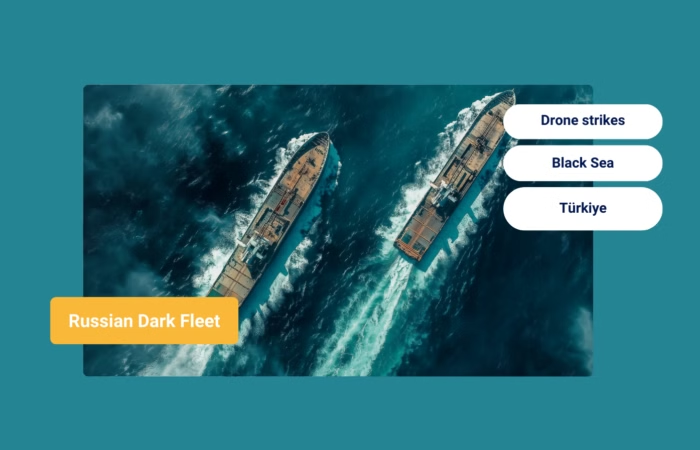
The Black Sea has become increasingly treacherous for Russia’s shadow fleet of oil tankers. Following a wave of Ukrainian maritime drone strikes in late November and December, vessels transporting Russian crude have abandoned their traditional direct routes across open water. Instead, they’re taking a dramatically longer path — hugging the coastlines of Georgia and Türkiye, and in some cases entering Turkish territorial waters.

New data from Windward has identified six dark fleet tankers recently observed operating unusually close to Türkiye’s coastline. This finding corroborates earlier reporting by The Insider which documented at least two tankers — Torx and Jumbo — altering their routes after the drone attacks began.
The Vessels Seeking Shelter
Windward Maritime AI™ identified the following tankers exhibiting coastal-hugging behavior near Türkiye:
| Vessel | IMO | Flag | Status |
| BELOMOR | 9384435 | Russia | Last seen near Greece, bound for Port Said |
| JUMBO | 9290335 | Sierra Leone | Positioned off Turkish coast, “For Orders” |
| VIREL | 9299874 | Vanuatu | Near Turkish waters, bound for Port Said |
| TENDUA | 9299862 | Sierra Leone | Near Russian port, “For Orders” |
| VAYU 1 | 9290517 | Benin | Near Russian port, “For Orders” |
| TORX | 9311610 | Panama | Last seen near Egypt |
All six vessels have been flagged as “High” smuggling risk by Windward’s Maritime AI™ platform. Several share connections to shell companies registered in the Seychelles, Mauritius, and the Marshall Islands — jurisdictions commonly used to obscure beneficial ownership in shadow fleet operations.


Why the Route Change Matters
The traditional shipping lane from Novorossiysk to the Bosphorus runs directly across the center of the Black Sea. The new coastal route adds approximately 350 miles (roughly 70% more distance) to each voyage. That’s additional fuel costs, longer transit times, and increased operational complexity for every barrel of Russian crude.
But for shadow fleet operators, the calculus is simple: the open sea has become a hunting ground.
Since late November, Ukrainian naval drones have struck multiple tankers with increasing precision:
- November 28: Tankers Kairos and Virat attacked simultaneously off Türkiye’s coast.
- November 29: Virat struck again; the vessel later changed its flag to Russian and limped to the port of Tuzla.
- December 2: Midvolga 2 attacked approximately 80 nautical miles off the Turkish coast.
- December 10: Dashan targeted south of Feodosia while transiting at maximum speed with its transponder switched off.
The Kairos ran aground off Bulgaria after the attack. The Dashan strike was conducted jointly by Ukraine’s Security Service (SBU) and the Ukrainian Navy, demonstrating increasing coordination in maritime operations.
The Turkish Territorial Gambit
By sailing within or near Türkiye’s 12-nautical-mile territorial waters, shadow fleet operators may be calculating that Ukraine will be more hesitant to strike—an attack in Turkish waters could be construed as a violation of Turkish sovereignty.
The Kremlin has already characterized previous attacks as “encroaching on the sovereignty of the Republic of Türkiye.” Turkish authorities, for their part, have stated the incidents pose a “serious threat to navigation, human life, property, and the environmental safety of the region.”
This creates a delicate diplomatic situation. Türkiye has not sanctioned Russia and remains an important transit point for Russian oil exports. Yet the presence of aging, poorly maintained tankers hugging its coastline—vessels with questionable insurance and opaque ownership structures—poses genuine risks to Turkish waters and beaches.
The Bigger Picture
The shadow fleet now comprises over 1,900 vessels globally, according to Windward’s Q3 2025 risk report — an estimated 10% of all tankers worldwide. The EU has sanctioned nearly 600 vessels, with 41 additional designations announced in the most recent tranche.
These vessels share common characteristics: advanced age (most are 15-25 years old), flags of convenience from jurisdictions with minimal oversight, shell company ownership structures, and inadequate or nonexistent insurance. The environmental risks are real, as demonstrated by a December 2024 oil spill in the Black Sea caused by two Russian shadow fleet vessels, the worst such incident in the region this century.
The route changes observed in the Black Sea represent a tactical adaptation, not a strategic solution. Ukrainian drone capabilities continue to improve, and the SBU has signaled it will continue targeting vessels that transport Russian commodities in violation of international sanctions.
For the aging tankers of Russia’s dark fleet, the waters are getting warmer. And not in a good way.
Explore more

Maritime Defense Weekly: Energy Flows and Infrastructure Risk
Week in Focus Russian Diesel Cargo Signaling Arrival in Cuba A Hong Kong-flagged medium-range tanker is signaling arrival in Cuba on March 2 after multiple AIS destination revisions. The vessel initially broadcast Havana, then shifted to “Caribbean Sea,” and later to “Gibraltar for orders,” despite already transiting the strait. Windward’s assessment indicates the tanker likely...
Read more

Maritime Defense Weekly: Offshore Enforcement and Baltic Exposure
Week in Focus Sanctions Enforcement Moves Further Offshore The United States intercepted and boarded Aquila II (IMO 9281152) in the Indian Ocean, nearly 1,000 nautical miles from where it fled a Venezuelan quarantine zone in January. The 22-year-old Suezmax had falsely broadcast under the Panamanian flag and has a history of extended dark activity and...
Read more

Enforcement Shock Accelerates Dark Fleet Reflagging to Russia
At a Glance A Structural Shift in Russia’s Shadow Fleet At least 120 falsely flagged, sanctioned tankers are likely to reflag to Russia’s registry in the coming months, as Western interdictions of stateless shadow fleet vessels accelerates a structural shift in Russia’s oil export logistics. All ships fit the profile and trading pattern of tankers...
Read more

Maritime Defense Weekly: Enforcement Tightens Across Global Shipping
The Week in Focus Maritime Enforcement Is Shifting From Designation to Constraint Maritime enforcement is increasingly focused on restricting how vessels operate in practice, not just on whether they appear on a sanctions list. Rather than relying solely on designations, recent actions are targeting the services and access that make maritime trade possible, including insurance,...
Read more

Tracking RAIDER: How Long-Term Vessel Behavior Uncovered a Pacific Drug Operation
At a Glance How a Dormant Vessel Triggered a Major Seizure In January 2026, French naval forces interdicted the MV RAIDER, a 41-meter pontoon vessel, in French Polynesian waters, seizing nearly five tonnes of cocaine, with an estimated value of nearly $150 million. Although the vessel was released without charges, its risk profile illustrates how...
Read more