


March 26, 2026
Maritime Terms Explained: The Iran War & Strait of Hormuz Crisis


What Role Did Marine Insurers Play in Halting Hormuz Traffic?
What’s inside?
Insurance Market Reaction
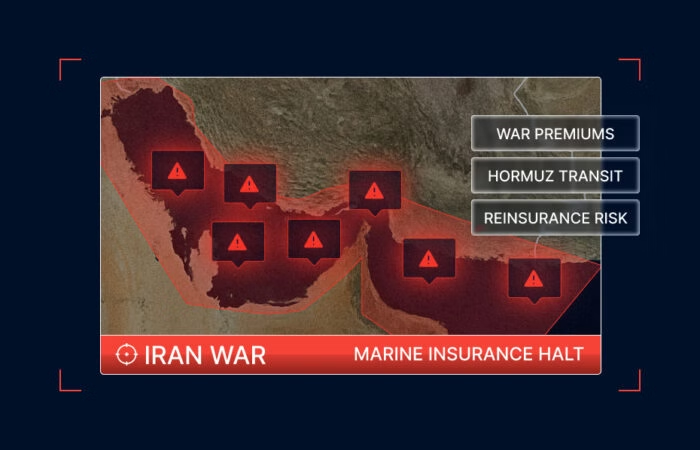
Traffic through the Strait of Hormuz declined by 80% within 24 hours of strikes being launched on Iran over the weekend as shipowners and charterers weighed whether to proceed with voyages.
Chief among their considerations was the stance taken by the world’s reinsurers that ultimately underwrite the marine insurance market.
By Monday, most of the world’s protection and indemnity clubs — the mutual insurers that cover third-party liabilities for about 90% of the global merchant fleet — began issuing notices cancelling certain war risk extensions for vessels trading in the Middle East.
They gave 72 hours’ notice, effective from March 2, of the cancellation of these war-related extensions attached to vessels’ P&I cover, a move triggered by the withdrawal of reinsurance for those risks.
These war-related extensions are add-on clauses taken out alongside a standard P&I policy to cover liabilities arising from war perils.
Traffic Through the Strait Has Effectively Stalled
Transit activity through the Strait of Hormuz had already been declining following the start of the war. Iran’s Revolutionary Guards later declared the Strait closed and warned that vessels attempting to transit could be targeted. By March 3, only four vessels crossed the Strait — a sharp drop from the seven-day average of roughly 77 crossings.

They sit alongside separate hull war risk policies that insure physical loss or damage to the ship, for which voyage-specific Additional Premiums are charged when vessels enter areas designated as high risk by the Lloyd’s market.
By March 2, transits through the Strait of Hormuz — through which roughly 20% of the world’s oil and gas flows — had effectively halted.
Hundreds of tankers remain stranded at anchorages and ports on either side of the strait. At least seven tankers have been struck by drones or missiles in waters off Oman and the UAE and at port in Bahrain since hostilities escalated.
Reinsurance Withdrawal and Aggregation Risk
The withdrawal of reinsurance support reflects the growing risk faced by insurers as vessels cluster in a confined area amid rapidly escalating hostilities.
Reinsurers are likely to have considered the aggregation risk of hundreds of ships in one location, the expanding geographical scope of attacks on ports and energy infrastructure across the region, and the uncertainty surrounding how long the conflict may last.
With those extensions cancelled, shipowners, charterers, and operators must now seek replacement terms if vessels are to continue trading in the region. New policies may still be available, but only after fresh underwriting assessments and likely at substantially higher cost.
War Risk Premiums Surge
The Joint War Committee of the Lloyd’s Market Association on Monday expanded its list of high-risk areas to include waters around Bahrain, Djibouti, Kuwait, Oman, and Qatar. Additional Premiums for voyages through the Gulf have surged, reportedly rising from around 0.2% of a vessel’s value to as much as 1%.
Some underwriters may now decline to quote new war risk terms altogether. Without adequate insurance cover in place, vessels cannot be chartered, and cargoes cannot be financed, effectively preventing voyages from proceeding even if the waterway remains physically open.
When Insurance Determines Maritime Access
This is not the first time reinsurers have withdrawn war risk support in response to a sudden escalation in conflict.
Similar arrangements were introduced in 2022 following Russia’s invasion of Ukraine, when insurers cancelled certain war risk extensions covering the Black Sea before replacement cover was negotiated as grain exports resumed under new risk terms.
While the initial collapse in traffic followed attacks on commercial vessels and heightened military threats, the insurance market’s response to this is likely to determine how quickly shipping can resume.
Until replacement war risk cover is secured and insurers regain confidence that vessels can safely transit the waterway, one of the world’s most critical energy chokepoints remains effectively closed.
Explore more

Maritime Terms Explained: The Iran War & Strait of Hormuz Crisis
Four weeks into the Iran war, maritime traffic through the Strait of Hormuz has not ceased, but it has fundamentally changed. AIS-visible crossings dropped to near zero at multiple points, with only 16 vessels recorded transiting the Strait throughout the third week of the conflict. Despite this collapse in visible movement, oil exports have continued,...
Read more

March 25, 2026: Iran War Maritime Intelligence Daily
At a Glance Operational Overview Maritime activity in and around the Strait of Hormuz remains constrained but operational under a clearly selective transit framework. While commercial shipping has not resumed through standard lanes, vessel movements continue through controlled routing patterns aligned with Iranian oversight. On March 24, only four AIS-transmitting vessels crossed the Strait, while...
Read more

March 24, 2026: Iran War Maritime Intelligence Daily
At a Glance Operational Overview Maritime activity in and around the Strait of Hormuz remains constrained but increasingly structured, as vessel movements continue under controlled routing patterns and elevated threat conditions. On March 23, limited transit activity was observed, with vessels routing north of Larak Island, reinforcing the emergence of a managed corridor rather than...
Read more

March 23, 2026: Iran War Maritime Intelligence Daily
At a Glance Operational Overview Maritime activity across the Arabian Gulf remains constrained but operationally active, with over 600 foreign-flagged vessels currently transmitting AIS in the region. While large-scale commercial flows continue, vessel behavior indicates sustained disruption, including elevated dark activity, reduced anchoring durations, and shifting routing patterns under heightened geopolitical control. Iran continues to...
Read more

Three Weeks Into the Iran War: A Maritime Intelligence Breakdown
At a Glance The Third Week of the Iran War at Sea Three weeks after the launch of Operation Epic Fury, the maritime conflict in the Gulf has moved beyond immediate disruption into a more structured and adaptive phase. Commercial traffic through the Strait of Hormuz remains near collapse, but the operating picture is no...
Read more