


April 12, 2026
April 12, 2026: Iran War Maritime Intelligence Daily


Maritime Defense Weekly: U.S. Intervention in Venezuela and Maritime Risk
What’s inside?
The Week in Focus
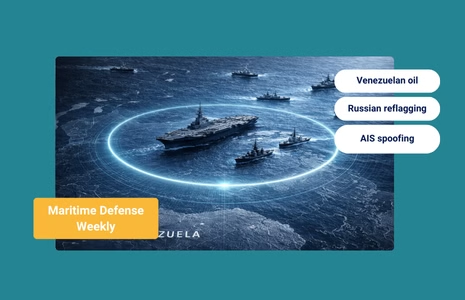
- U.S. military intervention in Venezuela has shifted the operating environment from sanctions monitoring to active maritime risk management, with uncertainty now driving behavior across ports, offshore operations, and regional shipping lanes.
- U.S. forces executed coordinated global sanctions interdictions under Operation Southern Spear, seizing the shadow fleet tanker Marinera in the North Atlantic and the Venezuela-linked tanker Sophia in the Caribbean, signaling that enforcement now extends worldwide rather than remaining regionally bounded.
- The Marinera interception escalated into a high-seas confrontation after the vessel reflagged to Russia mid-voyage, prompting the deployment of Russian naval assets and U.S. P-8 surveillance aircraft and special operations forces, marking a rare instance of direct great-power friction tied to sanctions enforcement at sea.
- Dark fleet operators are actively adapting to enforcement pressure, using AIS spoofing, coordinated departures, rerouting toward alternative transshipment hubs, and seeking state-backed protection to complicate interdiction.
- Russia has moved to shield exposed vessels by reflagging sanctioned tankers, raising the geopolitical cost of maritime enforcement and signaling readiness to contest interdictions indirectly.
- Maritime safety and environmental risk are increasing, highlighted by the grounding of a sanctioned, previously damaged tanker near a critical sea lane.
- The U.S. enforcement model emphasizes leverage through ambiguity, prompting behavioral shifts across shipping, insurance, and port operations in the absence of formal restrictions.
- China and Russia are closely studying the operation, absorbing operational lessons with potential implications for future gray-zone maritime pressure beyond the Caribbean.
Venezuela: Intervention, Transition, and Maritime Risk
Operation Absolute Resolve, the U.S. operation against Venezuela, has created a fragile interim environment. Following January 3 strikes on military infrastructure in Caracas and the port of La Guaira, Nicolás Maduro was removed, leaving a power vacuum with direct implications for global energy flows. The administration has indicated a willingness to temporarily oversee stabilization of the oil sector, signaling the potential for a sustained U.S. presence around key export infrastructure.
"At my direction, the U.S. Armed Forces conducted an extraordinary military operation in the capital of Venezuela…This was one of the most stunning, effective, and powerful displays of American military might and competence in American history." – PRESIDENT DONALD J. TRUMP 🇺🇸 pic.twitter.com/QibvrRKsSv
— The White House (@WhiteHouse) January 3, 2026
In the near term, retaliation appears unlikely, as U.S. strikes significantly degraded already weakened Venezuelan military capabilities. However, additional action remains a credible option should the current leadership fail to meet U.S. expectations.
For maritime stakeholders, the primary impact is elevated uncertainty rather than formal access denial. Since strikes began, commercial activity has shown heightened sensitivity, with increased risk perception around Venezuelan ports, offshore operations, and adjacent shipping lanes.
Oil production recovery remains a long-term prospect. Years of infrastructure decay will require an estimated $80-100 billion in investment over 7-10 years. Sustained investment depends less on immediate political transition than on regulatory predictability and operational stability – conditions that are not yet in place. As a result, near-term maritime energy flows remain exposed to political volatility rather than capacity-driven growth.
Dark Fleet Adaptation: Behavioral Response to Enforcement Pressure
In the immediate wake of the strikes, vessels linked to sanctions evasion shifted tactics. Rather than simply going dark, operators began generating “digital ghosts,” using spoofed AIS signals to obscure activity near the Venezuelan theater. False positional data appeared near Trinidad and Tobago, Guyana, Lomé, and the ABC islands, indicating deliberate efforts to mask port calls and routing patterns.
Windward tracked 116 high-risk vessels conducting over 130 Caribbean visits in a 30-day period. Of these, 19 were sanctioned, 81 flagged as high-risk, and 14 operating under fraudulent flags.
As U.S. naval presence increased, Venezuela-sanctioned vessel activity surged 184% near the Mauritius EEZ, confirming a rerouting effort away from the Atlantic toward alternative transshipment hubs capable of sustaining oil flows to Asian markets, particularly China.
Breach Attempts and State-Backed Protection
Following Maduro’s removal, at least 16 sanctioned tankers departed Venezuelan ports in what appeared to be a coordinated attempt to bypass enforcement. Operators employed saturation tactics, simultaneous departures, AIS spoofing, and complete signal loss to complicate interdiction. Four vessels broadcast false locations as distant as the Baltic Sea or Nigeria, while another twelve went entirely dark.
In parallel, dark fleet survival strategies shifted from anonymous flag hopping to state-backed protection. As stateless vessels became increasingly vulnerable to boarding under UNCLOS Article 110, Russia began absorbing exposed tankers into its national registry, providing sovereign cover.
This trend accelerated after Gambia removed 70 sanctioned tankers from its registry. Russia stepped into the gap, reflagging vessels such as Hyperion (IMO 9322968) and Premier (IMO 9577082). The mid-chase reflagging of Bella 1 (Marinera) during a U.S. Coast Guard pursuit marked the most explicit escalation, raising the political cost of interdiction by tying enforcement directly to Russian state assets.

Coordinated Seizures Under Operation Southern Spear
U.S. enforcement actions have escalated from regional pressure to coordinated, globally executable seizures. As part of Operation Southern Spear, U.S. forces conducted near-simultaneous interdictions of Venezuela-linked oil tankers across multiple theaters, underscoring that sanctions enforcement is no longer geographically bounded.
Early reporting indicates U.S. forces have boarded the sanctioned oil tanker Marinera (formerly Bella 1) in the North Atlantic, approximately 200 nautical miles south of Iceland, following a multi-week pursuit by the U.S. Coast Guard.

The vessel reflagged to Russia mid-chase, painting a Russian flag on its hull, after being sanctioned for transporting Iranian crude linked to Hezbollah and the IRGC. In response, Russia reportedly dispatched naval assets, including a submarine, while the United States positioned P-8 maritime patrol aircraft and special operations forces in the UK and Iceland.

In a parallel action, U.S. Southern Command seized the tanker Sophia in the Caribbean Sea. The vessel, flying a Cameroonian flag, had departed Venezuela carrying oil in violation of U.S. embargo restrictions. Unlike Marinera, Sophia did not attempt state-backed escalation or reflagging, reinforcing that enforcement risk now extends beyond high-profile confrontations to routine shadow fleet movements.
Together, these actions mark a critical inflection point. Sanctioned Venezuelan oil is being treated as interdicted cargo regardless of vessel flag, location, or transit route. Secretary of War Pete Hegseth stated that “the blockade of sanctioned and illicit Venezuelan oil remains in full effect, anywhere in the world,” signaling a shift from theater-specific pressure to sustained global enforcement.
The Grounding of the QUENDIL
The operational consequences of shadow fleet activity became tangible on January 4, when the sanctioned tanker QENDIL (IMO 9310525) ran aground off Bozcaada, Turkey. Previously damaged by Ukrainian drone strikes in December, the vessel had been adrift for nearly two weeks before grounding near a critical sea lane.

Windward had repeatedly flagged QENDIL as high-risk due to irregular operations, multiple flag changes, and direct links to Russian crude routes. The incident underscores that sanctions evasion fleets pose not only enforcement challenges, but escalating maritime safety, environmental, and jurisdictional risks, particularly as aging, poorly maintained vessels operate near strategic chokepoints with opaque ownership and limited accountability.
Regional Implications: Caribbean, Colombia, and Mexico
The Venezuela operation carries clear regional implications. Mexico, Colombia, and Cuba emerge as the most exposed, particularly as the United States signals continued willingness to conduct kinetic action on land and at sea against drug trafficking networks.
While a large-scale U.S. strike inside Mexico remains unlikely, prior U.S. boat strikes near Mexican territorial waters underscore that isolated maritime incidents cannot be ruled out under specific conditions. These security dynamics intersect directly with trade negotiations, reinforcing the convergence of security enforcement and economic leverage.
Maritime Implications
Expect heightened enforcement sensitivity in near-shore environments and along trafficking-adjacent routes, where security activity and commercial movement increasingly overlap.
Trade, Sanctions, and Maritime Exposure
Trade and economic policy are integral to the current risk environment. Trade negotiations, including the upcoming USMCA review, intersect directly with security considerations, while enforcement is increasingly executed through customs, sanctions, and compliance mechanisms rather than negotiated outcomes.
As cartel-linked entities receive terrorist designations, compliance exposure expands beyond primary actors to logistics chains and intermediaries, including maritime transport. Even inadvertent links can trigger scrutiny, raising baseline risk for vessels, operators, and ports connected to sensitive regions or counterparties.
Maritime Implications
A maritime operating environment where legal exposure, security pressure, and trade enforcement are tightly fused, requiring operators and authorities to assess risk holistically rather than through isolated regulatory lenses.
China: Reaction, Absorption, and Gray-Zone Implications
China’s official response has been sharply condemnatory but deliberately restrained, with a low likelihood of direct retaliation. The more consequential signal lies in how Chinese analysts and institutions are absorbing and studying the episode.
The operation is being examined as a contemporary case of joint action, including intelligence preparation, electronic warfare, cyber disruption, and leadership targeting. While there is no indication of an accelerated Taiwan timeline, the situation may lower Chinese inhibitions around higher-risk gray-zone coercion and selective pressure tactics.
Chinese financial regulators have already begun reassessing Venezuela-linked exposure, underscoring how rapidly kinetic events translate into maritime, financial, and trade risk management decisions.
Russia: Strategic Messaging and Economic Vulnerability
Russia’s response has been limited, reflecting constrained capacity due to the ongoing war in Ukraine. Moscow appears focused on indirect leverage, signaling restraint on Venezuela while seeking concessions related to U.S. pressure in Ukraine.
For Moscow, Venezuela functions primarily as a signaling venue rather than a theater for direct action. The higher stakes are economic. Should U.S. actions contribute to sustained pressure on global oil prices or restrict market access, the downstream impact on Russia’s war financing could be significant, an outcome already generating concern among Russian political and economic elites.
Maritime Implications
Control over energy flows and shipping access remains a central lever of strategic influence, with maritime activity serving as both a vulnerability and a pressure point.

Explore more

Maritime Defense Weekly: Energy Flows and Infrastructure Risk
Week in Focus Russian Diesel Cargo Signaling Arrival in Cuba A Hong Kong-flagged medium-range tanker is signaling arrival in Cuba on March 2 after multiple AIS destination revisions. The vessel initially broadcast Havana, then shifted to “Caribbean Sea,” and later to “Gibraltar for orders,” despite already transiting the strait. Windward’s assessment indicates the tanker likely...
Read more

Maritime Defense Weekly: Offshore Enforcement and Baltic Exposure
Week in Focus Sanctions Enforcement Moves Further Offshore The United States intercepted and boarded Aquila II (IMO 9281152) in the Indian Ocean, nearly 1,000 nautical miles from where it fled a Venezuelan quarantine zone in January. The 22-year-old Suezmax had falsely broadcast under the Panamanian flag and has a history of extended dark activity and...
Read more

Enforcement Shock Accelerates Dark Fleet Reflagging to Russia
At a Glance A Structural Shift in Russia’s Shadow Fleet At least 120 falsely flagged, sanctioned tankers are likely to reflag to Russia’s registry in the coming months, as Western interdictions of stateless shadow fleet vessels accelerates a structural shift in Russia’s oil export logistics. All ships fit the profile and trading pattern of tankers...
Read more

Maritime Defense Weekly: Enforcement Tightens Across Global Shipping
The Week in Focus Maritime Enforcement Is Shifting From Designation to Constraint Maritime enforcement is increasingly focused on restricting how vessels operate in practice, not just on whether they appear on a sanctions list. Rather than relying solely on designations, recent actions are targeting the services and access that make maritime trade possible, including insurance,...
Read more

Tracking RAIDER: How Long-Term Vessel Behavior Uncovered a Pacific Drug Operation
At a Glance How a Dormant Vessel Triggered a Major Seizure In January 2026, French naval forces interdicted the MV RAIDER, a 41-meter pontoon vessel, in French Polynesian waters, seizing nearly five tonnes of cocaine, with an estimated value of nearly $150 million. Although the vessel was released without charges, its risk profile illustrates how...
Read more