


April 2, 2026
April 2, 2026: Iran War Maritime Intelligence Daily


Maritime Defense Weekly: Maritime Enforcement Is Accelerating
What’s inside?
The Week in Focus
- U.S. maritime enforcement expanded beyond Venezuelan waters, with continued interdictions tied to oil sanctions signaling a shift from monitoring to physical enforcement at sea, regardless of distance from the original sanctions theater.
- European authorities conducted their first high-seas interdiction of a dark fleet tanker, boarding the falsely flagged aframax GRINCH (IMO 9288851) in the Mediterranean under UNCLOS authorities, signaling a new European willingness to act directly against stateless vessels.
- Safety failures are emerging as an enforcement vector, highlighted by the sanctioned tanker Chariot Tide (IMO 9323376), which signaled “not under command” for nearly 72 hours near the Strait of Gibraltar while falsely flagged and operating without valid insurance.
- False flagging is increasingly a liability rather than protection, as fraudulent registries now serve as legal justification for boarding, interdiction, and denial of assistance rather than a shield against enforcement.
- Russia has so far avoided direct retaliation despite enforcement actions affecting Russian-linked oil flows, suggesting strategic restraint as enforcement thresholds continue to evolve.
- Maritime space is being used as a pressure domain below formal escalation, aligning with the 2026 U.S. National Defense Strategy’s framing of maritime access, chokepoints, and infrastructure as standing security priorities rather than crisis-only concerns.
U.S. Maritime Enforcement Expands Beyond Venezuela
U.S. actions over recent weeks indicate a clear transition from sanctions monitoring to physical maritime enforcement. Interdictions linked to Venezuela-related oil sanctions have demonstrated that distance from the original theater does not insulate vessels from enforcement action.
The enforcement model emphasizes ambiguity rather than declaration. Thresholds are deliberately unclear, shaping behavior in advance of formal policy announcements. Shipping operators, insurers, and port authorities are increasingly adjusting operations based on perceived enforcement intent rather than written guidance.
This approach aligns with a broader U.S. strategy of applying leverage without committing to static redlines, using maritime space as a flexible pressure domain.
European Enforcement Signal Through the GRINCH Boarding
French authorities have boarded the sanctioned, falsely flagged aframax tanker GRINCH (IMO 9288851) on the Mediterranean high seas, marking the first European interdiction of a dark fleet tanker following a series of U.S. seizures over the past seven weeks.
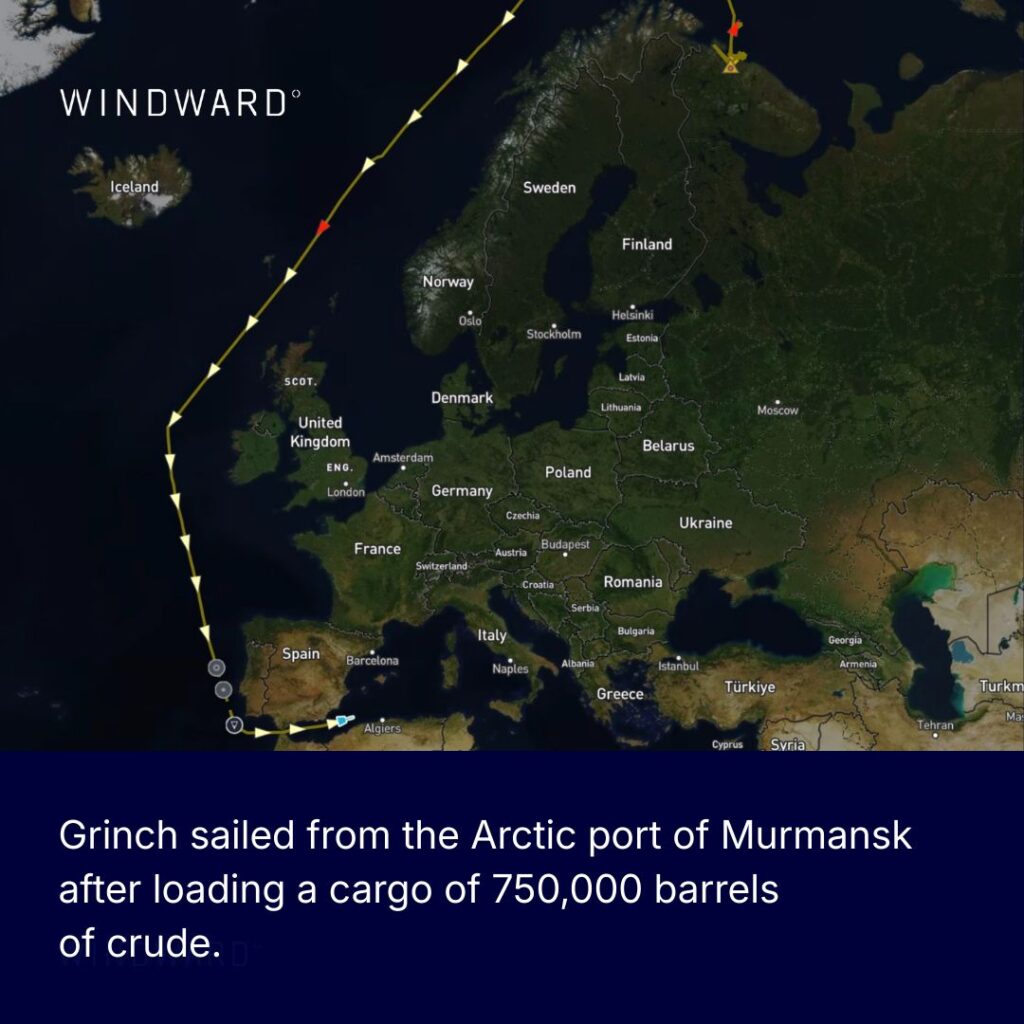
The vessel, sanctioned by the EU, UK, and United States for supporting Russia’s war in Ukraine, was carrying approximately 750,000 barrels of Russian Varandey crude loaded at Murmansk. According to the IMO database, GRINCH was falsely flagged under Comoros, rendering it effectively stateless and subject to boarding under the United Nations Convention on the Law of the Sea.

This action reflects a meaningful shift in European posture. False flagging, once used to evade enforcement, is increasingly becoming the legal basis for interdiction rather than a protective mechanism. France’s move suggests that European authorities may now be prepared to act directly against stateless or fraudulently flagged vessels operating in or near their waters.
Safety Failures Expose Shadow Fleet Operations
A sanctioned, falsely flagged tanker trading Russian oil, Chariot Tide (IMO 9323376), has highlighted how safety failures are emerging as a parallel enforcement pathway.
The vessel signaled “not under command” for nearly 72 hours while transiting near the Strait of Gibraltar and was trailed by multiple tugs through one of the world’s busiest maritime chokepoints. Chariot Tide is falsely flagged under the fraudulent Mozambique registry, invalidating any insurance coverage and complicating rescue or assistance due to uncertainty over payment and liability.

Windward detected the vessel signaling distress off the coast of Morocco, followed by prolonged low-speed maneuvering outside international traffic lanes, consistent with mechanical failure. Laden with approximately 300,000 barrels of diesel loaded at Primorsk in the Baltic, the tanker now represents both a sanctions evasion and a maritime safety risk.
The incident highlights how mechanical failure and regulatory noncompliance are increasingly exposing shadow fleet vessels to intervention, even without a deliberate enforcement trigger.
Strategic Restraint and Observation by Major Powers
Despite enforcement actions involving Russian-linked oil flows and vessels, Moscow has so far exercised restraint. The lack of overt retaliation suggests a prioritization of avoiding escalation that could harden U.S. or European enforcement postures further.
At the same time, these maritime actions are being closely observed by other major powers. The lessons extend beyond sanctions enforcement to how maritime space can be used to apply pressure below the threshold of open conflict.
Doctrinal Context from the 2026 U.S. National Defense Strategy
The release of the 2026 U.S. National Defense Strategy reinforces a structural shift in how the United States views the maritime domain. The strategy positions maritime routes, approaches, and infrastructure as core elements of homeland defense, economic security, and sustained competition, rather than as supporting environments activated only during crises.

Across the document, maritime access is treated as a standing condition that must be secured continuously. Sea lines of communication, chokepoints, ports, and adjacent infrastructure are framed as strategic variables whose disruption, congestion, or denial can carry consequences well beyond the maritime domain. This elevates routine maritime activity into a space where access, proximity, and behavior increasingly factor into national security assessments.
The strategy also elevates the Western Hemisphere as a priority enforcement theater, emphasizing protection of key terrain such as the Panama Canal and surrounding maritime corridors. In parallel, it frames Indo-Pacific stability around preventing coercion or control of sea lanes, increasing the importance of visibility, attribution, and deconfliction at sea rather than escalation or dominance.
Finally, the National Defense Strategy underscores that sustaining this posture depends on persistent awareness and scalable capability. Commercial technology, data, and industrial capacity are treated as strategic enablers, reflecting the reality that maritime monitoring, verification, and interpretation must operate continuously, at scale, and across regions where enforcement responsibility is increasingly distributed among allies and partners.

Explore more

Maritime Defense Weekly: Energy Flows and Infrastructure Risk
Week in Focus Russian Diesel Cargo Signaling Arrival in Cuba A Hong Kong-flagged medium-range tanker is signaling arrival in Cuba on March 2 after multiple AIS destination revisions. The vessel initially broadcast Havana, then shifted to “Caribbean Sea,” and later to “Gibraltar for orders,” despite already transiting the strait. Windward’s assessment indicates the tanker likely...
Read more

Maritime Defense Weekly: Offshore Enforcement and Baltic Exposure
Week in Focus Sanctions Enforcement Moves Further Offshore The United States intercepted and boarded Aquila II (IMO 9281152) in the Indian Ocean, nearly 1,000 nautical miles from where it fled a Venezuelan quarantine zone in January. The 22-year-old Suezmax had falsely broadcast under the Panamanian flag and has a history of extended dark activity and...
Read more

Enforcement Shock Accelerates Dark Fleet Reflagging to Russia
At a Glance A Structural Shift in Russia’s Shadow Fleet At least 120 falsely flagged, sanctioned tankers are likely to reflag to Russia’s registry in the coming months, as Western interdictions of stateless shadow fleet vessels accelerates a structural shift in Russia’s oil export logistics. All ships fit the profile and trading pattern of tankers...
Read more

Maritime Defense Weekly: Enforcement Tightens Across Global Shipping
The Week in Focus Maritime Enforcement Is Shifting From Designation to Constraint Maritime enforcement is increasingly focused on restricting how vessels operate in practice, not just on whether they appear on a sanctions list. Rather than relying solely on designations, recent actions are targeting the services and access that make maritime trade possible, including insurance,...
Read more

Tracking RAIDER: How Long-Term Vessel Behavior Uncovered a Pacific Drug Operation
At a Glance How a Dormant Vessel Triggered a Major Seizure In January 2026, French naval forces interdicted the MV RAIDER, a 41-meter pontoon vessel, in French Polynesian waters, seizing nearly five tonnes of cocaine, with an estimated value of nearly $150 million. Although the vessel was released without charges, its risk profile illustrates how...
Read more