


March 13, 2026
Two Weeks Into the Iran War: A Maritime Intelligence Breakdown


Maritime Defense Weekly: Trade Friction, Maritime Pressure Points
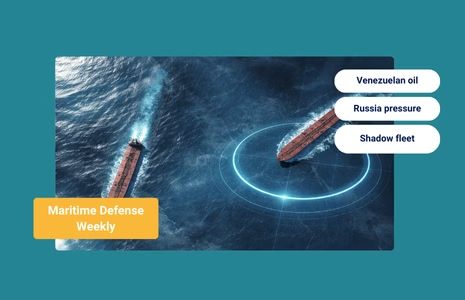
What’s inside?
The Week in Focus
- The White House announced a two-month military “quarantine” of Venezuelan oil, raising immediate questions around scope, legal authority, and treatment of non-sanctioned vessels.
- Russia’s shadow fleet remains a key economic vulnerability, with maritime activity increasingly tied to pressure on war sustainment.
- In the Black Sea, Russian shadow fleet tankers are shifting routes to hug the Turkish coastline following Ukrainian drone strikes, signaling tactical adaptation and heightened escalation sensitivity near NATO-adjacent waters.
- Defense technology trends, especially drones and AI-enabled systems, continue to lower the threshold for maritime disruption and surveillance.
Black Sea: Shadow Fleet Seeks Coastal Cover
Following Ukrainian maritime drone strikes in late November and December, Russia’s shadow fleet has begun altering its operating patterns in the Black Sea. Instead of transiting directly across open water, tankers are increasingly hugging the coastlines of Georgia and Türkiye, in some cases operating within or near Turkish territorial waters.
Windward data identified multiple high-risk tankers operating unusually close to Türkiye’s coast, all previously flagged for smuggling risk and linked to opaque ownership structures. The route change adds approximately 350 miles – roughly 70% additional distance – to voyages from Novorossiysk to the Bosphorus, reflecting a deliberate tradeoff between efficiency and exposure to Ukrainian drone strikes.

By operating near Turkish waters, shadow fleet operators may be betting that Ukraine will hesitate to strike where escalation risks and diplomatic consequences are higher. This places Türkiye in a sensitive position as a key transit corridor for Russian oil exports while facing growing navigational, environmental, and security risks from aging, poorly insured vessels operating along its coastline.
Looking Ahead: Maritime Risk Signals for 2026
Macro Global Overview: Friction Without Closure
As global security and trade structures continue to fragment, through uneven sanctions enforcement, bilateral trade frameworks, contested legal authorities, and the selective application of maritime force, the maritime space is emerging as a primary arena where pressure is applied without formal blockades or closures. Heading into 2026, the prevailing trend is behavioral deterrence – using enforcement ambiguity, jurisdictional gray zones, and escalation risk to influence movement rather than issuing explicit prohibitions.
Transshipment and Rules of Origin Enforcement
In 2026, aggressive enforcement against transshipment and tariff circumvention is likely to expand. This will place increased scrutiny on:
- Routing patterns.
- Port call sequences.
- Ship-to-ship transfers.
Maritime operators should expect compliance risk to be assessed increasingly through behavioral analysis, not just declared documentation.
U.S.-China: Maritime Pressure Below the Threshold
While large-scale conflict remains unlikely, the U.S.-China dynamic will continue to generate maritime risk through gray-zone pressure, trade leverage, and selective enforcement. Partial disruptions, inspections, or signaling actions at sea are more likely than overt escalation.
South Korea and Japan: Maritime Capacity and Deterrence
South Korea’s investment in submarines and shipbuilding, alongside Japan’s accelerating defense posture, points to a more capable and active maritime security environment in East Asia. These developments will shape naval balance, sea lane security, and alliance logistics heading into 2026.
Defense Technology: Lowering the Cost of Maritime Disruption
The continued scaling of drones, autonomous systems, and AI-enabled sensing is reducing the cost of maritime disruption. Surveillance, harassment, and denial at sea are becoming accessible to a wider range of actors, increasing the importance of early detection and pattern recognition.
Russia-Ukraine: Maritime Pressure as Economic Leverage
As the war extends into 2026, maritime pressure is becoming one of the few levers capable of imposing sustained costs on Russia. With Ukraine facing manpower constraints, drones and asymmetric maritime attacks are increasingly used to offset conventional limitations.
Russia’s ability to fund the war remains closely tied to moving energy and commodities by sea. Strikes on oil infrastructure and shadow fleet tankers, including recent Black Sea incidents involving falsely flagged vessels, show how maritime logistics are being treated as economic targets rather than neutral commerce.
The impact goes beyond individual vessels. Elevated risk across maritime logistics chains, unresolved salvage scenarios, and mounting operational friction are already constraining access and increasing the cumulative cost of sustaining maritime flows. As Russia’s economic position continues to degrade, persistent pressure on shadow fleet operations will remain a critical indicator of leverage heading into 2026.

Explore more

Maritime Defense Weekly: Energy Flows and Infrastructure Risk
Week in Focus Russian Diesel Cargo Signaling Arrival in Cuba A Hong Kong-flagged medium-range tanker is signaling arrival in Cuba on March 2 after multiple AIS destination revisions. The vessel initially broadcast Havana, then shifted to “Caribbean Sea,” and later to “Gibraltar for orders,” despite already transiting the strait. Windward’s assessment indicates the tanker likely...
Read more

Maritime Defense Weekly: Offshore Enforcement and Baltic Exposure
Week in Focus Sanctions Enforcement Moves Further Offshore The United States intercepted and boarded Aquila II (IMO 9281152) in the Indian Ocean, nearly 1,000 nautical miles from where it fled a Venezuelan quarantine zone in January. The 22-year-old Suezmax had falsely broadcast under the Panamanian flag and has a history of extended dark activity and...
Read more

Enforcement Shock Accelerates Dark Fleet Reflagging to Russia
At a Glance A Structural Shift in Russia’s Shadow Fleet At least 120 falsely flagged, sanctioned tankers are likely to reflag to Russia’s registry in the coming months, as Western interdictions of stateless shadow fleet vessels accelerates a structural shift in Russia’s oil export logistics. All ships fit the profile and trading pattern of tankers...
Read more

Maritime Defense Weekly: Enforcement Tightens Across Global Shipping
The Week in Focus Maritime Enforcement Is Shifting From Designation to Constraint Maritime enforcement is increasingly focused on restricting how vessels operate in practice, not just on whether they appear on a sanctions list. Rather than relying solely on designations, recent actions are targeting the services and access that make maritime trade possible, including insurance,...
Read more

Tracking RAIDER: How Long-Term Vessel Behavior Uncovered a Pacific Drug Operation
At a Glance How a Dormant Vessel Triggered a Major Seizure In January 2026, French naval forces interdicted the MV RAIDER, a 41-meter pontoon vessel, in French Polynesian waters, seizing nearly five tonnes of cocaine, with an estimated value of nearly $150 million. Although the vessel was released without charges, its risk profile illustrates how...
Read more