


April 2, 2026
April 2, 2026: Iran War Maritime Intelligence Daily


March 9, 2026: Iran War Maritime Intelligence Daily
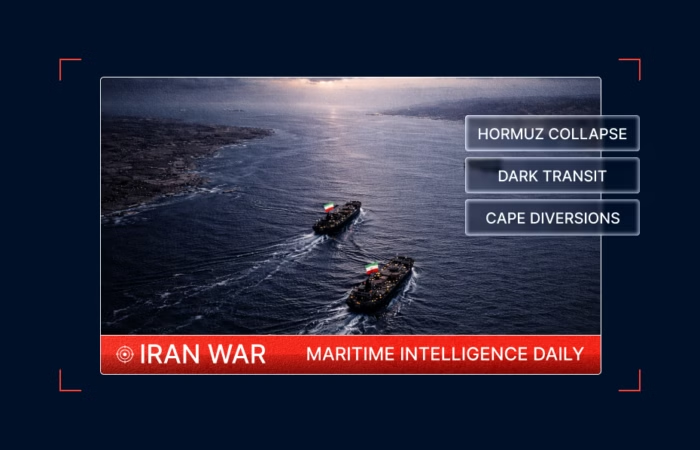
What’s inside?
At a Glance
- Traffic through the Strait of Hormuz fell to its lowest level of the conflict, with only two outbound Iranian-flagged vessels recorded and no inbound crossings.
- Evidence suggests that at least one tanker may have completed a dark transit through the Strait, reappearing after several days with AIS disabled.
- Regional shipping activity continues to redistribute across alternative routes, with Bab el-Mandeb remaining active while Cape of Good Hope transits surged sharply.
- Suez Canal traffic declined below recent averages.
- Operational stress is beginning to appear across regional logistics infrastructure, with rising exception activity across Gulf ports.
- Iraqi oil production and exports dropped as the collapse in Hormuz-linked shipping began affecting upstream supply flows.
- China deployed the Liaowang-1 signals intelligence vessel to the Gulf of Oman, positioning a major maritime surveillance platform near the active conflict theater.
Operational Overview
Commercial shipping through the Strait of Hormuz reached its lowest level of the conflict on March 8, with only two outbound transits recorded and no inbound crossings observed. Both vessels were Iranian-flagged, reinforcing the assessment that international commercial traffic has effectively withdrawn from the waterway.
At the same time, maritime activity is not disappearing but redistributing across alternative routes. Bab el-Mandeb remained active, while Suez Canal traffic declined below recent averages. In contrast, Cape of Good Hope transits surged sharply, reflecting a growing shift toward long-haul rerouting around the Middle East and Red Sea risk environment.
Evidence has also emerged that at least one commercial tanker may have completed a dark transit through Hormuz with AIS disabled before reappearing several days later, suggesting that a small number of operators are still attempting passage under highly atypical operating conditions in order to capture elevated freight premiums.
Operational stress is also beginning to appear across regional logistics infrastructure. Gulf port networks are recording rising exception activity, while Iraqi export flows have dropped sharply as the collapse in Hormuz-linked shipping begins affecting upstream oil production and storage capacity.
The strategic environment is evolving as well. China has deployed the Liaowang-1 signals intelligence vessel to the Gulf of Oman, placing a major maritime surveillance platform within observation range of the active conflict theater.
Together, these signals indicate that the disruption is extending beyond localized transit disruption, with shipping routes, tanker deployment patterns, port operations, and energy export flows beginning to adjust simultaneously.
Strait of Hormuz Traffic
Transit activity through the Strait of Hormuz reached its lowest daily level since the start of the conflict.
Only two crossings were recorded on March 8, both outbound, representing a 33% decrease compared with the previous day and far below the seven-day average of 5.88 crossings.

Both vessels were Iranian-flagged, and no inbound crossings were observed.
The exclusive presence of Iranian-flagged vessels suggests that foreign commercial operators have effectively withdrawn from the waterway, reinforcing the view that international commercial traffic through the Strait has largely ceased.
Industry reporting indicates that some tankers may still be attempting to transit the Strait with AIS signals disabled, but visible maritime traffic remains extremely limited.
Tanker Transit Detected
Evidence indicates that at least one commercial tanker may have completed a highly unusual transit through the Strait of Hormuz during the current crisis.
The vessel appears to have entered the Strait carrying approximately one million barrels of crude oil loaded at Saudi Arabia’s Juaymah Terminal, before switching off its AIS signal around March 4.

The ship reportedly remained dark for approximately five days before its signal reappeared around 07:00 UTC on March 9.
If confirmed, the voyage would represent one of the most audacious commercial transits attempted since the start of the Hormuz disruption.
The maneuver suggests that a small number of operators are attempting to exploit extremely high freight premiums by conducting dark passages through the Strait, minimizing visibility during the highest-risk segment of the voyage.
This behavior highlights the widening divide between risk-averse operators who have halted Gulf transits and a small group of opportunistic owners willing to operate in the current security environment.
Bab el-Mandeb and Suez Canal Traffic
Bab el-Mandeb
Traffic through Bab el-Mandeb remained elevated relative to historical norms.
A total of 30 crossings were recorded, including 14 inbound and 16 outbound movements. While this represents an 11.8% decrease compared with the previous day, activity remains well above the seven-day average.

The continued strength of Bab el-Mandeb traffic indicates that shipping flows are increasingly shifting toward alternative routes as Hormuz remains largely inactive.
Suez Canal
Transit activity through the Suez Canal declined on March 8.
A total of 31 crossings were recorded, representing a 27.9% decrease compared with the previous day and falling below the seven-day average.

The decline likely reflects ongoing uncertainty surrounding Middle East maritime routes and cargo flows rather than a structural closure.
Cape of Good Hope Diversion
Transit activity around the Cape of Good Hope increased sharply.
A total of 89 crossings were recorded, representing an 89% increase compared with the previous day and exceeding the seven-day average.

The surge suggests that rerouting around Africa is accelerating as operators attempt to bypass Middle East and Red Sea security risks affecting traditional transit corridors.
Chinese Intelligence Presence in the Gulf of Oman
China has reportedly deployed the 30,000-ton Liaowang-1 signals intelligence vessel to the Gulf of Oman, escorted by naval surface combatants.
The vessel is a high-capacity maritime intelligence platform capable of monitoring a wide battlespace using long-range sensors and advanced signal-processing systems.
Its positioning near the Strait of Hormuz places it within observation range of the active conflict theater.
The deployment suggests that China is seeking to monitor developments in real time while increasing its informational presence in a region central to its energy security.
Port Operations Disruption
Operational disruptions are beginning to appear across Gulf port infrastructure.
Exception activity recorded on March 8 includes:
- Jebel Ali (UAE): 10 transshipment delay cases (+233% day-on-day).
- Dammam (Saudi Arabia): 5 transshipment delay cases (+400% day-on-day).
- Shuwaikh (Kuwait): 4 late departure cases.
- Umm Qasr (Iraq): 2 transshipment delay cases.
The increase in operational exceptions suggests that logistical strain is spreading across regional container networks as vessels delay or reroute operations.
Iraqi Export Disruption
The collapse in Hormuz-linked shipping is now directly affecting Iraqi oil production and export capacity.
Iraqi authorities reportedly recorded zero oil and commercial vessel entries into Iraqi ports following the effective closure of the Strait.
Production from southern Iraqi fields reportedly fell by 70% to approximately 1.3 million barrels per day, down from roughly 4.3 million barrels per day before the conflict.
Exports reportedly dropped to around 800,000 barrels per day, with only two tankers loading and no new arrivals.
Storage capacity has reportedly reached maximum levels, forcing remaining production to be redirected toward domestic refining.
This represents one of the clearest signs so far that maritime disruption in Hormuz is translating into direct upstream supply destruction.
Saudi and Gulf State Risk Posture
Saudi Arabia has issued a direct warning to Tehran that it will retaliate if its territory or oil infrastructure is targeted.
The warning reflects growing concern among Gulf states that the conflict could widen further, particularly as attacks on vessels, ports, and energy infrastructure continue to expand beyond the immediate Strait of Hormuz approaches.
From a commercial perspective, the warning raises the prospect of further disruption to regional energy production and export infrastructure should the conflict expand into Gulf state territory.
Outlook
The March 9 operating picture shows a maritime environment where disruption is spreading beyond the Strait of Hormuz into global shipping routes, logistics infrastructure, and energy export systems.
Hormuz traffic has effectively collapsed, with only two Iranian-flagged vessels recorded and no inbound commercial traffic observed. At the same time, evidence of at least one tanker conducting a dark transit suggests that a small number of operators may still attempt passage under exceptional conditions.
Shipping activity is redistributing rather than normalizing. Bab el-Mandeb remains active relative to historical averages, Suez traffic has declined below trend, and Cape of Good Hope rerouting is accelerating as operators attempt to bypass Middle East and Red Sea risk corridors.
Operational disruptions are now appearing across Gulf port networks, while Iraqi oil production and exports have already begun to fall as the collapse in Hormuz-linked shipping feeds into upstream supply systems.
Meanwhile, China’s deployment of the Liaowang-1 intelligence vessel signals that major powers are expanding their monitoring presence in the region.
Taken together, these developments indicate that the maritime consequences of the conflict are expanding outward across global shipping networks, energy supply chains, and strategic monitoring activity.
Explore more

April 2, 2026: Iran War Maritime Intelligence Daily
At a Glance Operational Overview Three of the four bulk carriers that exited on April 1 were Greece-owned and one China-owned. This signals that EU as well as Asia shipowners are negotiating at both diplomatic and commercial levels to use the permission-based system. Strait of Hormuz Transits Rise Sanctioned, Iran-linked tankers dominated inbound transits on...
Read more

April 1, 2026: Iran War Maritime Intelligence Daily
At a Glance Operational Overview 36% of transits seen March 31 were on US-sanctioned vessels, while 27% were Greece-owned bulk carriers shipping agricultural commodities to or from the Islamic Republic. This highlights how the selective blockade of the Strait of Hormuz is benefiting Iran. Strait of Hormuz Transit and Selective Denial Transit through the Strait...
Read more

One Month of War in the Gulf: Mapping the Global Maritime Disruption
At a Glance The First Month of the Iran War at Sea One month after the launch of Operation Epic Fury, the maritime system is no longer reacting to disruption. It is operating within it. The first days of the conflict triggered an immediate collapse in commercial confidence. Tankers halted, insurance coverage was withdrawn, and...
Read more

March 31, 2026: Iran War Maritime Intelligence Daily
At a Glance Operational Overview Transit through the Strait of Hormuz remains controlled rather than open, but throughput is increasing. On March 30, six AIS-transmitting vessels crossed the corridor, while additional movements likely occurred under partial or fully dark conditions. At the same time, vessel activity at Bandar Abbas provides visibility into how this system...
Read more

March 30, 2026: Iran War Maritime Intelligence Daily
At a Glance Operational Overview Global oil and maritime markets are now facing simultaneous pressure across three critical export nodes. The Strait of Hormuz remains effectively closed under selective IRGC-controlled transit. Ust-Luga has sustained its fifth UAV attack in seven days. Yanbu is operating as the primary alternative outlet for Gulf crude while facing a...
Read more