


March 15, 2026
March 15, 2026: Iran War Maritime Intelligence Daily


March 15, 2026: Iran War Maritime Intelligence Daily
What’s inside?
At a Glance
- Commercial vessel traffic through the Strait of Hormuz fell to zero on March 14, marking the first full day of the conflict with no AIS-confirmed crossings in either direction.
- Multi-source intelligence detected approximately 400 vessels operating in the Gulf of Oman, indicating a large backlog of ships waiting near the Strait rather than immediately rerouting globally.
- Selective transit behavior continues under exceptional conditions, with several Pakistani and Turkish-linked vessels confirmed crossing the Strait on March 13 under apparent authorization or special circumstances.
- Route redistribution across global shipping corridors remains active, with elevated traffic around the Cape of Good Hope, stable flows through Bab el-Mandeb, and sharply reduced volumes transiting the Suez Canal.
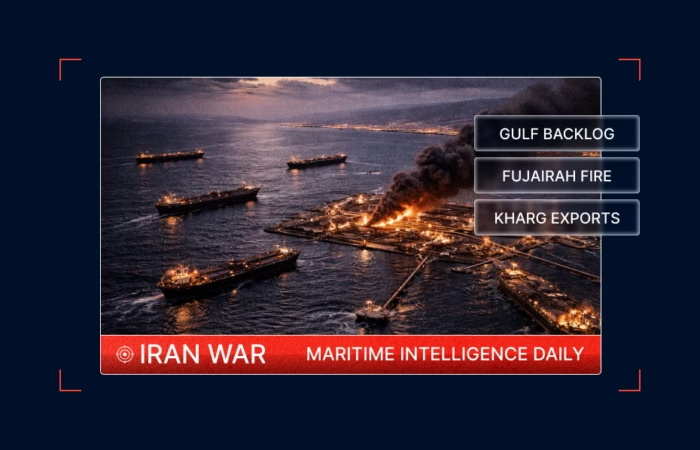
- Energy infrastructure disruption expanded beyond the Strait as a drone-related fire temporarily halted oil loading operations at Fujairah, a key Gulf export and bunkering hub located outside Hormuz.
- Iran’s Kharg Island export terminal remains operational despite recent strikes, while satellite imagery confirms continued tanker activity around the terminal even as export volumes remain significantly below pre-war levels.
- Policy responses to the war-driven oil market disruption are expanding, with OFAC General License 134 allowing Russian oil already loaded on approximately 377 tankers (≈215 million barrels) to complete delivery.
Operational Overview
Maritime activity across the Gulf maritime and energy system remained highly unstable on March 14 as the conflict entered its third week.
Commercial transit through the Strait of Hormuz fell to a new low, with no AIS-confirmed vessel crossings recorded in either direction. The development marks the first visible halt in commercial shipping through the chokepoint since hostilities began.
Despite the lack of visible traffic inside the Strait itself, the surrounding maritime environment remains densely populated. Multi-source intelligence collected on March 13 identified approximately 400 vessels operating across the Gulf of Oman, indicating that many shipping operators are holding position near the chokepoint rather than committing to long-distance diversions.
Selective transit activity also continues under exceptional circumstances. Windward confirmed that four cargo vessels crossed or were crossing the Strait overnight on March 13, including one Pakistani vessel, while three additional vessels were also observed transiting. A Turkish-owned vessel also reportedly received authorization to transit after calling at an Iranian port.
Beyond the Strait, global shipping routes continue to redistribute around the disruption. Traffic through Bab el-Mandeb remained broadly stable, Suez Canal volumes fell sharply below recent averages, and rerouting around the Cape of Good Hope remained elevated.
At the same time, the conflict is beginning to affect adjacent infrastructure and policy systems. Oil loading at Fujairah was temporarily halted after a drone-related fire, work on the 2Africa “Pearls” subsea cable segment in the Arabian Gulf was suspended under force majeure, and the United States issued a sanctions waiver allowing previously loaded Russian oil cargoes to complete delivery.
Taken together, the current maritime picture is defined by visible paralysis inside Hormuz, conditional exceptions for selected vessels, continued global rerouting, and widening disruption across energy infrastructure, logistics, and maritime policy frameworks.
Strait of Hormuz Traffic
Transit activity through the Strait of Hormuz fell to zero on March 14, with no AIS-confirmed crossings recorded in either direction, marking a 100% decrease compared with the previous day, and falling well below the 7-day average of 2.57 crossings.

Iranian officials have framed the situation as a selective restriction rather than a full closure. In remarks on March 15, Iranian Foreign Minister Abbas Araghchi stated that the Strait remains open to international shipping and claimed that only U.S. and Israeli vessels are barred from transit. According to Araghchi, vessels avoiding the area are doing so because of general security concerns rather than formal Iranian enforcement measures.
The statement comes amid U.S. warnings that multinational naval forces could be deployed to ensure freedom of navigation if Iranian attempts to restrict transit continue.
Selective and Low-Visibility Movement
Despite the absence of AIS-confirmed crossings on March 14, intelligence sources indicate that limited vessel movement occurred shortly beforehand.
Windward confirmed that four cargo vessels crossed or were crossing the Strait overnight on March 13 and into the early morning hours, including one Pakistani vessel.

Separately, Turkish authorities confirmed that a Turkish-owned vessel was permitted to transit the Strait after calling at an Iranian port, while 14 additional Turkish-owned vessels remain in the region awaiting clearance.
Multi-source intelligence also identified a ~200-meter vessel transiting the Strait on March 13 at 02:05 UTC, suggesting that isolated movements were still occurring shortly before AIS-visible traffic dropped to zero.

Taken together, these developments suggest that access to the Strait may increasingly be managed through selective authorization rather than normal commercial freedom of navigation, with some vessels permitted passage based on operational or diplomatic considerations.
Gulf of Oman Maritime Overview
Windward Remote Sensing Intelligence for the Gulf of Oman on March 13 identified approximately 400 vessels operating in the region, indicating a densely populated maritime environment surrounding the Strait.


The concentration suggests that many vessels are holding position outside Hormuz rather than dispersing globally, potentially reflecting expectations that the corridor may reopen.
Vessel size distribution includes:
- <80 m: 24 vessels.
- 80–150 m: 127 vessels.
- 150–250 m: 178 vessels.
- 250–350 m: 60 vessels.
- 350 m+: 11 vessels.
Medium-sized vessels between 150–250 meters dominate the distribution, while vessels larger than 250 meters account for roughly 18% of detections.
The relatively small number of vessels under 80 meters suggests that the area represents a commercial shipping concentration rather than a small-craft anchorage zone.
Satellite imagery also identified at least eight vessels positioned east of the Strait, likely operating in floating storage or waiting-to-load patterns.
Kharg Island Export Activity
Iran’s primary crude export terminal at Kharg Island continues to operate despite sustained military strikes and regional maritime disruption.
Recent U.S. strikes reportedly targeted military infrastructure rather than oil loading facilities, suggesting an effort to signal escalation capability without immediately disrupting global oil supply.
Vessel tracking and satellite imagery confirm that limited crude export activity continues at the terminal, with multiple VLCC-class vessels present despite export volumes remaining well below pre-war levels.
According to Vortexa data, two sanctioned tankers departed Kharg after March 11, including SERENA (IMO 9569645), which departed March 11, and ARK III (IMO 9187655), departing March 15.
The combined cargo associated with these departures is estimated at approximately 2.68 million barrels of crude oil.
Satellite imagery indicates a sustained tanker presence around the terminal.
EO imagery from March 14 identified six VLCCs and two smaller tankers positioned at or near the terminal.

SAR imagery from March 15 shows approximately ten tankers in the Kharg anchorage area, suggesting that additional vessels may be waiting to load or operating with limited AIS visibility.

Satellite-based fire monitoring detected active fire signatures on Kharg Island on March 14, consistent with reports of recent strikes, though no active detections were visible on March 15 imagery.

Bab el-Mandeb and Suez Canal Traffic
Bab el-Mandeb
Transit activity through Bab el-Mandeb remained broadly stable on March 14.
A total of 21 crossings (13 inbound, 8 outbound) were recorded, representing a 40% increase compared with the previous day and remaining close to the 7-day average of 22.57 crossings.

Traffic included six bulk carriers, four container vessels, and four crude oil tankers among the most common vessel subclasses observed. Flag distribution was led by Panama with six vessels and Liberia with five, followed by Malta with two vessels.
Suez Canal
Transit activity through the Suez Canal declined sharply.
A total of 23 crossings (15 inbound, 8 outbound) were recorded, representing a 39.47% decrease compared with the previous day and falling significantly below the 7-day average of 36.86 crossings.

Vessel subclasses included five crude oil tankers, five bulk carriers, and two general cargo vessels, while the flag distribution was led by Liberia and Panama with five vessels each, followed by the Marshall Islands with four vessels.
The decline suggests that operators are increasingly avoiding Red Sea routes linked to the Gulf crisis.
Cape of Good Hope Diversion
Rerouting around the Cape of Good Hope remained active on March 14, although overall traffic declined compared with the previous day. A total of 69 crossings were recorded (35 eastbound and 34 westbound), representing a 28.12% decrease compared with the previous day and falling below the 7-day moving average of 78.25 transits.

The traffic mix was led by 27 bulk carriers and 13 container vessels, with five crude oil tankers also observed among the transiting vessels. An additional 24 vessels were classified under other or unidentified categories, reflecting the diverse traffic composition along this long-haul diversion route.
Flag distribution was evenly concentrated among the leading registries, with 10 vessels each flagged to Panama, the Marshall Islands, and Liberia.
Despite the day-to-day decline, the sustained level of traffic confirms that long-haul diversions around Africa remain an active routing strategy as operators continue to avoid higher-risk corridors linked to the Gulf and Red Sea conflict zones. These diversions imply longer voyage times, higher freight costs, and increased logistical pressure on Asia–Europe trade lanes.
Port Operations Disruptions
Operational exceptions on March 14 indicate continuing strain across Gulf-adjacent logistics hubs.
Inside the Gulf
Umm al Quwain, UAE:
- 2 transshipment delays (+900% vs 7-day average).
Hamad, Qatar:
- 2 transshipment rollovers.
Outside the Gulf
Karachi, Pakistan:
- 6 transshipment rollovers.
- 9 delay cases (+152% vs 7-day average).
Salalah, Oman:
- 34 rollovers.
- 36 delays (+76% vs average).
Sohar, Oman:
- 3 delay cases (+162.5% vs average).
The disruption remains concentrated in Oman and Pakistan, reflecting the role of these ports as major transshipment hubs for Gulf-linked cargo flows.
Fujairah Energy Hub Disruption
Oil loading operations at Fujairah, the UAE’s key export and bunkering hub located outside the Strait of Hormuz, were temporarily suspended following a drone-related incident on March 14.
UAE authorities reported intercepting a drone, but debris from the interception caused a fire at the facility, prompting a precautionary halt in loading operations while damage assessments were conducted.
Fujairah is a critical outlet for Murban crude exports and one of the world’s largest bunkering hubs, with more than 70 million barrels of storage capacity.
The incident highlights the vulnerability of alternative export infrastructure relied upon to bypass the Strait of Hormuz.
Critical Infrastructure Disruption
The conflict is also beginning to affect non-shipping maritime infrastructure.
Work on the “Pearls” segment of the 2Africa subsea cable project in the Arabian Gulf has been suspended after contractor Alcatel Submarine Networks issued force majeure notices citing regional security risks.
The suspension underscores how the conflict is beginning to affect digital infrastructure and subsea installation operations, extending disruption beyond shipping and energy markets.
OFAC General License 134
On March 12, the U.S. Treasury’s Office of Foreign Assets Control issued General License 134, temporarily authorizing the delivery and sale of Russian-origin crude oil and petroleum products loaded on vessels on or before March 12, 2026.
The measure is intended to stabilize commodity markets disrupted by the Middle East war and currently affects approximately 215 million barrels of Russian oil carried by 377 tankers that remain at sea or in floating storage. The cargo mix includes about 126 million barrels of crude oil, 60 million barrels of refined products, and 35 million barrels of fuel oil.
Windward data indicates that 44% of the affected tankers are sanctioned by the United States, United Kingdom, or European Union, while roughly 50% are classified as high-risk vessels. The fleet involved includes approximately 10 VLCCs, 60 Suezmax tankers, 135 Aframax or LR2 tankers, and more than 130 Medium Range tankers.
The license allows cargoes already loaded to complete delivery, but does not authorize new Russian oil trade. By enabling these shipments to reach their destinations, the waiver reduces pressure on floating storage while helping stabilize oil markets disrupted by the Gulf conflict.
Russian Oil Floating Storage
Beyond the cargoes covered by GL134, approximately 250 million barrels of Russian crude and petroleum products remain at sea, either in floating storage or awaiting discharge.

China and India remain the largest destination markets for Russian maritime crude flows.

The accumulation of oil on the water reflects both logistical disruption caused by the Gulf conflict and backlog created by sanctions and market volatility.
Outlook
Maritime traffic patterns around the Gulf suggest that shipping operators are currently adopting a wait-and-see posture rather than committing to permanent rerouting. The concentration of hundreds of vessels in the Gulf of Oman indicates that many operators expect some form of reopening or controlled transit regime in the Strait of Hormuz rather than a prolonged closure.
However, the risk environment remains highly unstable. The halt in Hormuz transit, infrastructure disruptions, such as the Fujairah incident, and ongoing military activity across the region continue to create uncertainty for commercial shipping and energy markets.
If restrictions on Hormuz transit persist, the global shipping system is likely to experience continued route redistribution toward the Cape of Good Hope, declining Suez Canal volumes, and sustained logistical pressure on Asia–Europe trade corridors. Energy markets would face additional strain as export routes adjust and floating storage accumulates.
In the near term, maritime activity is likely to remain characterized by limited authorized transits, vessel accumulation outside the Gulf, and elevated reliance on satellite and Remote Sensing Intelligence to monitor activity in contested waters.
Explore more

Two Weeks Into the Iran War: A Maritime Intelligence Breakdown
At a Glance The Second Week of the Iran War at Sea Two weeks after the launch of Operation Epic Fury, the maritime conflict in the Gulf has shifted from immediate disruption to sustained systemic stress across global shipping networks. The initial days of the conflict triggered a rapid collapse in commercial confidence in the...
Read more

March 12, 2026: Iran War Maritime Intelligence Daily
At a Glance Operational Overview Maritime security conditions across the Gulf deteriorated further on March 11 as multiple coordinated attacks targeted commercial vessels across several operating environments, including open transit corridors, anchorage zones, and ship-to-ship transfer areas linked to regional oil exports. Commercial vessel activity through the Strait of Hormuz remains extremely limited. Only two...
Read more

March 11, 2026: Iran War Maritime Intelligence Daily
At a Glance Operational Overview Transit activity through the Strait of Hormuz remained heavily suppressed on March 10, with only two outbound crossings recorded and no inbound movements observed. While this represents a slight increase from the previous day, volumes remain far below normal operating levels and continue to reflect a severely disrupted commercial shipping...
Read more

March 10, 2026: Iran War Maritime Intelligence Daily
At a Glance Operational Overview Commercial shipping through the Strait of Hormuz reached a new low on March 9, with only one outbound transit recorded and no inbound movements observed. The vessel was Iranian-flagged, meaning that all detected crossings during the last 24 hours involved Iranian vessels, reinforcing the assessment that Western-linked commercial shipping has...
Read more