


March 12, 2026
March 12, 2026: Iran War Maritime Intelligence Daily


March 12, 2026: Iran War Maritime Intelligence Daily
What’s inside?
At a Glance
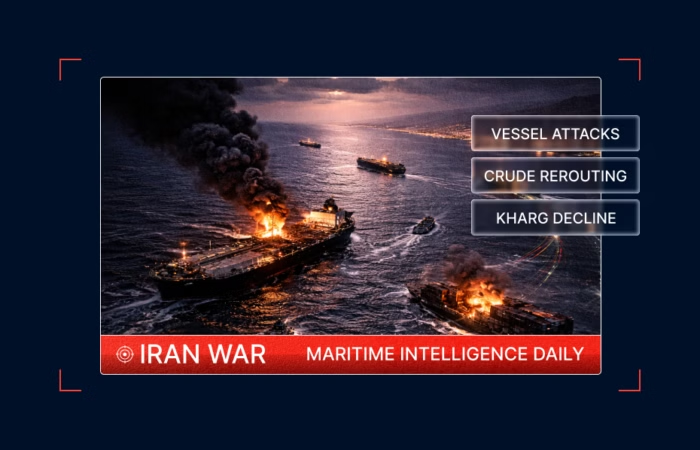
- Maritime security conditions across the Gulf deteriorated sharply on March 11 as coordinated attacks targeted commercial vessels across the Strait of Hormuz, the northern Gulf, and Iraqi territorial waters.
- At least five ships were struck within a 24-hour period, bringing the total number of vessels hit since the start of hostilities on February 28 to at least 16 vessels.
- Transit activity through the Strait of Hormuz remains near a standstill, with only two outbound crossings recorded and no inbound transits.
- As traffic collapses in the Gulf, alternate global routes are absorbing displaced flows. Bab el-Mandeb and Suez Canal traffic rose sharply, while volumes around the Cape of Good Hope remain elevated as vessels continue avoiding the Strait.
- Energy logistics are also shifting. Saudi Arabia is accelerating crude exports through the Petroline pipeline to the Red Sea terminal at Yanbu, enabling shipments to bypass Hormuz entirely.
- Iranian crude exports from Kharg Island have fallen 51.7% since February 28, while tankers servicing the terminal increasingly rely on AIS suppression and spoofing to obscure activity.
Operational Overview
Maritime security conditions across the Gulf deteriorated further on March 11 as multiple coordinated attacks targeted commercial vessels across several operating environments, including open transit corridors, anchorage zones, and ship-to-ship transfer areas linked to regional oil exports.
Commercial vessel activity through the Strait of Hormuz remains extremely limited. Only two outbound crossings were recorded during the reporting period, with no inbound transits observed. The collapse in traffic reflects the combined impact of direct attacks, escalating military confrontation, and the withdrawal of insurance coverage for vessels operating in Gulf waters.
While traffic through Hormuz has slowed dramatically, alternate global routes are absorbing displaced maritime flows. Transit volumes increased sharply through both Bab el-Mandeb and the Suez Canal, while Cape of Good Hope rerouting continues to rise, confirming the sustained diversion of vessels away from high-risk waters near the Strait.
Energy supply logistics are also adapting. Saudi Arabia is increasingly redirecting crude exports westward through the Petroline pipeline to the Red Sea export terminal at Yanbu, enabling oil shipments to bypass Hormuz entirely.
The maritime picture now reflects a region operating under sustained high-risk conditions, where direct vessel attacks, disrupted shipping flows, and shifting export logistics are reshaping trade patterns across the Middle East.
Strait of Hormuz Traffic
Transit activity through the Strait of Hormuz remained severely constrained on March 11.
A total of two crossings were recorded, both outbound, representing a 33% decrease compared with the previous day and remaining broadly aligned with the seven-day average of 2.57 crossings.

The vessels included one crude oil tanker and one vessel of unknown classification.
Flag distribution included one Comoros-flagged vessel and one Netherlands Caribbean-flagged vessel.
No inbound crossings were recorded during the reporting period.
Attacks and Incidents
March 11 marked one of the most severe days of maritime attacks since the conflict began.
At least five vessels were targeted across the Gulf region, including incidents in the Strait of Hormuz, waters near the United Arab Emirates, and Iraqi territorial waters. These attacks bring the total number of ships struck since February 28 to at least 16 vessels across the Gulf and Red Sea theaters.
Mayuree Naree
The Thailand-flagged bulk carrier MAYUREE NAREE sustained the most severe damage when Iranian projectiles struck the vessel approximately 11 nautical miles north of Oman while it was transiting the Strait of Hormuz.

The strike triggered a stern engine-room fire that disabled propulsion. All crew members were evacuated, although three crew members were initially reported missing and believed trapped in the engine room at the time of the incident.
AIS data shows the vessel exhibited extensive dark activity during the nine days preceding the attack, including anomalous speed readings between 81 and 101 knots, behavior consistent with AIS spoofing or signal manipulation.
The vessel had departed Khalifa Port in the UAE and was sailing toward Kandla, India, when it was struck.
One Majesty
The Japan-flagged container ship ONE MAJESTY was struck by a projectile approximately 25 nautical miles northwest of Ras Al Khaimah.

The vessel sustained minor hull damage above the waterline, including a 10-centimeter breach. It remains seaworthy and is proceeding toward a safe anchorage.
Star Gwyneth
The Marshall Islands-flagged bulk carrier STAR GWYNETH was struck by a projectile roughly 50 nautical miles northwest of Dubai.
The strike caused a two-meter hull breach in the forward cargo hold and damaged a ballast tank, forcing the vessel to anchor for inspection. All crew members remain safe aboard.
The vessel had departed Iran’s Imam Khomeini port nine days earlier following a 12-day port call. The timing raises questions about whether vessels with recent operational links to Iranian exports may face heightened exposure during the conflict.
Basra Ship-to-Ship Tanker Attack
Two crude oil tankers engaged in a ship-to-ship transfer operation near the Basra offshore STS zone were attacked overnight in Iraqi waters.
The vessels were identified as SAFESEA VISHNU, a Marshall Islands-flagged tanker owned by the U.S.-based Safesea Transport Group, and ZEFYROS, a Malta-flagged tanker linked to Greek shipping interests.

The attack occurred roughly five nautical miles south of Al Basrah while both vessels were actively transferring cargo.
Maritime security reporting indicates that explosive-laden Iranian surface vessels struck both tankers, triggering large fires onboard. Iraqi Coast Guard units evacuated the surviving crew members.
One Indian crew member aboard SAFESEA VISHNU was killed in the blast.
The severity of the fires and the proximity to offshore infrastructure prompted Iraqi authorities and the State Organization for Marketing of Oil (SOMO) to immediately suspend export terminal operations.
The attack represents a clear escalation in targeting strategy. Striking tankers during an STS transfer maximizes both economic disruption and environmental risk within the Gulf’s energy export system.
IRGC Warning and Safe Sia Incident
Iran’s Islamic Revolutionary Guard Corps (IRGC) has continued issuing warnings that vessels operating in Gulf waters may be targeted if military operations against Iran persist.
Iranian media reported that a Marshall Islands-flagged, U.S.-owned tanker named SAFE SIA was struck in the northern Persian Gulf after allegedly ignoring warnings issued by the IRGC Navy. Details of the incident remain limited and are still being verified.
Escalation in Maritime Targeting
The attacks follow repeated IRGC statements that vessels perceived to be linked to the United States, Israel, or their partners could be targeted if military operations against Iran continue.
With the latest incidents, the total number of vessels struck since the start of the conflict has reached at least 16 ships.
Shipping activity across the Gulf has slowed dramatically since February 28, when U.S.–Israeli strikes on Iran triggered widespread disruption to commercial maritime traffic.
Bab el-Mandeb and Suez Canal Traffic
Bab el-Mandeb
Transit activity through Bab el-Mandeb increased significantly on March 11.
A total of 26 crossings were recorded, representing a 62.5% increase compared with the previous day and rising above the seven-day average of 23.3 crossings.

Traffic included six bulk carriers, five crude oil tankers, and four oil products tankers. Flag distribution was led by Liberia (seven vessels), followed by Panama (six) and the Marshall Islands (three).
Suez Canal
Transit activity through the Suez Canal also rose sharply.
A total of 44 crossings were recorded, representing a 63% increase compared with the previous day and significantly exceeding the seven-day average of 35.29 crossings.

Traffic included 10 bulk carriers, six crude oil tankers, and five oil/chemical tankers. Flag distribution was led by Panama, the Marshall Islands, and Liberia.
Cape of Good Hope Diversion
Traffic around the Cape of Good Hope remained elevated.
A total of 86 crossings were recorded, representing a 7.5% increase compared with the previous day and remaining broadly aligned with the seven-day average of 82.43 crossings.

The majority of vessels were bulk carriers, followed by container vessels and crude tankers.
These sustained volumes confirm that rerouting around Africa remains a primary diversion route for vessels avoiding Middle Eastern transit corridors.
Port Operations Disruptions
Operational exceptions increased across several Gulf and regional ports on March 11.
Inside the Gulf
Jebel Ali, UAE:
- 8 late departures (-27.27% vs previous day, +36.59% vs 7-day average).
- 25 transshipment rollovers (+316.67% vs previous day).
- 25 transshipment delays (+101.15% vs 7-day average).
Hamad, Qatar:
- 3 late departures (+200% vs previous day).
Shuwaikh, Kuwait:
- 2 late departures.
- 2 transshipment rollovers.
Outside the Gulf
Karachi, Pakistan:
- 5 late departures.
- 8 transshipment delays (+300% vs weekly average).
Salalah, Oman:
- 11 late departures.
- 8 rollovers.
- 88 transshipment delay cases (+343% vs weekly average).
These disruptions indicate increasing operational strain across Gulf and near-Gulf logistics networks.
Iranian Oil Exports from Kharg Island Decline Sharply
Iran’s primary crude export hub at Kharg Island has experienced a significant decline in throughput since the start of hostilities on February 28.
Average export volumes have fallen from approximately 2.04 million barrels per day between February 1 and February 27 to roughly 0.98 million barrels per day between February 28 and March 12, representing a 51.7% reduction in daily crude exports from Iran’s main loading terminal.

Remote Sensing Intelligence indicates that the tankers servicing Kharg Island are increasingly relying on AIS suppression and location spoofing to obscure export activity. Six Very Large Crude Carriers (VLCCs) linked to the terminal have exhibited deceptive tracking behavior since the start of the conflict.
Satellite imagery from March 7 confirmed three vessels — HEDY, NORA, and PING SHUN — either docked or waiting near the terminal, despite their broadcast AIS signals indicating different locations.

Several vessels in the fleet have been operating completely dark. NORA has not transmitted AIS since February 14, DANIEL since February 22, and HEDY since February 24, even though satellite imagery confirms their presence near Kharg.
Other ships are actively spoofing their positions. PING SHUN broadcast a circular movement pattern in the Gulf of Oman while imagery confirmed it was waiting at the terminal, before departing Kharg on March 10. STAR FOREST transmitted a linear track across the Iran–Kuwait–Iraq EEZ triangle despite showing no physical movement consistent with that track.

These patterns indicate that Iranian export operations are continuing at reduced levels but with heightened reliance on deceptive shipping behavior, likely intended to obscure loading activity and reduce exposure to sanctions enforcement or targeting.
Wet Cargo Analysis: Saudi Red Sea Export Pivot
Saudi Arabia is accelerating efforts to bypass the Strait of Hormuz by redirecting crude exports toward the Red Sea.
Arab Light crude is now being transported through the 1,200-kilometer Petroline pipeline, linking eastern production fields directly to the Red Sea export terminal at Yanbu.
A fleet of 27 Very Large Crude Carriers (VLCCs) is currently signaling Yanbu as their destination. Each vessel can carry roughly two million barrels of crude, indicating sustained export activity through the remainder of the month.
Arrival schedules suggest continuous loading activity, with one vessel arriving immediately, 21 VLCCs scheduled to load by March 21, and five additional vessels expected to arrive between March 22 and March 25. Arrivals are averaging one to two vessels per day.
Ownership within the fleet shows a strong concentration among state-linked shipping operators. Approximately 46% of the vessels are owned by Saudi Arabia’s Bahri, while 32% are owned by China’s COSCO, with the remainder controlled by independent tanker operators.
Freight markets are already reflecting the pressure created by this rerouting. Charter rates for Yanbu-to-Asia VLCC voyages have surged to roughly $460,000 per day, among the highest rates recorded for this route.
Outlook
Maritime risk across the Gulf and surrounding waterways remains extremely elevated following the March 11 attacks.
Recent incidents demonstrate that commercial vessels are now being targeted across multiple operational contexts, including ships transiting the Strait of Hormuz, vessels anchored or drifting in Gulf waters, and tankers engaged in ship-to-ship transfer operations tied to regional oil exports.
The strike against the Thailand-flagged MAYUREE NAREE during its Hormuz transit, combined with attacks near Dubai and within Iraqi STS zones, indicates that both moving and stationary vessels may be exposed to threat activity.
Iranian messaging continues to reinforce this escalation. IRGC officials have warned that vessels operating in Gulf waters could be targeted if attacks against Iran persist, while Iranian media have reported additional strikes against ships allegedly ignoring naval warnings.
Reports that Iran may be preparing naval mine deployments within the Strait of Hormuz further raise the possibility that the chokepoint could become temporarily inaccessible to commercial shipping.
Shipping operators should expect continued disruption to vessel movement, elevated war-risk exposure, and additional attacks against commercial maritime targets while the conflict remains active.
Explore more

March 11, 2026: Iran War Maritime Intelligence Daily
At a Glance Operational Overview Transit activity through the Strait of Hormuz remained heavily suppressed on March 10, with only two outbound crossings recorded and no inbound movements observed. While this represents a slight increase from the previous day, volumes remain far below normal operating levels and continue to reflect a severely disrupted commercial shipping...
Read more

March 10, 2026: Iran War Maritime Intelligence Daily
At a Glance Operational Overview Commercial shipping through the Strait of Hormuz reached a new low on March 9, with only one outbound transit recorded and no inbound movements observed. The vessel was Iranian-flagged, meaning that all detected crossings during the last 24 hours involved Iranian vessels, reinforcing the assessment that Western-linked commercial shipping has...
Read more
March 9, 2026: Iran War Maritime Intelligence Daily
At a Glance Operational Overview Commercial shipping through the Strait of Hormuz reached its lowest level of the conflict on March 8, with only two outbound transits recorded and no inbound crossings observed. Both vessels were Iranian-flagged, reinforcing the assessment that international commercial traffic has effectively withdrawn from the waterway. At the same time, maritime...
Read more

March 8, 2026: Iran War Maritime Intelligence Daily
At a Glance Operational Overview Traffic through the Strait of Hormuz remained near a standstill on March 7, with only three total crossings recorded and SAR imagery confirming continued lean traffic conditions through the waterway. The small number of successful transits suggests that passage remains possible for a narrow subset of vessels, even as the...
Read more