


September 17, 2026
77 Ships Blacklisted, None Deterred: Inside Iran's Failing Hormuz Toll Regime


Kharg’s Western Terminal Reactivates as the Caspian Corridor Structurally Expands

What’s inside?
At a Glance
- President Trump stated the U.S. has total control of the Strait of Hormuz via its naval blockade, while Iran said it still controls the waterway and plans a toll system, with no resolution framework in place.
- Kharg Island’s western terminal reactivated on August 12 for the first time since July 18, ending 25 consecutive days empty, with a dark VLCC-class tanker berthed and loading.
- The eastern and LPG terminals at Kharg remain empty for 14 and 17 consecutive days, respectively.
- North Larak anchorage held 35 tanker and cargo hulls on August 12, up from 28 on August 10, with dark vessels accounting for approximately 74% of the cluster and 10 sanctioned vessels identified.
- The CAROLINE BEZENGI oil slick has grown to 390 to 400 square kilometers as of August 10, up from approximately 20 square kilometers on July 31, with projections of a further approximately 121-kilometer advance over the following 48 hours.
- CARUZO, a Sierra Leone-flagged Suezmax tanker, resumed AIS transmission after a 66-day dark period covered in anti-drone nets and IBC water tanks, marking the beginning of a wider commercial response to Ukraine’s drone campaign.
- Russia-Iran Caspian Sea maritime trade has structurally shifted, with wet cargo movements from Russia to Iran rising 2.9 times and volume rising 2.5 times in the 164 days following the February 28 blockade escalation.
- A subsea cable off Perth, Australia was reported damaged inside its protection zone on August 11, with an investigation open.
Competing Claims on Hormuz Control
President Trump stated the U.S. has total control of the Strait via its naval blockade. Iran says it still controls the waterway, plans a toll system, and will not reopen it until its conditions are met. The competing claims reflect an increasingly hardened diplomatic posture on both sides with no resolution framework in place.
EO imagery collected over the Strait of Hormuz on August 13 at 02:16 to 02:17 UTC identified dark cargo and tanker activity clustered in the Qeshm and Larak pocket, alongside an Iran-flagged landing craft transiting toward Larak Island.
North Larak Anchorage Absorbs Additional Sanctioned Tonnage
EO imagery collected over the Strait of Hormuz on August 12 at 02:33 UTC showed the North Larak anchorage holding 35 tanker and cargo hulls, up from 28 on August 10, with dark vessels accounting for approximately 74% of the cluster. Ten sanctioned vessels were identified at North Larak on August 12, with all eight named sanctioned vessels present on August 10 remaining on station and two newly correlated this pass, both transmitting and both sanctioned, indicating the anchorage is actively receiving additional sanctioned tonnage. The West Larak anchorage showed a smaller but corroborating increase, with 14 tanker and cargo contacts on August 12 against 13 on August 10, with the dark tanker sub-cluster growing from 7 to 8 vessels.
KAVOMALEAS (IMO 1042823), the oil products tanker attacked on June 20, remains stationary approximately 170 nautical miles from its last recorded position as of the August 10 collection, consistent with a vessel holding position rather than transiting. Thirty-six high-speed craft were assessed in the northern corridor providing a possible escort or patrol overlay to the broader anchorage activity, though no direct link to specific vessels is confirmed.
Kharg Island’s Western Terminal Reactivates After 25 Days
SAR imagery collected over Kharg Island on August 11 at 14:11 UTC confirmed all three terminals remained empty — the western terminal for 24 consecutive days, the LPG terminal for 15 consecutive days, and the eastern terminal for 12 consecutive days. The waiting area held 17 dark stationary tankers, unchanged from August 9. Vortexa records zero departures from July 31 through August 11.

EO imagery collected on August 12 at 08:52 UTC showed the western oil terminal reactivated for the first time since July 18, ending 25 consecutive days empty, with a dark VLCC-class tanker of approximately 333 meters berthed and loading. The eastern oil terminal and LPG terminal remained empty for 13 and 16 consecutive days, respectively.
SAR imagery collected on August 13 at 02:08 UTC confirmed the western terminal vessel, assessed as the same VLCC that had been holding in the waiting area since July 11 before finally berthing, remains at berth and loading. The eastern terminal stayed empty for 14 consecutive days and the LPG terminal for 17 consecutive days. The waiting area eased slightly to 16 dark tankers, down one from 17 on August 11, consistent with the western terminal arrival having departed the waiting area to berth.

The CAROLINE BEZENGI Oil Slick Grows
CAROLINE BEZENGI (IMO 9224439), a Cameroon-flagged sanctioned Suezmax tanker that grounded at the Hallaniyat Islands on June 12 after being struck by an explosion between June 6 and 8, is producing a slick now assessed at 390 to 400 square kilometers by Oman’s Environment Authority as of August 10, up from approximately 20 square kilometers on July 31, with projections of a further approximately 121 kilometer advance over the following 48 hours.
No salvage vessel is yet on scene. The vessel was carrying approximately 1 million barrels of Russian-origin crude from Novorossiysk to Sikka, India at the time of the explosion. The grounding site is inside a protected marine reserve. Oman made its first public disclosure on August 10, nearly two months after the incident.
Yanbu Sustains Dark Fleet Loading Turnover
EO imagery collected on August 13 at 03:53 UTC confirmed continued loading-berth turnover at Yanbu King Fahd, with a near-complete tanker line refresh since the August 10 collection. Twelve vessels were assessed loading, down from 14 on August 10, with five vessels unchanged since August 10 and seven new dark tanker arrivals since that collection, all assessed laden, ranging from approximately 149 to 333 meters. One dark cargo vessel of approximately 125 meters was observed transiting from the waiting area into the berth line.
Per Vortexa, nine vessels departed Yanbu between August 10 and 13 — Arab Light crude and clean products bound for Egypt, India, the UAE, the Bahamas, and the U.S. Gulf Coast — with a total loaded quantity of approximately 8.63 million barrels. One dark laden tanker of approximately 184 meters is assessed with probable confidence as NCC MASA (IMO 9688336), the vessel identified inbound to Yanbu on August 10, now assessed as having completed its inbound transit and loading at berth.
The waiting area holds three dark tankers at anchor ranging from approximately 107 to 149 meters. The predominantly dark posture at Yanbu King Fahd has been sustained since July 27.
CARUZO Emerges from a 66-Day Dark Period With Anti-Drone Protection
CARUZO (IMO 9137648), a Sierra Leone-flagged Suezmax tanker, resumed AIS transmission at the northern mouth of the Bosphorus Strait on August 11 after a 66-day dark period running from June 6 to August 11, one of the longest continuous AIS blackouts tracked in the Russia shadow fleet this year. The vessel transmitted a laden status and a destination of Istanbul for orders before changing to a Canakkale pilot signal during transit. By evening, it was transiting south through the Bosphorus past Istanbul into the Sea of Marmara before slowing overnight and anchoring by 08:30 BST on August 12. Cargo is assessed at approximately 1.02 million barrels of crude per Vortexa.
The vessel has sailed under three flags since being sold into dark fleet trading in August 2023, with prior activity including loading Russian crude from the Baltic ports of Ust-Luga and Primorsk since October 2023, ship-to-ship transfers in the Kerch Strait, and port calls at the Russian-occupied Crimean port of Kamysh-Burun. The UK, EU, Switzerland, Canada, and Australia designated the vessel across 2025, with New Zealand adding it in February 2026. The U.S. has not sanctioned it. The U.S. has not sanctioned any Russian tankers since January 2025, the last action taken under the Biden administration. The vessel’s registered owner and manager changed on August 8, three days before the Bosphorus transit, to a China-incorporated firm.
The vessel was observed covered in anti-drone nets and IBC water tanks during the Bosphorus transit per open-source photography. At least 40 ships have been struck by Ukrainian or Russian drones or missiles since July, including five at the CPC terminal at Novorossiysk. Ukraine’s Operation MoLoChKa claimed more than 100 small tankers providing logistics to Crimean ports, with Ukraine’s Unmanned Forces putting the running total at well over 200 vessel strikes by early August.
CARUZO’s anti-drone protection may mark the beginning of a wider commercial response. Some operators are hiring private maritime security firms to watch for incoming uncrewed boats, rigging cable or mesh netting to snag drones before they reach the hull, or fitting armour plating and sandbags at Russia’s reported instruction to bulk carriers calling at its ports.
Russia’s Black Sea Fleet has had approximately a third of its combat strength put out of action by drones and uncrewed boats since 2022, with state budgets and dedicated crews, and is still losing hulls to the same tactics in 2026. The commercial owners now fitting netting and hiring watchmen are not navies. They are operators losing assets when their ships and cargo cannot move, and for the moment they appear to be the only ones taking protective action on their own initiative.
The Caspian Sea Russia-Iran Corridor Structurally Expands
A Windward analysis covering the 164 days before and after the February 28, 2026 blockade escalation documents a sustained structural shift in Russia-Iran maritime trade through the Caspian Sea. Russian cargo and tanker visits to Iran’s EEZ rose 13%, from 208 to 235, and Iranian vessels visiting Russia’s EEZ rose 7%, from 142 to 152. Wet cargo data shows the same shift more sharply at the shipment level. Russia-to-Iran wet cargo movements rose 2.9 times from 8 to 23 shipments, with volume rising 2.5 times from approximately 174,100 to approximately 437,000 barrels, per Vortexa. Iran-to-Russia flows remain at zero, a one-way supply corridor.

On top of this structural shift, a shorter mid-to-late July window shows a sharper spike, as tanker presence and Iranian anchorage counts combined ran approximately 2.0 times above baseline, 82 versus 42 expected, on top of a tanker baseline already elevated approximately 6.5 times since September 2025. Iran’s own public announcement on July 21 to 22 of a pivot of more than 30% of imports through Russia and Caspian routes directly predicts and spans the full anomaly window.
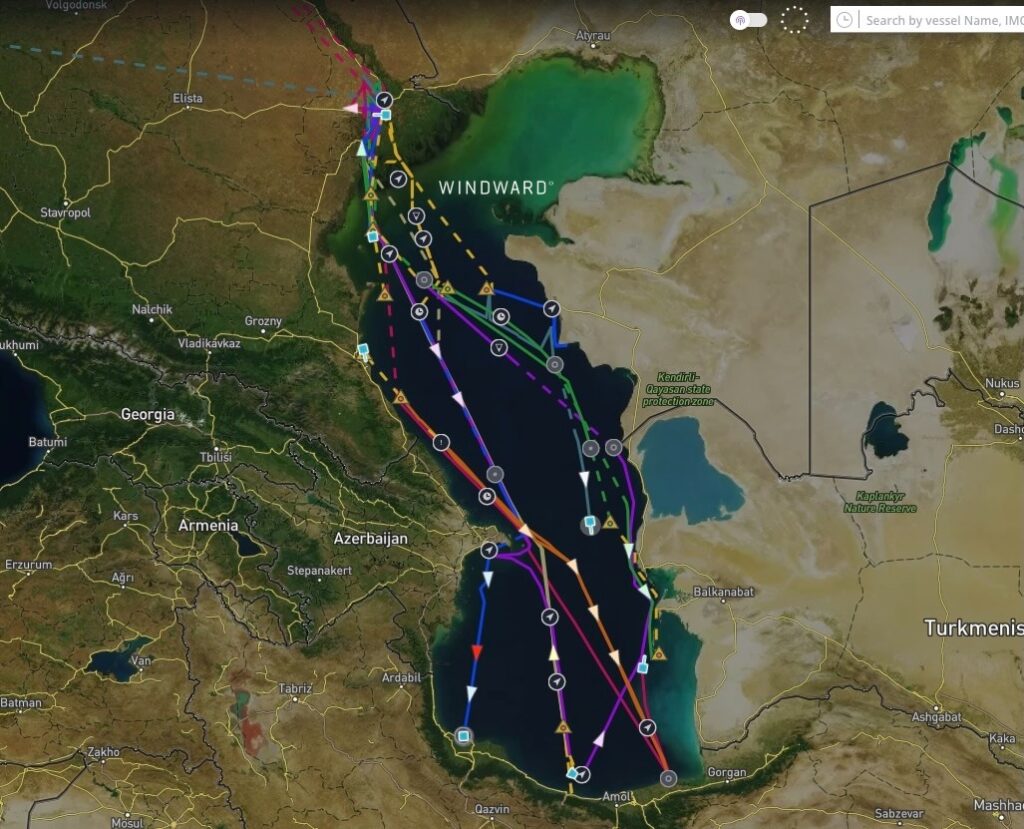
As of August 8, Iran and Russia officials were actively negotiating a joint roadmap explicitly targeting Caspian Sea logistics, covering facilitation of Iranian essential goods transportation through the Caspian Sea and removal of obstacles to maritime and land trade, alongside the Rasht-Astara railway project.
The dominant signal is structural and deliberate rather than event-driven, assessed as a direct reaction to the Hormuz blockade and a durable expansion of the Russia-Iran bilateral trade relationship. The July 25 to 27 Ukrainian strike on a Caspian-transiting Iran-linked vessel represents a live risk to watch, as continued strikes on this corridor could temporarily deter cargo movement independent of the underlying structural growth.
Perth Subsea Cable Damaged
A subsea cable off Perth, Australia was reported damaged inside its protection zone on August 11. No cause has been made public, and a vessel-detection investigation into the cause is open but at an early stage. Windward’s multi-sensor intelligence has identified a suspect for the cable cut.
Outlook
Iran’s export architecture continues to adapt as the U.S. blockade holds. Kharg Island’s western terminal reactivated for the first time in 25 days, with a VLCC that had been holding since July 11 finally berthed and loading. North Larak anchorage has grown from 28 to 35 hulls in two days, actively absorbing additional sanctioned tonnage. And the Caspian Sea corridor is now measurably functioning as a durable structural workaround, with Russia-to-Iran wet cargo movements 2.9 times higher than pre-blockade levels and both governments actively negotiating a joint logistics roadmap.
The commercial response to the wider conflict is beginning to show. CARUZO’s anti-drone nets and water tanks at the Bosphorus mark the first visible commercial adaptation to Ukraine’s Operation MoLoChKa drone campaign, which has struck more than 200 vessels since inception. Operators are moving ahead of state actors, hiring private maritime security and fitting protective gear on their own initiative.
The environmental cost of the sanctioned dark fleet is compounding. The CAROLINE BEZENGI oil slick has grown twentyfold in 10 days to 390 to 400 square kilometers, with a further 121-kilometer advance projected over the next 48 hours and no salvage vessel yet on scene. And a subsea cable off Perth was reported damaged inside its protection zone on August 11, with the investigation open.
Windward assesses the operational risk environment across the Strait of Hormuz, northern Arabian Gulf, Caspian Sea, Black Sea, and eastern Mediterranean as elevated, with Iran’s export architecture visibly adapting through Kharg terminal reactivation, North Larak sanctioned tonnage accumulation, Caspian corridor expansion, and commercial-side protective adaptation to the widening kinetic threat environment.
Explore more

77 Ships Blacklisted, None Deterred: Inside Iran’s Failing Hormuz Toll Regime
At a Glance Operational Overview Iran’s Persian Gulf Strait Authority opened in mid-May to oversee transits and toll payments through the Strait of Hormuz. It has since released three tranches of blacklisted vessel names, on August 24, September 2, and September 14. Windward analysis of all 77 vessels finds that every one used the “unauthorized”...
Read more

The Houthis Take Perim and Petroline Is Hit as Freight Rates Cross $1 Million a Day
At a Glance Operational Overview Saudi Arabia’s workaround to the partial closure of the Strait of Hormuz came under direct attack last week. Saudi Arabia diverted crude to the Red Sea port of Yanbu via the East-West pipeline. On September 10, a pumping station on the pipeline was attacked and preemptively shut down. On the...
Read more

A Fatal Strike and the First Seizure Since June as Iran’s Transit Rules Take Effect
At a Glance A Chief Engineer Killed Aboard a Bulk Carrier Exiting Hormuz MINOAN DIGNITY (IMO 9294484), a Liberia-flagged bulk carrier of 225 meters and 76,801 DWT, was struck by an unknown projectile in its engine room while transiting outbound through the Strait of Hormuz southern corridor overnight on August 17 to 18. The vessel’s...
Read more

A Second ADNOC Strike in a Week as Koh-e-Mubarak Hardens Into an Evasion Hub
At a Glance Two ADNOC Tankers Strcuk by Iranian UAVs The UAE Ministry of Foreign Affairs condemned what it described as a hostile Iranian attack on two ADNOC-affiliated vessels struck by UAVs while transiting the Strait of Hormuz on August 14, with no injuries reported. The UAE called it a violation of UN Security Council...
Read more