


March 20, 2026
Iran War at Sea: How the Conflict Is Disrupting Global Trade and Energy


Electro-Optical (EO) Imagery: Bringing Maritime Intelligence Into Focus
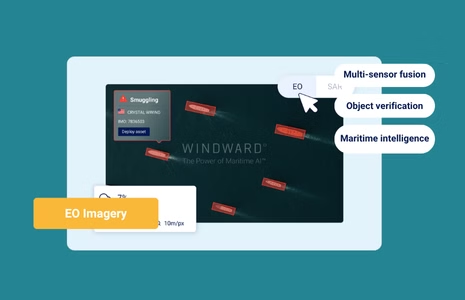
What’s inside?
At a Glance
- EO imagery (electro-optical imagery) captures reflected sunlight to deliver color-based satellite views of maritime activity.
- It’s the most visual layer of remote sensing intelligence, offering confirmation that complements SAR and RF detections.
- Enables faster validation of data, detection of deceptive shipping practices, and continuous monitoring of maritime operations.
- EO imagery has evolved from government and defense applications to commercial and compliance use cases.
- It plays a vital role in verifying vessel identity, tracking port activity, and supporting sanctions compliance.
- EO is integrated within Windward’s Remote Sensing Intelligence solution, combining visual data with behavioral analytics for a complete maritime picture.
The Visual Foundation of Remote Sensing Intelligence
From detecting ship-to-ship (STS) transfers to confirming cargo operations, decisions in the maritime domain often depend on what can be seen and verified. EO imagery – short for electro-optical imagery – provides that visual proof.
Unlike sensor data or automated alerts, EO imagery delivers a direct, human-understandable view of activity at sea. It provides clear visual confirmation of maritime events, enabling faster, more confident decision-making.
As part of Windward’s Remote Sensing Intelligence solution, EO imagery connects seamlessly with synthetic aperture radar (SAR), radio frequency (RF) emissions, and behavioral analytics. Together, these sources fuse into one operational picture, enabling users to see not only where something is happening, but what it truly means.
What Electro-Optical (EO) Imagery Is and How It Works
EO imagery captures light reflected from the Earth’s surface, much like a high-resolution camera in orbit. The imagery is composed of several light bands:
- Panchromatic: Single grayscale band with high spatial resolution, ideal for spotting details.
- Visible (RGB): Three color bands – red, green, blue – showing the world as the human eye perceives it.
- Multispectral: Combines visible and infrared bands to reveal details about materials, vegetation, or water clarity.
In maritime operations, these capabilities can be translated into actionable intelligence. Analysts can use EO imagery to identify vessel types, verify activity at ports, and even assess infrastructure conditions by comparing images over time.
However, EO depends on sunlight and clear skies, meaning it’s less effective under cloud cover or at night.

From Military Tool to Commercial Maritime Insight
The evolution of electro-optical (EO) imagery began in the early days of the space race. In 1959, the United States launched CORONA (KH-4B), the world’s first successful reconnaissance satellite, capable of photographing Earth’s surface from orbit. Initially designed for military intelligence, CORONA marked the beginning of space-based surveillance, giving the U.S. a strategic advantage during the Cold War. That same year, Explorer-6 transmitted the first TV images of Earth from space, marking the birth of EO-based remote sensing.
In the 1960s through the 1990s, EO imaging advanced rapidly from strategic reconnaissance and meteorological monitoring to civilian and commercial observation. Early missions like TIROS, Nimbus, and Landsat-1 (1972) pioneered Earth observation for weather forecasting, environmental monitoring, and military mapping. By the 1980s, programs such as SPOT expanded global access to optical data, bridging government use and private-sector applications. The multispectral and hyperspectral era that followed in the 1990s, marked by IKONOS (1999) and QuickBird (2001), delivered sub-meter resolution and made high-quality satellite imagery available to civilian users for the first time.
From 2010 onward, the EO landscape was transformed by miniaturization, commercialization, and the entry of private space companies. Startups deployed small satellites equipped with advanced optical sensors, enabling revisit rates of multiple times per day and sub-meter resolutions that rivaled classified government systems at a fraction of the cost.
Today, more than 13,000 active satellites are in orbit, with 18,000 expected to be launched between 2021 and 2031. The EO systems market is currently valued at $13.1 billion, and is projected to reach $20.1 billion by 2034, driven by rapid growth in analytics, automation, and commercial constellations.
This evolution, from film-return reconnaissance to near-real-time optical intelligence, has made EO imagery a foundation of remote sensing intelligence, providing high-fidelity visual confirmation for defense, compliance, and maritime operations worldwide.
When to Use EO vs. Other Sensors
Each sensor provides a different lens into maritime activity. EO is the most intuitive, as a literal picture of what’s happening, but it’s not always available. The table below summarizes where EO fits within the larger remote sensing toolkit.
Comparing EO, SAR, and RF Capabilities in Maritime Operations
| Sensor Type | Strengths | Limitations | Best Used For |
| EO (Electro-Optical) | High-resolution, color, imagery; visual verification. | Requires daylight and clear weather. | Vessel ID, port activity, STS transfer verification. |
| SAR (Synthetic Aperture Radar) | Works day/night, through clouds. | Less intuitive, grayscale imagery. | Dark vessel detection, infrastructure monitoring. |
| RF (Radio Frequency) | Detects emissions without cooperation. | Limited visual context. | Locating non-reporting vessels, cueing imagery tasking. |
The Power of Multi-Source Fusion
Remote sensing intelligence doesn’t rely on a single data stream. Each sensor – EO, SAR, and RF – captures a different layer of truth. When these layers are fused with AIS data and behavioral analytics, they deliver verified visibility across every maritime domain.
This multi-source fusion enables users to detect, validate, and understand maritime events in context, turning isolated detections into a coherent operational picture. It’s how Windward transforms raw data into real maritime intelligence.
EO Imagery in Real Maritime Scenarios
From enforcement missions to commodity trading, maritime visibility depends on both scale and certainty. EO imagery sits at the center of this ecosystem, providing the visual confirmation that links detection to decision. It helps different sectors validate events, identify patterns, and maintain awareness across global waters.
Government & Defense Applications
EO imagery is a critical component of maritime domain awareness. Its visual confirmation helps governments and enforcement agencies verify detections, assess risk, and coordinate responses with confidence. While SAR and RF provide continuous coverage, EO imagery delivers the clear, interpretable proof needed to validate and report events.
Dark Vessel Detection & Tracking
EO imagery visually confirms vessels detected by SAR or RF that may have gone dark or have manipulated their AIS signals. It helps analysts identify the vessel type, assess nearby activity, and compare with historical imagery to determine intent.
IUU Fishing Detection
In illegal, unreported, and unregulated (IUU) fishing investigations, EO imagery captures daytime evidence of unauthorized fishing fleets within restricted zones. Combined with SAR’s night and all-weather coverage, it supports enforcement actions and long-term monitoring.
Maritime Border Surveillance
EO imagery helps monitor coastal and offshore zones for small or irregular vessels that may indicate smuggling or migration. Clear optical imagery enables authorities to classify vessel types and assess movement patterns, complementing SAR and RF detections for full situational awareness.
Critical Maritime Infrastructure Monitoring
Optical imagery reveals unauthorized construction or vessel presence near pipelines, rigs, and subsea cables. Repeated imagery over time allows operators to detect changes or interference, while SAR ensures monitoring continues in all weather conditions.
Maritime Area Monitoring & Surveillance
For persistent monitoring of ports, terminals, and sensitive areas, EO imagery offers a visual baseline that helps analysts recognize anomalies. Comparing archived and recent imagery identifies trends or deviations, strengthening predictive intelligence and incident response.
Commercial & Trade Applications
For traders, operators, and logistics teams, EO imagery delivers ground-truth visibility across global trade. It supports compliance verification, operational efficiency, and market intelligence, helping organizations make faster, evidence-based decisions.
Wet Bulk Commodity Trading: Ship-to-Ship Transfer Verification
EO imagery provides the visual proof needed to verify STS transfers, especially in high-risk regions linked to sanctions evasion. It confirms vessel positioning, proximity, and activity patterns, complementing SAR detections and RF emission tracking to expose hidden transfers.
Dry Bulk Commodity Trading: Stockpile and Port Monitoring
Electro-optical imagery allows traders and analysts to monitor stockpiles of coal, grain, or iron ore, and to assess port congestion or loading activity. Its color and contrast make it easy to distinguish material changes, while SAR imagery maintains coverage under cloudy conditions.
Offshore Platform and Rig Security
EO imagery captures vessel movement around offshore platforms and rigs, helping operators assess security risks and identify unauthorized approaches. When combined with SAR’s detection and RF’s signal correlation, it forms a layered defense against interference.
Port Activity and Supply Chain Intelligence
EO imagery reveals congestion levels, vessel lineups, and cargo throughput. By comparing archived and recent imagery, companies can anticipate disruptions, benchmark operational efficiency, and validate AIS-reported data.
Whether supporting enforcement missions or informing trade decisions, EO imagery delivers the visual confirmation that turns remote sensing intelligence into verified maritime awareness.
Why EO Imagery Matters for Remote Sensing Intelligence
Illicit maritime activity is evolving faster than traditional oversight can follow. Documentation can be falsified, AIS can be spoofed, and events can unfold thousands of miles from any patrol. EO imagery restores confidence, showing what’s actually there.
When fused with other sensors and AI-driven behavioral modeling, it illustrates and interprets the sea. Remote sensing intelligence depends on this combination of clarity, context, and continuity, and EO imagery is its most immediate, visual anchor.
How Windward Elevates EO Imagery Into Actionable Intelligence
Within Windward’s Remote Sensing Intelligence environment, every image becomes part of a connected investigation. The following capabilities turn EO imagery from static snapshots into a living source of operational insight:
- Integrated Analysis: EO imagery is analyzed alongside SAR, RF, and AIS data in the same workspace.
- AI-Powered Insights: Behavioral analytics identify anomalies such as loitering, spoofing, or STS transfers.
- Collaborative Tools: Analysts can annotate, comment, and share imagery directly through the platform.
- MAI Expert™: Windward’s Gen AI agent runs feasibility checks before tasking, ensuring the right sensor and provider are selected for each area of interest.
This workflow turns visual data into verified operational intelligence, reducing manual effort and latency from days to hours.
Frequently Asked Questions (FAQs)
What is EO imagery used for in maritime operations?
EO imagery helps identify vessels, monitor ports, verify AIS positions, and confirm ship-to-ship transfers, providing visual proof of maritime activity.
How does EO imagery differ from SAR?
EO relies on reflected sunlight to capture color and detail, while SAR uses radar pulses that work in all weather, day or night. Together, they ensure continuous coverage.
Can EO imagery detect dark vessels?
Not directly – EO can’t see through clouds or darkness. However, it confirms and classifies detections first made by SAR or RF sensors.
How accurate is EO imagery for maritime analysis?
Modern satellites achieve sub-meter resolution, allowing precise visual identification of vessels, port assets, and coastal infrastructure.
How does Windward use EO imagery differently?
Windward integrates EO imagery within its Remote Sensing Intelligence platform, combining it with SAR, RF, and behavioral analytics for verified maritime awareness.
Explore more

Maritime Defense Weekly: Energy Flows and Infrastructure Risk
Week in Focus Russian Diesel Cargo Signaling Arrival in Cuba A Hong Kong-flagged medium-range tanker is signaling arrival in Cuba on March 2 after multiple AIS destination revisions. The vessel initially broadcast Havana, then shifted to “Caribbean Sea,” and later to “Gibraltar for orders,” despite already transiting the strait. Windward’s assessment indicates the tanker likely...
Read more

Maritime Defense Weekly: Offshore Enforcement and Baltic Exposure
Week in Focus Sanctions Enforcement Moves Further Offshore The United States intercepted and boarded Aquila II (IMO 9281152) in the Indian Ocean, nearly 1,000 nautical miles from where it fled a Venezuelan quarantine zone in January. The 22-year-old Suezmax had falsely broadcast under the Panamanian flag and has a history of extended dark activity and...
Read more

Enforcement Shock Accelerates Dark Fleet Reflagging to Russia
At a Glance A Structural Shift in Russia’s Shadow Fleet At least 120 falsely flagged, sanctioned tankers are likely to reflag to Russia’s registry in the coming months, as Western interdictions of stateless shadow fleet vessels accelerates a structural shift in Russia’s oil export logistics. All ships fit the profile and trading pattern of tankers...
Read more

Maritime Defense Weekly: Enforcement Tightens Across Global Shipping
The Week in Focus Maritime Enforcement Is Shifting From Designation to Constraint Maritime enforcement is increasingly focused on restricting how vessels operate in practice, not just on whether they appear on a sanctions list. Rather than relying solely on designations, recent actions are targeting the services and access that make maritime trade possible, including insurance,...
Read more

Tracking RAIDER: How Long-Term Vessel Behavior Uncovered a Pacific Drug Operation
At a Glance How a Dormant Vessel Triggered a Major Seizure In January 2026, French naval forces interdicted the MV RAIDER, a 41-meter pontoon vessel, in French Polynesian waters, seizing nearly five tonnes of cocaine, with an estimated value of nearly $150 million. Although the vessel was released without charges, its risk profile illustrates how...
Read more