


October 8, 2026
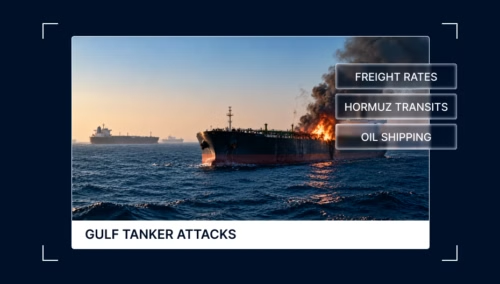
Tanker Attacks Spread Beyond the Strait of Hormuz as Gulf Freight Costs Soar


April 13, 2026: Iran War Maritime Intelligence Daily

What’s inside?
At a Glance
- U.S. Central Command announced a blockade on all traffic to Iranian ports, introducing enforcement alongside mine clearance operations.
- 21 vessels transited the Strait of Hormuz on April 12, with continued constrained, selective, and inconsistent routing behavior.
- Vessel turnarounds around the blockade start reflect early behavioral response to enforcement risk.
- 732 vessels remain in the Gulf, indicating buildup without corresponding transit release.
- Iranian exports remain active, with ~157.7 million barrels on water and ~97.6% directed toward China.
- 171 crude tankers are now bound for the U.S. Gulf, reinforcing global flow redirection.
- Dark vessel activity remains elevated across Iranian and Iraqi ports.
Operational Overview
Maritime conditions in and around the Strait of Hormuz are shifting beyond controlled access toward active enforcement and rising confrontation risk.
Following the collapse of U.S.–Iran negotiations, U.S. Central Command announced a blockade targeting all maritime traffic entering and exiting Iranian ports, while continuing mine clearance operations in the Strait. This introduces a dual dynamic where efforts to enable safe passage exist alongside the potential for interdiction.
At sea, transit activity continues but remains constrained and uneven. Vessel movements reflect selective access, limited participation, and inconsistent routing behavior, with no return to stable commercial flow. At the same time, Iranian oil exports remain structurally active, and global crude flows continue to redirect toward the U.S. Gulf.
The Strait of Hormuz is no longer operating solely as a controlled chokepoint. It is now a contested maritime space shaped by selective access, military positioning, and emerging enforcement actions.
Transit Remains Active but Constrained
Transit through the Strait remains active, but there is no normalization in routing or participation.
On April 12, 21 vessels transited the Strait, including 11 inbound and 10 outbound crossings. Inbound traffic included vessels flagged to China, Iran, and flag-of-convenience registries, with five tankers, including two VLCCs. Outbound traffic included a mix of cargo vessels and tankers, split between five Iran-flagged vessels and five flagged under flag-of-convenience registries.
As of April 13 at 12:47 UTC, activity remains limited and inconsistent, with 8 inbound and 3 outbound crossings. Vessel flags include Iran, India, the Marshall Islands, Vietnam, Hong Kong, Panama, the Comoros, and Aruba. Subclasses include LPG carriers, oil product tankers, a landing craft, a bulk carrier, and cargo vessels.

One LPG tanker executed a U-turn within the Strait, reinforcing continued uncertainty in passage conditions.

Vessel Positioning Reflects Limited Access
Vessel positioning across the Gulf continues to reflect constrained access rather than a return to normal flow.
As of April 13 at 13:00 UTC, only a small number of vessels appear to be positioning for transit, with five outbound and three inbound vessels bow-headed toward the Strait.


At the same time, 732 cargo vessels and tankers remain present across the Gulf. This accumulation is not matched by increased transit volume, indicating controlled staging activity rather than broader release of movement.
Access remains uncertain despite ongoing vessel activity.
U.S. Blockade and Operational Posture
U.S. Central Command has formally announced a blockade targeting all maritime traffic entering and exiting Iranian ports, effective April 13 at 10:00 AM ET. The measure applies regardless of vessel nationality, while still allowing transit through the Strait for vessels not calling Iranian ports.
Iran’s armed forces condemned the action as illegal and warned of consequences for military vessels approaching the Strait.
The reported legal basis for the blockade is the San Remo Manual on International Law Applicable to Armed Conflicts at Sea (1994). Enforcement is expected to be more straightforward for outbound traffic, but more complex for inbound vessels and for those operating under deceptive conditions, including spoofed positions and AIS-dark port calls.
This comes alongside ongoing mine clearance operations, with two U.S. destroyers deployed and unmanned systems expected to support route clearance.
The operating environment now reflects a combined approach. U.S. forces are attempting to enable safe passage while simultaneously restricting Iranian-linked maritime flows, introducing a complex enforcement layer into vessel movement.
Early Behavioral Response to Blockade Implementation
The first observable effects of the blockade are beginning to emerge in vessel behavior.
Windward identified two key turnarounds around the enforcement deadline. An OFAC-sanctioned, falsely flagged, laden tanker reversed course at 12:47 UTC, just over an hour before the blockade took effect.

An EU/OFAC-sanctioned, falsely flagged vessel also executed a turnaround at 14:00 UTC, coinciding with the start of enforcement.

These maneuvers indicate early behavioral response to the blockade, with vessels adjusting routing in anticipation of interdiction risk.
Crude Flows Remain Selective and Redirected
Crude flows continue, but through a limited and selective set of routes.
A total of 171 crude carriers are currently reporting the U.S. as their destination, reinforcing the continued large-scale redirection of global flows toward the U.S. Gulf Coast.
At the same time, movement through Hormuz remains constrained and inconsistent, confirming that global trade is adapting around disruption rather than through normalization.
Iranian Export Activity Remains Structurally Intact
Iranian export operations continue despite the evolving enforcement environment.
As of April 13, total Iranian oil on water is estimated at approximately 157.7 million barrels. Of this, 97.6% is destined for China. Among 89 tankers, AIS signals are available for 32 vessels, while 57 are not transmitting. Of those, 30 are Iranian-flagged NITC vessels, consistent with established operating patterns.
Windward Remote Sensing Intelligence identified two non-AIS transmitting VLCCs loading at Kharg Island on April 13, with an estimated combined capacity of approximately 4 million barrels.
Recent loading patterns show sustained throughput, with average daily volumes of approximately 2.04 million barrels between February and April.
Iranian exports remain structurally intact, supported by dark fleet operations and concentrated demand from China, despite increasing external pressure. The U.S. blockade directly targets these flows, which have averaged approximately 2 million barrels per day in recent months, making it a vital financial lifeline for the Islamic Republic.

Dark Vessel Activity Persists Across Ports
Dark vessel activity remains elevated across both Iranian and Iraqi port environments.
On April 13 at 07:21 UTC, three non-AIS transmitting tankers, approximately 240–250 meters in length, were observed berthing at port, likely engaged in loading operations. In addition, 14 non-AIS transmitting vessels above 180 meters, assessed to be tankers, were identified in the port waiting area.

Earlier, at 02:47 UTC, 12 non-AIS transmitting tankers above 150 meters were detected across Iraqi port infrastructure, including five vessels in the Umm Qasr area, and seven across the Umm Qasr and Khor Al Zubair ports.

This distribution highlights sustained dark vessel concentration across both Iranian and Iraqi port environments, reinforcing the continued use of reduced-visibility operations in regional energy and cargo flows.
Energy Infrastructure and Bypass Flows
Regional producers continue to rely on alternative export routes to bypass Hormuz constraints.
Saudi Arabia’s East–West Pipeline is operating at full capacity, with approximately 5.2 million barrels loaded on April 12. This reflects continued reliance on Red Sea export routes.
At the same time, Hormuz-linked flows cannot be fully replaced, reinforcing the continued importance of the Strait despite disruption.
Gulf-Wide Activity Remains Elevated
Gulf-wide vessel presence remains high but constrained.
As of April 13 at 12:40 UTC, 732 cargo and tanker vessels are present in the Gulf.

Within this, 91 vessels are identified as part of the dark fleet, with 20 operating without AIS transmission.

China-linked presence remains significant, with 89 vessels identified as China-owned or operated, including 62 cargo vessels and 27 tankers.
Bulk carrier activity continues to reflect engagement with Iranian ports. Over the past seven days, 18 bulk carriers visited Iranian ports, with 10 currently present in the Gulf. Of these, three are Iranian-flagged, while five have operated in Iranian ports east of the Strait.
Security Incident Highlights ongoing Risk
Security risk remains present beyond the Strait itself.
A St. Kitts and Nevis-flagged pleasure craft was approached by a small vessel carrying approximately 12 individuals 54 nautical miles southwest of Hodeidah, Yemen. Four individuals were reported to be armed with automatic weapons.
The vessel attempted to approach before diverting after the pleasure craft fired a flare. No damage or injuries were reported.
This incident highlights continued small-boat threat activity in the southern Red Sea and Gulf of Aden.
Outlook
Transit through the Strait remains limited, selective, and operationally inconsistent, with vessel behavior, including U-turns and limited staging, confirming that passage cannot be assumed.
Iranian control over access remains intact despite increasing external pressure. At the same time, the U.S. blockade is now in effect, adding a second layer of constraint, although its direct operational impact on maritime traffic has not yet been observed on a large scale.
U.S. operations now combine mine clearance with declared enforcement targeting Iranian port traffic, increasing complexity for vessels operating under conditions of AIS manipulation, spoofing, and dark port activity.
Crude flows continue along prioritized routes toward China and the U.S., while regional infrastructure, including Saudi pipeline routes, absorbs part of the disruption.
The operating environment is shifting from a controlled chokepoint toward a contested maritime space, where access, enforcement, and vessel movement are increasingly shaped by overlapping control dynamics.
Explore more

Tanker Attacks Spread Beyond the Strait of Hormuz as Gulf Freight Costs Soar
At a Glance A Tanker Is Struck Off Qatar as Gulf Attacks Surge An unnamed tanker was struck by multiple projectiles 51 nautical miles off Madinat ash Shamal, Qatar, according to an October 7 report from UK Maritime Trade Operations. UKMTO has reported 16 attacks on ships in the Middle East Gulf in the past...
Read more

Is Iran Losing Its Grip on Strait of Hormuz Traffic?
Iran has demanded that all Strait of Hormuz transits use the northern corridor through its territorial waters. Rising volumes of Saudi, Iraqi, and Kuwaiti crude, along with UAE volumes that cannot reach Fujairah by pipeline, are instead moving through the southern corridor, which remains under USCENTCOM air defense and naval support. Windward MIOC assesses that...
Read more

77 Ships Blacklisted, None Deterred: Inside Iran’s Failing Hormuz Toll Regime
At a Glance Operational Overview Iran’s Persian Gulf Strait Authority opened in mid-May to oversee transits and toll payments through the Strait of Hormuz. It has since released three tranches of blacklisted vessel names, on August 24, September 2, and September 14. Windward analysis of all 77 vessels finds that every one used the “unauthorized”...
Read more

The Houthis Take Perim and Petroline Is Hit as Freight Rates Cross $1 Million a Day
At a Glance Operational Overview Saudi Arabia’s workaround to the partial closure of the Strait of Hormuz came under direct attack last week. Saudi Arabia diverted crude to the Red Sea port of Yanbu via the East-West pipeline. On September 10, a pumping station on the pipeline was attacked and preemptively shut down. On the...
Read more

A Fatal Strike and the First Seizure Since June as Iran’s Transit Rules Take Effect
At a Glance A Chief Engineer Killed Aboard a Bulk Carrier Exiting Hormuz MINOAN DIGNITY (IMO 9294484), a Liberia-flagged bulk carrier of 225 meters and 76,801 DWT, was struck by an unknown projectile in its engine room while transiting outbound through the Strait of Hormuz southern corridor overnight on August 17 to 18. The vessel’s...
Read more