


April 12, 2026
April 12, 2026: Iran War Maritime Intelligence Daily


April 12, 2026: Iran War Maritime Intelligence Daily
What’s inside?
At a Glance
- Four days into the ceasefire, no agreement has been reached, and Hormuz remains restricted and inconsistent.
- 17 vessels transited on April 11, but access remains selective with continued dark activity and declining Gulf vessel presence.
- A VLCC U-turn near Larak Island highlights the gap between ceasefire expectations and actual access conditions.
- Iranian exports remain active, with ~6 million barrels loading at Kharg Island and ~58.75 million barrels shipped since March 1.
- U.S. forces initiated mine clearance operations, alongside signaling potential enforcement and interdiction actions.
- 172 crude tankers are now en route to the U.S. Gulf Coast, reflecting a major shift in global flows.
- Global disruptions continue, including vessel detention near Sweden and severe operational impact from the Antwerp-Bruges oil spill.
Operational Overview
Four days into the ceasefire, maritime conditions in the Strait of Hormuz remain constrained, inconsistent, and dependent on permissions rather than open navigation.
After 21 hours of negotiations, no agreement was reached. At sea, this is reflected in restricted transit, selective vessel movement, and failed passage attempts rather than any normalization. While transit volumes have increased slightly, movement remains operationally unreliable.
At the same time, crude flows toward Asia continue, Iranian export activity remains active, and U.S. forces have begun mine clearance operations to establish a safe passage corridor. U.S. leadership has also signaled a potential shift toward enforcement, including possible interdiction and blockade measures in the Strait of Hormuz following failed negotiations.
The Strait is operating as a controlled and unstable system, where movement is possible but not predictable, and the risk of direct confrontation between state actors is increasing.
Transit Remains Active but Restricted
Transit through the Strait continues, but without a return to normal commercial routing.
On April 11, 17 vessels transited the Strait, including 7 inbound and 10 outbound crossings.
Inbound traffic included:
- Four tankers flagged to Angola, Cameroon, and two to Palau.
- Three cargo vessels flagged to India, and two to Iran.
Outbound traffic included:
- Five tankers flagged to Botswana, Liberia, India, Hong Kong, and China.
- One bulk carrier flagged to China.
- Four cargo vessels flagged to the Marshall Islands, Iran, Gambia, and Panama.
Limited dark activity was observed, with one inbound and one outbound vessel operating without AIS transmission. Across the region, 179 dark activity events were detected.
The total Gulf vessel count declined sharply to 624, down 201 vessels day-over-day, indicating continued contraction in overall vessel presence.
Transit remains selective, risk-tolerant, and operationally constrained.
Failed Transit Highlights Routing Instability
Vessel behavior continues to reflect uncertainty and failed access attempts.
A ballast VLCC altered course multiple times following the ceasefire announcement. After bunkering in Fujairah, the vessel initially set a destination for Corpus Christi, aligning with increased crude flows toward the U.S. Gulf Coast.
Approximately 42 hours after the ceasefire, the vessel reversed course in the Arabian Sea and shifted toward an Iraqi destination, reflecting expectations of resumed Iraqi exports.
After approaching Larak Island on April 11, the vessel executed a U-turn instead of completing transit and is now waiting south of the Strait.

This sequence highlights the lack of predictable access. Ceasefire expectations have not translated into consistent passage conditions.
Selective Crude Flows Continue
Despite constraints, selective crude flows through Hormuz persist.
Two tankers were observed carrying approximately 1.91 million barrels each of Iraqi crude bound for China, with both successfully crossing the Strait.
At the same time, two Pakistani tankers exited the Strait, bringing the total to three since the start of Operation Epic Fury.

Transit on April 11 also included outbound crude tankers and continued IRISL-linked cargo movement, including an Iran-linked container vessel transiting inbound.
Access continues to be granted selectively, with specific cargo flows and trade routes prioritized while broader commercial activity remains limited.
Kharg Island Sustained Export Activity
Iranian export operations remain active under constrained conditions.
Satellite imagery from April 11 at 07:31 UTC identified three VLCCs loading at Kharg Island, with an estimated combined volume of approximately 6 million barrels of crude oil.
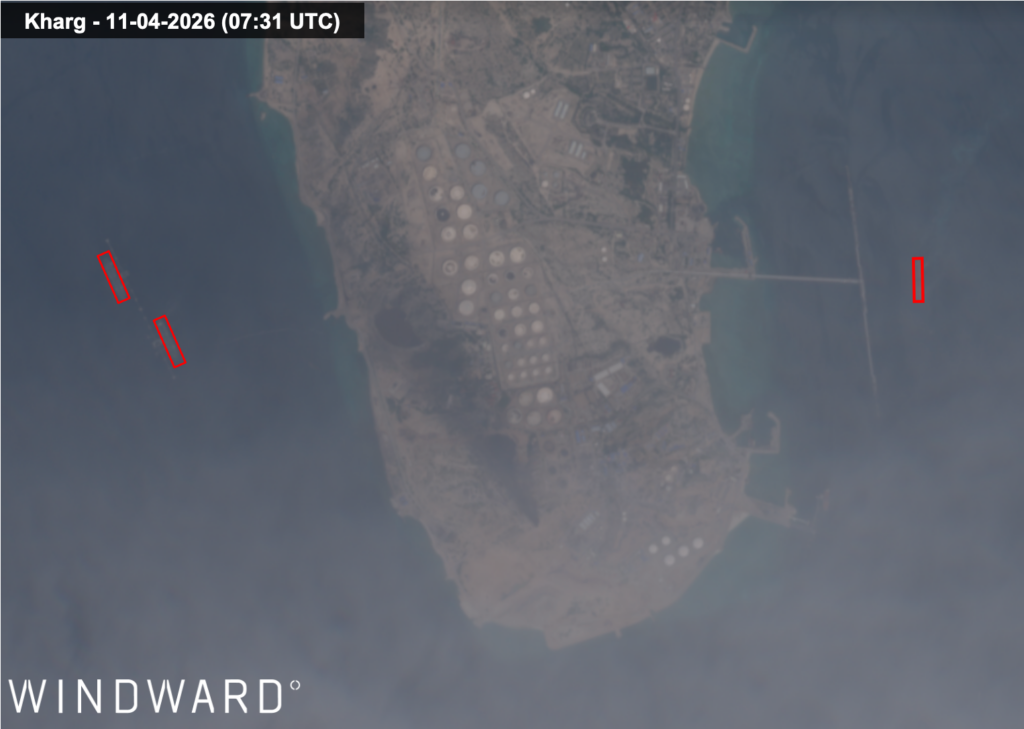
The last confirmed departures occurred on April 8, when two vessels carried a total of 2.23 million barrels.
Since March 1, total departures from Kharg Island have reached approximately 58.75 million barrels, with more than 90% of volumes directed toward China.
Export activity remains sustained and concentrated, despite restricted transit conditions.
U.S. Operations Introduce New Dynamics
U.S. forces have initiated active operations in the Strait, combining mine clearance with emerging enforcement signals.
On April 11, CENTCOM deployed guided-missile destroyers USS Frank E. Peterson (DDG 121) and USS Michael Murphy (DDG 112) into the Arabian Gulf to begin mine clearance operations targeting IRGC-laid mines. Additional assets, including underwater drones, are expected to support the effort.
One U.S. naval vessel is currently operating in the Hormuz area after remaining dark on AIS for 43 days, indicating likely involvement in minesweeping operations.

At the same time, U.S. signaling has expanded beyond clearance. Following failed negotiations, leadership indicated that enforcement measures may follow, suggesting a potential blockade, including interdiction of vessels operating under Iranian-imposed transit conditions and broader actions to secure passage.
U.S. operations introduce a second layer of control, where vessel movement may be affected not only by Iranian restrictions but also by potential enforcement actions.
Global Crude Flows Shift Toward the U.S.
Global crude flows are increasingly redirecting toward the U.S. Gulf Coast.
A total of 172 crude oil tankers are currently en route to the region, reflecting a sharp increase in inbound volumes.

Windward’s Early Detection analysis shows a 46% increase in tankers arriving via the northern corridor from Europe and a 132% increase in arrivals via the southern corridor from Asia and the Gulf.


This shift indicates a broader rebalancing of global crude flows toward the U.S. as a stable pricing and export anchor amid Hormuz disruption.
Operational impacts are expected to include congestion and scheduling pressure across key U.S. Gulf infrastructure.
Producers Prepare for Potential Reopening
Regional producers are positioning for a potential reopening of Hormuz-linked exports.
Saudi Arabia, Kuwait, and Iraq have requested loading nominations for April and May cargoes requiring transit through the Strait.
Saudi Arabia continues balancing exports between Yanbu and Ras Tanura, while Iraq is planning Hormuz-linked shipments.
Despite these preparations, actual transit volumes have not materially increased, and the shipping industry remains on high alert due to ongoing uncertainty.
Global Maritime Disruptions Persist
Disruption continues across global maritime systems.
A Panama-flagged bulk carrier departing Ust-Luga was detained by Swedish authorities near Ystad on April 12 after altering speed and course under suspicion of environmental violations involving coal residue discharge in the Baltic Sea. The vessel was escorted into Swedish waters and remains under investigation. This marks the second such detention since April 3 involving vessels originating from Russia.
In Europe, the Port of Antwerp-Bruges is recovering from a major oil spill that began on April 9. This occurred during a bunkering operation on the Liberian-flagged vessel at Deurganck dock, caused by a hull crack linked to corrosion. By the morning of April 10, authorities had effectively shut down key access to the Port of Antwerp-Bruges, the second largest port in Europe, with oil spreading from Deurganck dock into the Scheldt river, impacting adjacent terminals and riverbank nature areas.
The incident caused severe operational disruption:
- 286 port-of-loading rollovers (+346.88% day-over-day).
- 467 transshipment rollovers (+222.07% day-over-day).
- 107 delay cases (+35.44% day-over-day).
At peak disruption, dozens of vessels were delayed or trapped, including large container ships at deep-sea terminals. Emergency response teams deployed containment measures and vessel-by-vessel cleaning operations.
As of April 12, recovery is underway, with 29 cargo vessels and 26 large tankers (over 10K DWT) present in the port area and operations gradually resuming.

Outlook
The Strait of Hormuz remains a controlled and unstable system, where access is selective, and passage cannot be assumed. Vessel behavior continues to reflect this reality. U-turns and repeated rerouting attempts show that ceasefire conditions have not translated into reliable transit, and Iranian control over access remains intact with no return to open navigation.
At the same time, U.S. operations are adding a second layer of activity. Mine clearance efforts are underway to establish a safe passage corridor, while signaling around potential enforcement, including interdiction and broader intervention, introduces an additional variable shaping vessel movement.
Crude flows continue along prioritized routes, particularly toward China and the U.S., reinforcing selective access dynamics. Across the system, global shipping networks are adjusting in real time, with rerouting, backlog accumulation, and operational constraints continuing to limit any meaningful normalization.
Explore more

Hormuz After the Ceasefire: A Controlled System, Not a Recovery
At a Glance A Ceasefire Without Reopening A ceasefire has been declared, but the maritime system has not reset. Transit through the Strait of Hormuz remains restricted, coordinated, and selectively enforced. There has been no return to open commercial navigation. Standard shipping lanes remain largely unused, and no meaningful increase in traffic has followed the...
Read more

April 8, 2026: Iran War Maritime Intelligence Daily
At a Glance Operational Overview On April 7, the day before the ceasefire was announced, 11 vessels transited the Strait of Hormuz — four inbound and seven outbound. All four inbound vessels carried Sanctioned risk. Outbound traffic comprised three tankers and four bulk carriers, all via the Northern Corridor. The profile was broadly reflected in...
Read more
April 7, 2026: Iran War Maritime Intelligence Daily
At a Glance Operational Overview Bulk carriers in Iranian trades including those with beneficial ownership in Greece and China continue to exit the Strait of Hormuz while Iran ensures regular transits for its oil and gas shipments. Energy commodities exports from other Gulf countries are seen on an ad-hoc basis. Strait of Hormuz Transits Steady...
Read more

April 6, 2026: Iran War Maritime Intelligence Daily
At a Glance Operational Overview The Strait of Hormuz is no longer operating as a single controlled chokepoint. Between April 2 and 5, transit evolved into a dual-corridor system, combining military control with emerging diplomatic coordination. A northern route remains centered around IRGC control near Larak Island. In parallel, a southern corridor has emerged along...
Read more