


June 8, 2026
Why Russia's Sanctioned Shadow Fleet Is Bypassing the English Channel


Why Russia’s Sanctioned Shadow Fleet Is Bypassing the English Channel
What’s inside?
At a Glance
- At least 12 Western-sanctioned Russian shadow fleet tankers have made repeated transits around Great Britain rather than through the English Channel, avoiding UK coast guard scrutiny.
- Eleven of the 12 vessels are broadcasting the Cameroon flag, with most having reflagged from prior fraudulent registries such as Benin or Timor Leste.
- The diversions are uneconomic and unusual, adding hundreds of nautical miles to voyages between Russian Baltic ports and global markets, trading voyage time for reduced enforcement exposure.
- The shift follows the UK government’s March 2026 pledge to interdict UK-sanctioned vessels in UK waters, alongside intensified northwest European coastal scrutiny that has produced at least 16 boardings of falsely flagged tankers since December 2023.
Russian Tankers Repeatedly Bypass the English Channel
Western-sanctioned tankers loading oil at Russian Baltic ports normally transit the English Channel as part of standard voyage routing. In the past 30 days, Windward tracked 84 Western-sanctioned tankers through the Channel — 44% flagged with Sierra Leone, 19% with Cameroon, and 18% with Russia.
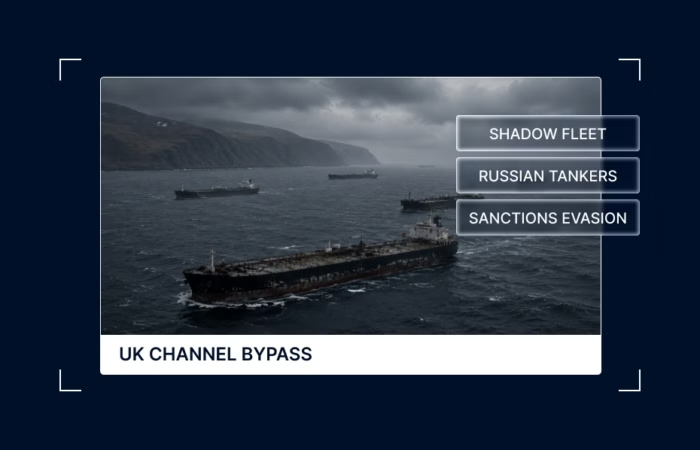
Inside that flow, a smaller group has chosen a different path. At least 12 sanctioned tankers have been documented making repeated transits the long way around Great Britain, sailing along the outer edge of the UK’s Exclusive Economic Zone rather than through the Channel, where the coast guard now routinely radios passing vessels for flag and insurance details. The route is hundreds of nautical miles longer. The fuel and time costs are material. The diversion pattern was first noted in 2025, as coastal countries across northwest Europe intensified scrutiny on shadow fleet vessels.

Under international maritime law, ships have the right of “innocent passage” and cannot be stopped by coastal states as they sail through territorial waters to another destination. Falsely flagged ships, however, are defined as stateless and can be boarded. A vessel is considered falsely flagged when it broadcasts via AIS the flag of a country whose maritime authority confirms it is not on the ship registry. The UK government signaled in March 2026 that UK-sanctioned vessels would be interdicted in UK waters, though it did not initially set out the legal basis for doing so. The 12 vessels documented here had already begun bypassing the Channel before that announcement.
The 12 Vessels Seen Rerouting
The 12 tankers identified by Windward as repeatedly bypassing the English Channel over the past six months are listed below, along with sanctions designations, flag histories, and recent diversion windows.
OCEAN II (IMO 9233777): Sanctioned by the UK in October 2025 and the EU in April 2026. Cameroon-flagged since the first sanctions were imposed. Has not transited the English Channel since October 2025, with two diversions around Great Britain to call at Russian Baltic ports since.
SUN (IMO 9293117): UK sanctioned July 2025, EU sanctioned May 2025. Used the fraudulent Benin registry from July 2025 to February 2026 before switching to Cameroon. Last Channel transit June 2024. Diverted around Great Britain in May, August, and November 2025, and January and April 2026.
DESTAMAR (IMO 9253894): UK and EU sanctioned in July and May 2025, respectively. Falsely flagged with a fraudulent Benin registry from July 2025 to January 2026 before switching to Cameroon. Channel bypasses recorded in July and December 2025 and May 2026. Last legitimate Channel transit March 2025.
JI HANG (IMO 9281009): UK sanctioned October 2025, EU sanctioned July 2025. Bypassed the English Channel in May 2026 on its first Russian Baltic loading since joining the shadow fleet in early 2025. Reflagged from Panama to Cameroon after being sanctioned.
ONEIROI (IMO 9390587): EU sanctioned April 2026. Diverted around Great Britain in May 2026. Last Channel transit October 2025. Reflagged to Cameroon shortly after being sanctioned.
CHENG HE (IMO 9304629): EU sanctioned October 2025, UK sanctioned June 2025. Bypassed the Channel in May 2026 on its first call to Russian Baltic ports since joining the shadow fleet. Reflagged from Panama to Sao Tome and Principe from July 2025 to January 2026, then to Cameroon.
BLUE (IMO 9236353): EU and UK sanctioned May 2025. Among the first vessels to regularly bypass the English Channel, doing so in July, October, and December 2025 and February 2026. Cameroon-flagged.
INA (IMO 9308443): EU and UK sanctioned May 2025. Bypasses recorded in August and October 2025 and February 2026. Has used the fraudulent registries of Benin and Timor-Leste since being sanctioned. Now Cameroon-flagged.
FINA A (IMO 9283306): EU and UK sanctioned in July and May 2025, respectively. Bypasses recorded in December 2025 and March to April 2026, including 10 days of loitering in the North Sea inside Denmark’s EEZ. Currently flagged with Equatorial Guinea, previously used the fraudulent Benin registry.

PEACE (IMO 9249130): EU sanctioned November 2024, UK sanctioned July 2025. Bypasses recorded in August and October 2025 and January 2026. Last legitimate Channel transit August 2024. Used the fraudulent Benin and Timor-Leste registries until reflagging to Cameroon in April 2026.
JAMES II (IMO 9253909): UK sanctioned May 2025. Bypassed the Channel in February 2026. Removed from the Palau registry shortly after UK designation, but continues to falsely broadcast Palau as its flag, leaving the vessel effectively stateless.
MANDALA (IMO 9299135): Cameroon-flagged tanker that zig-zagged over the same area in the Atlantic in both February and April 2026 while taking a course around Great Britain. The vessel did not transmit AIS for just over 24 hours from January 9 to 10 in the same vicinity while sailing northbound for Russia.

What the Pattern Signals
The bypass behavior is a deliberate, repeated operational choice by sanctioned vessels with consistent characteristics. They are paying a real economic cost to avoid a specific stretch of water.
Three features of the pattern stand out for compliance, sanctions, and maritime enforcement stakeholders.
Most Diverting Tankers Are Flagged in Cameroon
Eleven of the 12 vessels are now Cameroon-flagged. Most reflagged to Cameroon in 2025 or 2026, after prior use of fraudulent registries such as Benin or Timor Leste upon sanctioning.
Falsely Flagged Transits Have Disappeared From the Channel
No falsely flagged ships have been tracked by Windward transiting the English Channel in the past 90 days. Seven vessels flagged with Equatorial Guinea, a flag associated with fraudulent registries, were observed, though whether those specific vessels are using a fraudulent registration is unconfirmed.
Enforcement Actions Are Intensifying
Since December 2023, France, Sweden, Estonia, Finland, and Germany have boarded, detained, diverted, or attempted to board at least 16 falsely flagged tankers, including 11 in 2026 alone. The UK’s March 2026 pledge to interdict sanctioned vessels in its waters signals further tightening of enforcement across the region. The bypass routes show operators responding to the cost-benefit calculation of being intercepted in waters where the legal basis for boarding has firmed up.
What Behavioral Intelligence Sees
Sanctioned status, Cameroon flagging after prior use of fraudulent registries, uneconomic routing that adds hundreds of miles per voyage, and repeated bypass of the same coastal jurisdiction are the signals that distinguish the pattern from ordinary commercial traffic. All of this is visible to behavioral intelligence that tracks vessel behavior, identity history, and ownership over time.
What This Means for Compliance and Enforcement
For sanctions compliance teams at financial institutions, P&I clubs, port state authorities, and trading firms, the pattern raises three operational questions.
The first is exposure mapping. The sanctions environment has measurably tightened across northwest Europe in the past 18 months. The exposure is not theoretical. UK, French, Swedish, Estonian, Finnish, and German authorities are actively interdicting falsely flagged tankers, and that posture is expanding.
The second is identity verification. Cameroon reflagging in 2025 to 2026, particularly when preceded by the use of fraudulent registries such as Benin or Timor Leste, is a pattern worth tracking.
The third is route-level behavioral monitoring. The bypass routes are visible because someone is watching vessels behave uneconomically over time. Agencies and institutions adopting behavioral intelligence as part of their sanctions screening are pulling ahead of those relying on AIS alone.
Frequently Asked Questions (FAQs)
Why are sanctioned Russian shadow fleet tankers sailing around Great Britain?
At least 12 Western-sanctioned tankers are diverting around Great Britain rather than transiting the English Channel, where the UK coast guard now routinely radios passing vessels for flag and insurance details. The longer route trades fuel and voyage time for reduced enforcement exposure, especially after the UK government’s March 2026 pledge to interdict sanctioned vessels in its waters.
What is the common signature across the 12 bypass vessels?
Eleven of the 12 are now Cameroon-flagged, having reflagged in 2025 or 2026 after prior use of fraudulent registries such as Benin or Timor Leste. All 12 are Western-sanctioned and transit between Russian Baltic ports and global markets on repeated diversions around Great Britain.
How many sanctioned tankers are still transiting the English Channel?
Windward tracked 84 Western-sanctioned tankers through the Channel in the past 30 days — 44% flagged with Sierra Leone, 19% with Cameroon, and 18% with Russia.
What does behavioral intelligence see that conventional screening cannot?
Behavioral intelligence interprets vessel movement, identity history, ownership patterns, and operational behavior over time, including flag switches after sanctioning, uneconomic routing, and loitering. Conventional screening sees the current declared flag and AIS broadcast, but not the behavioral pattern that distinguishes sanctioned exposure from ordinary commercial transit.
Explore more

Why Customs Enforcement Is Moving from Document Screening to Behavioral Intelligence
At a Glance The Screening Model Customs Was Built On No Longer Holds For most of the last twenty years, customs enforcement has operated on a screening model. Cargo manifests arrive ahead of port call, risk scores are calculated against the declared origin, shipper, and route, and anomalies trigger inspection. The model worked while the...
Read more

Why Behavioral Intelligence Now Defines Subsea Cable Protection
At a Glance From Monitoring to Prevention For most of the past decade, cable protection meant monitoring. Operators watched the screen, generated alerts when a vessel of concern appeared near a cable, and responded after the fact when damage occurred. The threat landscape has shifted in ways that existing tools and protocols were not designed...
Read more

Maritime Defense Weekly: Energy Flows and Infrastructure Risk
Week in Focus Russian Diesel Cargo Signaling Arrival in Cuba A Hong Kong-flagged medium-range tanker is signaling arrival in Cuba on March 2 after multiple AIS destination revisions. The vessel initially broadcast Havana, then shifted to “Caribbean Sea,” and later to “Gibraltar for orders,” despite already transiting the strait. Windward’s assessment indicates the tanker likely...
Read more

Maritime Defense Weekly: Offshore Enforcement and Baltic Exposure
Week in Focus Sanctions Enforcement Moves Further Offshore The United States intercepted and boarded Aquila II (IMO 9281152) in the Indian Ocean, nearly 1,000 nautical miles from where it fled a Venezuelan quarantine zone in January. The 22-year-old Suezmax had falsely broadcast under the Panamanian flag and has a history of extended dark activity and...
Read more