


June 25, 2026
Introducing GPS Jamming Resilience: Cutting False Vessel Activity From Contested Waters


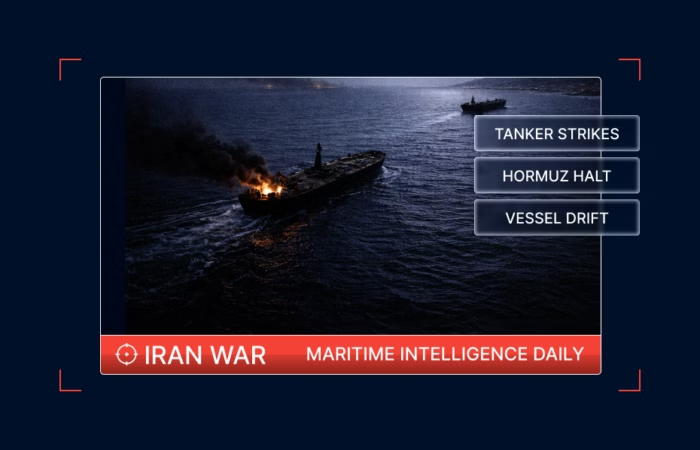
March 2, 2026: Iran War Maritime Intelligence Daily
What’s inside?
At a Glance
- Four commercial tankers were struck in the Strait of Hormuz and the Gulf of Oman within 36 hours of Operation Epic Fury.
- Targeting patterns are consistent with area denial effects, not precision affiliation targeting.
- Commercial traffic through the Strait of Hormuz has effectively stopped.
- War-risk insurance has been withdrawn, and premiums are at multi-year highs.
- Hundreds of vessels are now drifting or holding position in the Gulf of Oman.
- No U.S., UK, or EU-flagged vessels were observed transiting March 1-2.
- Dry bulk carriers dominate the limited transits that remain.
- Hezbollah’s formal entry into the conflict expands maritime spillover risk beyond the Gulf.
- A U.S.-flagged tanker was struck while moored in Bahrain, extending risk into port environments.
- Active fires and sustained military presence at Bandar Abbas introduce additional instability inside Iran’s principal naval port.
Operational Summary
As of March 2, 2026, tanker traffic through the Strait of Hormuz has collapsed following vessel strikes and escalating military activity in the Gulf.
While Operation Epic Fury began on February 28, the past 24 hours reflect the operational consequences: suspended transits, halted tanker movement, insurance withdrawal, and precautionary vessel positioning across the Gulf of Oman.
While the maritime corridor remains technically open, commercial tanker passage has effectively ceased.
Iran War Daily Maritime Intelligence.
— Windward (@WindwardAI) March 2, 2026
Major disruption of global energy corridors in the past 24 hours:
• Chokepoints paralyzed.
• Commercial vessels attacked.
• Severe GPS jamming degrading navigation.
• Red Sea vessels evacuating.
Routing behavior is shifting in real… pic.twitter.com/hNEDNDRNJo
Confirmed Vessel Strikes
Windward analysis confirms that all four vessels were within reported strike zones during the escalation window.
Confirmed attacks include:
- MKD Vyom (IMO 9284386): Marshall Islands-flagged crude tanker carrying gasoline; one crew fatality following an engine room explosion.
- Skylight (IMO 9330020): Sanctioned chemical tanker; fire onboard, four crew injured, 20 evacuated.
- Hercules Star (IMO 9916135): Gibraltar-flagged commercial tanker; strike confirmed off the UAE coast.
- Sea La Donna (IMO 9380532): Incident unverified; GPS spoofing/jamming indicators observed; no confirmed casualties.
The UK Maritime Trade Operations Centre (UKMTO) confirmed attacks on Skylight, MKD Vyom, and Hercules Star, while warning of significant military activity across the Arabian Gulf, Gulf of Oman, North Arabian Sea, and the Strait of Hormuz.
Targeting Pattern Analysis
The mix of targeted vessels spans:
- Sanctioned Iranian-linked transport (Skylight).
- A clearly Western-aligned commercial tanker (Hercules Star).
- A neutral-flagged and unaligned tanker (MKD Vyom).
- A mixed-profile vessel with Western ownership and Russian trade ties (Sea La Donna).

This spread contradicts any hypothesis of selective, affiliation-based targeting. Instead, the pattern is consistent with area denial, aiming to disrupt all commercial traffic through the corridor irrespective of nationality or cargo, rather than precision strikes against specific flagged entities.
No public claim of responsibility for individual vessel strikes has been documented. Ambiguity remains as to whether these are deliberate tanker attacks or collateral to broader missile, drone, or asymmetrical exchanges across the region.
Strait of Hormuz Traffic
Commercial tanker traffic through the Strait of Hormuz has effectively halted.
Windward analysis shows:
- No active tanker transits in the primary Hormuz shipping lanes as of March 1.
- Only one small tanker (12,000 DWT) and one small cargo vessel were observed transiting early March 2 UTC.
- Approximately 26 tankers are drifting or berthed in the Gulf without confirmed destinations.
- Hundreds of other vessels are holding position in the Gulf of Oman.
- No U.S., UK, or EU-flagged vessels were observed transiting during the March 1-2 period.
Major global operators have suspended Gulf transit, and war-risk cover has been withdrawn across the corridor.
While the Strait is not formally closed, tanker traffic has functionally stopped.
Ras Tanura Export Risk
Iran has reportedly targeted the Ras Tanura refinery, one of the region’s most critical crude export hubs. The strike elevates risk around Saudi export infrastructure and introduces direct uncertainty into outbound tanker operations.
As of 09:35 GMT on March 2, only four AIS-transmitting tankers are visible in the Ras Tanura area. This reduced presence reflects heightened caution and risk recalibration following the refinery attack.
Four tankers departed Ras Tanura by March 1 loaded with more than 5 million barrels of crude. Three additional tankers remain in loading position and are expected to depart later today with approximately 2.5 million barrels, including one vessel chartered by Glencore.

Cargo Movements and Export Distortion
The evacuation wave observed at the onset of escalation has transitioned into holding behavior.

Approximately 27 vessels carrying an estimated 12 million barrels are currently in transit without confirmed discharge destinations, holding in the Arabian Sea pending further instruction.

Visible Iranian-origin exports remain minimal in transparent tracking data, suggesting either operational disruption or increased reliance on dark activity evasion.
Saudi and UAE export flows that cleared early in the escalation window have not been replaced by sustained outbound tanker traffic.
Who Is Still Moving
Among the limited vessels transiting between March 1 and March 2, dry bulk carriers significantly outnumber tankers. Several of the vessels still moving carry elevated Iran-related compliance exposure or operate under UAE-based management, while Western-aligned tankers are notably absent from observed traffic. This divergence suggests differentiated risk tolerance between bulk and tanker operators, with tanker traffic effectively withdrawing from the corridor.
Data analysis of vessels identified in the Strait on the last full day shows the following distribution:
- Vessel Subclass:
- Bulk carriers: 7
- Oil products tankers: 3
- General cargo vessels: 2
- LPG tanker: 1
- Container vessel: 1
- Specialized carriers (heavy load/aggregate): 3
- Flag State Distribution:
- Panama: 4
- Liberia: 3
- Marshall Islands: 3
- Iran: 2
- Other (Barbados, Madeira, Russia, China): 4
- Smuggling Risk Profile:
- Low risk: 13
- Moderate risk: 2
- High risk: 3
Signal Environment and Risk Conditions
AIS dark activity remains elevated across the Gulf, while GPS spoofing and jamming continue to degrade signal reliability. Vessel behavior reflects precautionary shutdowns, holding patterns, and delayed entry decisions rather than active routing through the Strait. Windward’s current threat classification remains “critical,” with a high likelihood of continued maritime disruption in and around the Strait of Hormuz.
Three Iranian container vessels have positioned themselves just outside the naval port attacked yesterday, in a location consistent with monitoring inbound traffic to the Gulf. Their positioning suggests potential surveillance or signal collection activity amid degraded AIS conditions.

Bandar Abbas Port Status
As of 10:56 GMT on March 2, 2026, the Port of Bandar Abbas is experiencing multiple active fires, including one aboard a berthed vessel, while maintaining a significant combined military and commercial presence at port facilities.
Three distinct fires are currently reported in the vicinity. Two are located at port infrastructure facilities, and one involves a vessel currently at berth.
Seventeen military vessels remain berthed at the port, alongside five commercial vessels.
The presence of active fires within Iran’s principal naval and commercial port introduces additional operational uncertainty and increases the risk of secondary maritime disruption in the Gulf. Continued military concentration at the facility suggests a heightened defensive posture rather than evacuation.
Strike on U.S.-Flagged Tanker Stena Imperative
At 02:57 GMT, the U.S.-flagged tanker Stena Imperative was struck while moored at Khalifa Bin Salman Port, Bahrain.
Windward analysis indicates the vessel was stationary at berth at the time of impact.
AIS tracking confirms the tanker went dark on February 28 at 07:43 UTC and remained non-transmitting for more than 72 hours leading into the strike.

The vessel was reportedly hit by two projectiles. Bahraini authorities have stated that intercepted missile debris may have caused the damage. However, the timing aligns with IRGC retaliatory windows following the February 28 operations.
The onboard fire has been extinguished. Casualty reports remain conflicting, with some outlets reporting one fatality while others indicate safe evacuation of the crew. Verification remains ongoing.
The strike demonstrates that U.S.-linked commercial vessels are exposed even while stationary in port, extending risk beyond transit corridors into fixed infrastructure environments.
Conflict Expands Beyond the Gulf
On March 2, Hezbollah formally entered the conflict, launching missiles and drones toward Israel following the reported killing of Iran’s Supreme Leader. Israel responded with airstrikes targeting Hezbollah-controlled areas in southern Beirut.
Hezbollah’s participation materially expands the maritime risk envelope beyond the Gulf. The development increases the probability of renewed proxy-linked activity in the Eastern Mediterranean and reinforces spillover risk into the Red Sea corridor, where Houthi forces have previously targeted commercial shipping.
With multiple Iranian-aligned actors now actively engaged, escalation pathways widen from a bilateral confrontation to a multi-front regional conflict. For maritime stakeholders, this raises the likelihood of episodic targeting risk, broader insurance volatility, and further disruption to Red Sea and Suez-linked traffic.
Outlook
The past 24 hours confirm a transition from strike events to sustained behavioral paralysis among tanker operators.
Energy flows are disrupted. Insurance withdrawal is reinforcing avoidance. Signal degradation continues to complicate monitoring.
Absent rapid stabilization, tanker transit suspension is likely to persist. Dry cargo movement may continue selectively, but tanker risk tolerance has collapsed.
Windward will publish the next Iran War Maritime Intelligence Daily update as the operational picture evolves.
Explore more

IRGC Orders Vessels to Turn Back: The Southern Corridor Reversal Stalls the Hormuz Recovery
At a Glance Operational Overview A week of widening commercial confidence in the Strait of Hormuz has run into the first significant test of the post-MoU operating environment. On June 25, the IRGC published a Telegram claim that vessels in the southern corridor had been ordered to turn back, with Windward identifying five vessels exhibiting...
Read more

Hormuz Re-Closure Meets Market Resistance as Traffic Returns
At a Glance Operational Overview The June 18-22 reporting period captures a rapid shift from cautious normalization to renewed uncertainty. Following the June 17 Memorandum of Understanding (MoU) and the formal lifting of the blockade on June 18, commercial shipping responded immediately. Transit volumes rose above 20 crossings per day, Chinese-affiliated and European-owned vessels resumed...
Read more

Hormuz Reopens After MoU Signing: Chinese-Led First Movers Alongside Sanctioned Iran Tonnage
At a Glance Operational Overview The Strait of Hormuz is reopening. Following the June 17 signing of the U.S.-Iran memorandum of understanding, the first commercial vessels stranded inside the Arabian Gulf since the war began transited the corridor on June 18. The June 17 to 18 window recorded 18 transits, the highest single-window count of...
Read more

From Hormuz Closure to Cautious Reopening: What Marine Insurers Are Facing
With the U.S.-Iran memorandum of understanding now signed electronically by both presidents and in effect as of Wednesday, June 17, 2026, the maritime industry is entering a phase of cautious reopening. Windward hosted an executive briefing to analyze the implications for the marine insurance market. While stranded ships have started their engines, the current atmosphere...
Read more

U.S. and Iran Agree to End Hormuz Conflict: Reopening Begins, But Not in a Rush
At a Glance Operational Overview The Strait of Hormuz is reopening, but cautiously. Thirty-six hours after the U.S. and Iran agreed to end the conflict in the strait, stranded ships have started their engines, but few have sailed. The contrast with the brief mid-April false start is shaping shipowner behavior this time. The agreement is...
Read more