


October 15, 2026
Trade Data vs. Maritime Intelligence: What Customs Agencies Actually Need


Widespread GPS Jamming Hits 1,000-plus Ships in the Middle East

What’s inside?
At a Glance
- More than 1,100 vessels experienced GPS and AIS interference across the Middle East Gulf within 24 hours, amid heightened regional tensions following the launch of Operation Epic Fury.
- Ships were falsely positioned at airports, a nuclear power plant, and on Iranian land, creating navigation and compliance risks.
- Windward identified at least 21 new AIS jamming clusters across the UAE, Qatari, Omani, and Iranian waters.
- Traffic through the Strait of Hormuz slowed, with some Western-affiliated tankers transiting dark or reversing course.
- Persistent electronic interference increases collision risk, false compliance alerts, and operational uncertainty in one of the world’s most critical energy corridors.
Escalating Electronic Interference Across the Gulf
Widespread GPS jamming has affected more than 1,100 ships in the Middle East Gulf in the past 24 hours, erroneously placing vessels at airports, a nuclear power plant, and on land in areas of Iran, Oman, and the United Arab Emirates.
Electronic interference with ships’ Automatic Identification Systems was already endemic in the region before the launch of Operation Epic Fury, creating significant maritime navigation hazards for the roughly 10,000 vessels operating in the area at any given time.

Windward identified at least 21 new clusters where ships’ AIS are being jammed. Tugs and offshore vessels are among a dozen ships that were shown to be at Al Hamra airport and surrounding fields earlier today.
While not the main airport for the emirate of Ras Al Khaimah, ships’ signals in the area underscore aviation dangers and disruptions that have shut down airspace across one of the world’s busiest zones, stranding tens of thousands of passengers worldwide.
AIS signals have also been diverted to the Barakah Nuclear Power Plant and nearby waters, while hundreds of other vessels are creating circle-like patterns off UAE, Qatari, and Omani waters.

Other ships have had their AIS signals diverted to Assaluyeh and other ports in Iran, triggering “false positive” risk and compliance breaches for banks, charterers, insurers, and other marine service providers.

Navigational and Compliance Risk Intensifies
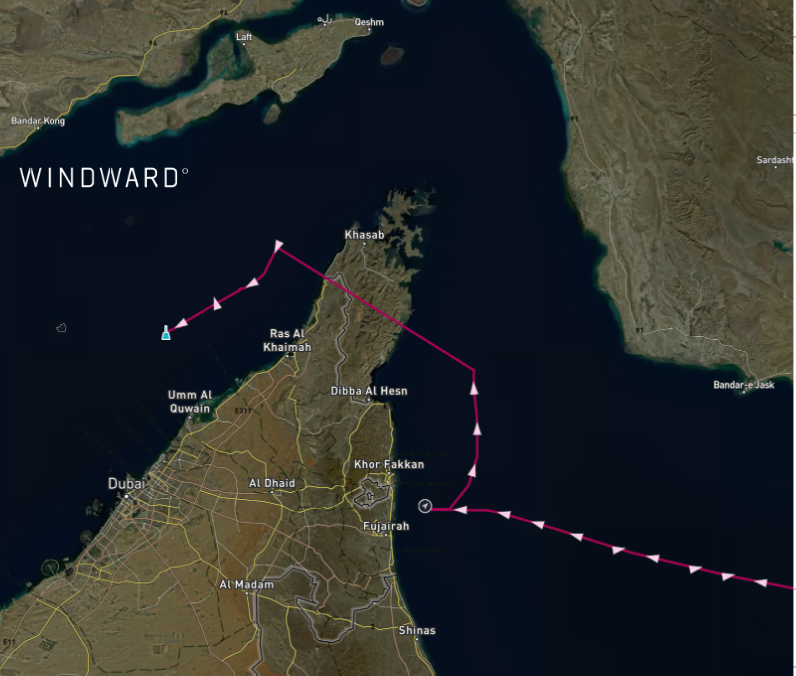
Jamming and false location signals also create major problems in congested waters where precise navigation is essential for collision avoidance and traffic separation compliance, as traffic through the Strait of Hormuz continues, albeit at a slower pace.

Transits slowed as Western-affiliated tankers and liquefied natural gas carriers sailing to load at Qatar and the UAE paused or reversed course to avoid the region over the past 18 hours. About 20% of the world’s oil and gas exports transit the Strait.
Tankers account for about 60% of traffic, bulk carriers for nearly 17% of transits, and containerships another 16%, according to the IMF’s PortWatch.
Windward analysis tracked just under 100 transits in the past 24 hours, about a third lower than typical. However, tankers have been observed transiting dark, with AIS increasingly unreliable for monitoring traffic.
Explore more

Tanker Attacks Spread Beyond the Strait of Hormuz as Gulf Freight Costs Soar
At a Glance A Tanker Is Struck Off Qatar as Gulf Attacks Surge An unnamed tanker was struck by multiple projectiles 51 nautical miles off Madinat ash Shamal, Qatar, according to an October 7 report from UK Maritime Trade Operations. UKMTO has reported 16 attacks on ships in the Middle East Gulf in the past...
Read more

Is Iran Losing Its Grip on Strait of Hormuz Traffic?
Iran has demanded that all Strait of Hormuz transits use the northern corridor through its territorial waters. Rising volumes of Saudi, Iraqi, and Kuwaiti crude, along with UAE volumes that cannot reach Fujairah by pipeline, are instead moving through the southern corridor, which remains under USCENTCOM air defense and naval support. Windward MIOC assesses that...
Read more

77 Ships Blacklisted, None Deterred: Inside Iran’s Failing Hormuz Toll Regime
At a Glance Operational Overview Iran’s Persian Gulf Strait Authority opened in mid-May to oversee transits and toll payments through the Strait of Hormuz. It has since released three tranches of blacklisted vessel names, on August 24, September 2, and September 14. Windward analysis of all 77 vessels finds that every one used the “unauthorized”...
Read more

The Houthis Take Perim and Petroline Is Hit as Freight Rates Cross $1 Million a Day
At a Glance Operational Overview Saudi Arabia’s workaround to the partial closure of the Strait of Hormuz came under direct attack last week. Saudi Arabia diverted crude to the Red Sea port of Yanbu via the East-West pipeline. On September 10, a pumping station on the pipeline was attacked and preemptively shut down. On the...
Read more

A Fatal Strike and the First Seizure Since June as Iran’s Transit Rules Take Effect
At a Glance A Chief Engineer Killed Aboard a Bulk Carrier Exiting Hormuz MINOAN DIGNITY (IMO 9294484), a Liberia-flagged bulk carrier of 225 meters and 76,801 DWT, was struck by an unknown projectile in its engine room while transiting outbound through the Strait of Hormuz southern corridor overnight on August 17 to 18. The vessel’s...
Read more