


September 14, 2026
What Marine Underwriters Are Now Pricing Against


Maritime Defense Weekly: Tanker Seizures and Drone Attacks Escalate Maritime Risk

What’s inside?
The Week in Focus
- Drone strikes in the Black Sea have targeted multiple commercial tankers awaiting loading at or near the Caspian Pipeline Consortium (CPC) terminal.
- U.S. forces have expanded interdiction under Operation Southern Spear, seizing multiple sanctioned tankers, including the Marinera in the North Atlantic and the sixth vessel, Veronica, in the Caribbean Sea, demonstrating a broadening of enforcement beyond the immediate Venezuela theater.
- Dark fleet operators continue to adjust routing and identity practices to evade interdiction, increasing complexity for tracking and compliance.
- Russia’s registry activities and naval signaling remain a factor in enforcement calculus for sanctioned or reflagged vessels.
- Maritime safety and navigational risk are elevated where commercial traffic intersects kinetic and electronic threats.
- China and Russia are observing these developments, potentially recalibrating gray-zone maritime responses.
Black Sea: Commercial Tankers Under Fire
On January 13, multiple Greek-managed commercial tankers – Delta Harmony, Matilda, Freud, and Delta Supreme – were struck by drone attacks while positioned in the Black Sea near the CPC export terminal at Novorossiysk, where Kazakh crude is loaded for export.

These strikes occurred as vessels were awaiting access to the terminal – a critical node handling the majority of Kazakhstan’s export volumes. Initial reports vary on the exact number and severity of strikes, with some sources noting two tankers received damage and others indicating up to four were affected, though material damage and crew injury appear limited.
Concurrently, persistent GPS signal anomalies and erratic vessel tracks have been observed in the same corridor, consistent with electronic interference that complicates real-time tracking and collision avoidance. This combination of drone threats and electronic disruption layers complexity into navigational safety and risk assessment for commercial shipping in a region already tense from war-related dynamics.
The Black Sea risk environment now encompasses kinetic threats (unmanned systems), electronic warfare effects, and export capacity constraints, all of which intersect on high-value energy routes, thereby amplifying operational uncertainty for both commercial and state actors.
Coordinated Seizures Under Operation Southern Spear
Operation Southern Spear – the U.S. campaign to enforce oil sanctions linked to Venezuela – has continued to expand in scale and geographic scope, now encompassing multiple interdictions across ocean basins. In pre-dawn operations, U.S. forces have seized a succession of tankers deemed to be operating in defiance of the U.S. quarantine on sanctioned vessels, pairing interagency maritime enforcement with naval and aviation assets.
Early January actions included the seizure of Marinera (formerly Bella 1) in the North Atlantic following a protracted pursuit and mid-voyage reflagging to Russia.

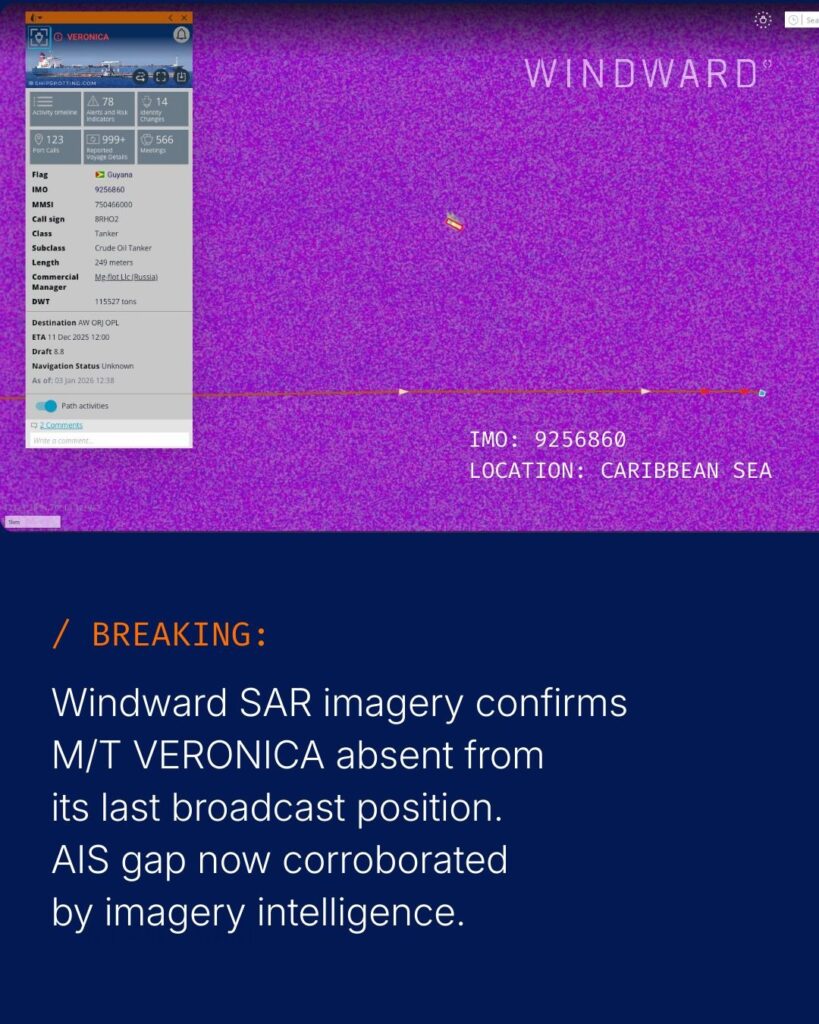
Most recently, on January 15, U.S. Marines and sailors boarding from USS Gerald R. Ford apprehended M/T Veronica in the Caribbean Sea, the sixth tanker seized under this enforcement campaign. The Veronica had been flagged by Windward as high risk due to identity manipulation, inconsistent AIS behavior, prior port state control deficiencies, and a history of sanctions-related cargo detentions.
Ownership analysis reinforces Veronica’s risk profile. The vessel is registered, operated, and managed by Burevestmarin LLC (ООО “Буревестмарин”), a Russian company controlled by Ilya Bugai (Bugay), a Crimea-born businessman now based in Moscow and CEO of petrochemical trader Rusneftekhimtorg, which has links to sanctioned networks.
Burevestmarin also owns Marinera (formerly Bella 1), already seized under Operation Southern Spear, and SOKOLO (IMO 9153525), acquired in January 2026. The clustered ownership and ongoing name-change activity align with identity-cycling tactics seen across sanctioned tanker networks.
These coordinated seizures demonstrate an enforcement posture that is global in reach and operationally diverse, involving:
- Sustained pursuit and interdiction in the open ocean.
- Interdiction in coastal/interdiction zones.
- Integration of naval, Coast Guard, and special operations elements.
This pattern signals that distance from the theater of sanctions (e.g., Caribbean) does not insulate vessels from interdiction, and that behavioral indicators – such as AIS anomalies, flag changes, and ownership opacity – are increasingly treated as enforcement triggers rather than anomalies to be tolerated.
Enforcement Behavior and Shadow Fleet Evolution
The convergence of U.S. interdiction efforts and adaptive tactics by shadow fleet operators continues to reshape maritime behavior. Operators seeking to carry sanctioned cargoes have used reflagging, AIS manipulation, and routing obfuscation to avoid detection and interdiction; U.S. and allied responses have progressively eroded these tactics’ effectiveness and increased legal and operational risk for owners and crews.
This dynamic is pulling compliance, insurance, and port state authorities into more proactive roles, wherein behavioral risk signals (movement patterns, signal anomalies, registry changes) are treated as enforcement vectors rather than secondary indicators.
Risk Signals to Watch
- Drone and unmanned systems use against commercial energy traffickers in the Black Sea and other contested littorals.
- Electronic warfare impacts on AIS/positioning affect maritime domain awareness and safe navigation.
- Expansion of sanctions enforcement beyond proximate waters of Venezuela to the open ocean and the Caribbean Sea, underscoring that lawful interdiction is being operationalized through kinetic means.
- Shadow fleet adaptation and state registry protections as persistent complicating factors for compliance and enforcement.
- Great-power signaling surrounding reflagging and interdiction, particularly involving responses from Russia and observation by China.
Explore more

Ordinary Traffic Is Where Military and Criminal Threats Hide
A vessel’s AIS track goes quiet. A ship slows and holds position outside a shipping lane. A port call shows cargo that doesn’t match what left the previous port. Each of these is the same kind of event — a break from a known pattern. None of them says, on its own, what kind of...
Read more

Why Navies Need Purpose-Built Tools for Adversarial and Commercial Traffic
At a Glance Two Missions, Same Waters, Different Questions A frigate operating in the Baltic and a coast guard cutter in the same waters are asking different questions of the maritime picture in front of them. The frigate wants to know about the vessels that are not what they claim to be. Which of the...
Read more

Why Maritime Operations Centers Need Fusion, Not Another Data Feed
At a Glance The Constraint Isn’t Data, It’s Fusion MOCs receive multi-sensor data at volumes the operational teams inside them cannot fully process, cross-reference, or turn into decision-relevant intelligence at the pace commanders require. The constraint on decision advantage is not the size of the incoming data pipeline. It is the fusion layer that turns...
Read more

Beyond AIS: Why Raw Tracking Data Isn’t Enough for Naval Procurement Anymore
At a Glance Procurement Is Asking for Tracking When It Needs Intelligence Naval procurement conversations across 2026 increasingly begin with the same request. The service needs better vessel tracking. The requirement documents specify AIS coverage, refresh rates, and geographic zones. The evaluation criteria focus on data volume, latency, and integration formats. But tracking is not...
Read more

What the Navy’s Procurement Reset Means for the Intelligence Layer
At a Glance The Navy’s FY27 Request Signals Urgency, Not Just Budget Growth The Department of the Navy’s FY27 budget request is one of the largest in recent memory. The $377.5 billion topline is a 23% increase over FY26, with $65.8 billion for shipbuilding, $150 billion for procurement broadly, and generational investment in the Golden...
Read more