At a Glance What Is the Maritime Gray Zone? The maritime gray zone describes state or state-aligned actions that fall between routine presence and open conflict. These operations are intentionally deniable, often unattributable, and designed to achieve strategic gains without crossing the threshold of armed escalation. Gray-zone maritime activity includes behaviors that look routine on...
At a Glance The Foundation of Truth: Elevating Maritime Intelligence Above the Noise In the global maritime ecosystem, data is the new oil, but “dirty oil” is currently clogging the engines of compliance and national security. For years, the industry has focused on Know Your Customer (KYC) and Windward’s trademarked Know Your Vessel (KYV™). While...
The Integrity Gap: Why Know Your Data (KYD™) is the New Frontier of Maritime Intelligence
What’s inside?
At a Glance
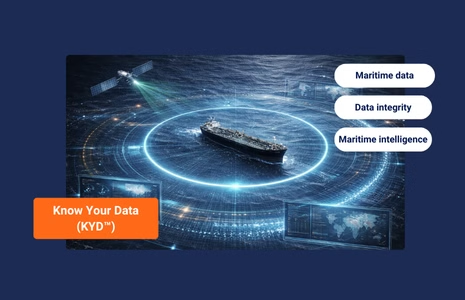
KYD™ serves as a proprietary validation layer that ensures all data feeding AI and risk models remains accurate, complete, and resilient against intentional manipulation.
By cross-referencing independent signals such as SAR, EO, and RF against historical behavioral baselines, the system verifies the truth before any risk score is generated.
Know your data provides the data integrity required to expose sneaky actors and deceptive counterparties, ensuring commercial and government decisions are powered by validated truth rather than manipulated signals.
The Foundation of Truth: Elevating Maritime Intelligence Above the Noise
In the global maritime ecosystem, data is the new oil, but “dirty oil” is currently clogging the engines of compliance and national security. For years, the industry has focused on Know Your Customer (KYC) and Windward’s trademarked Know Your Vessel (KYV™). While these are critical, they share a common vulnerability: they are only as good as the information feeding them.
As we enter 2026, the rise of the shadow fleet and sophisticated AIS spoofing has created a reality where the data itself is a weapon. This is why Windward has pioneered Know Your Data (KYD™) – the foundational framework for the next generation of Maritime AI™.
The AI Paradox: Why Advanced Models Fail Without KYD™
Artificial intelligence is often touted as a silver bullet for maritime risk. However, there is a dangerous paradox at play: the more advanced the AI, the more sensitive it is to the quality of its inputs. In computer science, this is known as “Garbage In, Garbage Out” (GIGO). In maritime intelligence, GIGO can lead to a vessel carrying sanctioned oil entering a port undetected or a legitimate trader being blacklisted due to a data glitch.
The Rise of Data Deception
The challenge has shifted from passive data gaps to active data warfare – the intentional manipulation aimed at obscuring reality. Deceptive shipping practices (DSPs) have evolved beyond dark activity. Today’s sophisticated actors utilize digital camouflage to create a false reality in the eyes of regulators and AI models:
GNSS manipulation: This is the strategic tampering of Global Navigation Satellite System (GNSS) signals to broadcast a false location. While often used to hide a vessel’s presence during illicit ship-to-ship transfers in sanctioned zones, its application is broader, allowing vessels to mask prohibited port calls or bypass maritime corridors while appearing to remain in safe, open waters.
Identity laundering:Zombie vessels – ships that assume the IMO numbers and identities of scrapped or inactive vessels – enable this behavior. By recycling these “clean” identities, a sanctioned tanker or high-risk asset can adopt a legitimate history, effectively hiding its true origins from automated screening systems.
Flag hopping: This tactic involves a vessel rapidly changing its registry, sometimes multiple times in a single year, to exploit administrative lags and jurisdictions with weak oversight. The goal is to create a fragmented paper trail that obscures the true ownership and regulatory accountability of the vessel.
Without a KYD™ framework, an AI model sees these manipulated signals as “truth.” It builds its risk scores on a foundation of lies. Know your data is the process of stripping away these digital masks.
The Three Pillars of Know Your Data (KYD™)
To transform raw maritime signals into actionable intelligence, the KYD™ framework enforces a rigorous validation standard across three critical dimensions:
1. Accuracy: Verifying the Signal
In the maritime domain, accuracy is not just about having the “correct” coordinates – it’s about confirming that the signal matches physical reality. KYD™ validates reported data by seeking independent, non-collaborative corroboration.
Fragmented data is the primary hiding place for illicit activity. KYD™ fuses an expansive array of disparate data streams, including 30+ sources like port logs, corporate registries, radio frequency (RF) signals, and historical “behavioral fingerprints” to build a continuous narrative. This ensures that dark activities are not merely treated as missing information, but are instead analyzed for behavioral anomalies that suggest intentional concealment or unauthorized ship-to-ship transfers.
3. Explainability: The Audit Trail
Intelligence is only as valuable as it is defensible. KYD™ ensures that every insight – from a high-risk score to a sanctioned entity match – is backed by a transparent chain of evidence. Through MAI Expert™, Windward users can see exactly which validated indicators drove a classification. This “glass box” approach gives compliance officers and government agencies the audit-ready transparency required for high-stakes enforcement, commercial litigation, or regulatory reviews.
The Integrated Risk Stack: KYC, KYV™, and KYD™
Understanding how these frameworks interact is essential for operational excellence. While they overlap, they serve distinct roles in the risk stack.
Framework
Primary Focus
Operational Value
Know Your Customer (KYC)
The entity.
Prevents engagement with sanctioned individuals, shell companies, or high-risk counterparties.
Know Your Vessel (KYV™)
The asset.
Identifies behavioral risks such as dark activity, ship-to-ship transfers, and port call anomalies.
Know Your Data (KYD™)
The foundation.
Validates digital signals and sensor integrity to ensure all insights are built on truth, not deception.
Know Your Data in Action: Commercial and Government Use Cases
For Commercial Trading & Finance: Reducing Friction
A compliance “false positive” can hold up a shipment for days, costing hundreds of thousands of dollars in demurrage. Most false positives are the result of “dirty data” – an outdated registry entry or a mismatched vessel name.
KYD™ cleans the data before the screening happens. By ensuring the vessel identity is verified and the movement history is accurate, Windward users see up to ~75% fewer false positives. This allows traders to move with the speed of the market while maintaining a “bulletproof” compliance posture.
For Government & Enforcement: Actionable Intelligence
KYD™ establishes a trusted operational baseline. By comparing declared movements with remote sensing detections, KYD™ exposes the “digital camouflage” used by illicit actors. This allows agencies to allocate their limited assets toward genuine threats rather than data ghosts.
The 2026 Regulatory Landscape: Why Know Your Data is No Longer Optional
The OFAC April 2025 Advisory and the EU’s 18th Sanctions Package have fundamentally redrawn the lines of responsibility, making it clear that ignorance of a vessel’s digital deception is no longer a valid legal defense.
The recent seizure of the tanker Centuries in the Caribbean serves as a stark warning to the global market. Unlike previous interdictions, the Centuries was not on a sanctions list when it was boarded; the decision to seize the vessel was driven by its behavioral risk indicators, including documented GNSS manipulation and suspicious ship-to-ship transfers.
This shift – from list-based vetting to behavioral interdiction – highlights the “AI Paradox”: if your risk models are fed by spoofed data that haven’t been validated, you are operating with an unmitigated blind spot that now carries major risks.
As we move into 2026, the complexity only intensifies with the EU’s upcoming ban on refined petroleum products derived from Russian crude. Proving that a shipment doesn’t trace back to a sanctioned origin requires the ability to map a complex, multi-stage supply chain across a global fleet that is actively trying to hide its tracks. From the Mediterranean, where Ukraine recently struck the shadow fleet tanker Qendil 2,000 km from its borders, to the Baltic Sea, where Sweden’s detention of the Adler signaled a tightening European net, the message is clear: there is no geographic sanctuary for deceptive data.
In this environment, you cannot detect location tampering or verify a cargo’s origin if you don’t “Know Your Data.” Relying on unverified AIS or static registry snapshots in 2026 is a gamble that commercial and government leaders can no longer afford to take. Know Your Data (KYD™) is the essential filter that turns the chaos of global maritime signals into the clarity of actionable, defensible, and interdiction-proof intelligence.
Frequently Asked Questions (FAQs)
Is KYD™ another name for data quality?
No. Data quality is about syntax; KYD™ is about semantics and truth. While data quality might check if an IMO number has the right amount of digits, KYD™ checks if that IMO number actually belongs to the ship currently broadcasting it, or if it’s a zombie vessel being used for sanctions evasion.
Why is KYD™ essential in today’s enforcement landscape?
In 2026, enforcement has moved beyond simple lists to real-time behavioral interdiction, as seen with the recent seizure of the Centuries. Regulators now expect stakeholders to prove the integrity of their data at every stage of the supply chain. KYD™ provides the “immune system” for your operations, ensuring that your AI-driven decisions are defensible and that you are not inadvertently doing business with bad actors who use digital camouflage to hide their true risk profile.
How does KYD™ handle dark activity?
When a vessel turns off its AIS, most systems lose sight of it. KYD™ uses Remote Sensing Intelligence utilizing SAR and EO satellite data to maintain a physical look at the vessel’s last known and predicted locations, ensuring the dark period is still a verifiable period.
How does Windward’s KYD™ help reduce false positives in sanctions compliance?
Most false positives stem from “dirty” data – mismatched vessel names or outdated records. KYD™ reconciles these points across an expansive array of trusted sources before screening begins, ensuring compliance teams only focus on genuine, high-probability risks, which can reduce the alert burden by up to 75%.
Why did Windward trademark KYD™ and KYV™?
We trademarked these terms because they represent a specific, rigorous methodology for Maritime AI™. In an industry full of buzzwords, KYD™ and KYV™ signify a commitment to attribution-grade intelligence that can hold up in a court of law or a regulatory audit.
Can Windward’s KYD™ be integrated into existing ERP or CTRM systems?
Yes. Windward’s Maritime AI™ platform is designed to feed validated, KYD-cleansed insights directly into existing workflows via API, ensuring that your existing systems are finally powered by trustworthy data.
Everything you need to know about Maritime AI™ directly to your LinkedIn
Generative AI Will Reshape Shipping Within 18 Months
At the 17th Annual Capital Link Shipping & Marine Services Forum, held during London International Shipping Week, Windward’s Co-Founder and CEO, Ami Daniel, issued a striking forecast: “In the next 12 to 18 months, you’ll see generative AI change how people analyze and make decisions. In my view, everybody will be a PhD-level analyst with...
Artificial Intelligence, Decarbonization and the Dark Fleet Dominate LISW25 Agenda
London International Shipping Week 2025 captured the industry at a crossroads. More than 30,000 delegates gathered across hundreds of events, confronting a sector caught between technology’s promise, climate ambition, and the hard edge of geopolitics. Three themes dominated the week: artificial intelligence, decarbonization, and the rise of the dark fleet. But the common thread was...
From LLMs to AI Agents & Agentic Workflows: How AI Powers Maritime Operations
If you work in the maritime ecosystem, you’ve probably seen the wave of AI buzzwords hitting every sector: Large Language Models (LLMs), AI agents, agentic workflows. They build on one another, but what role does each play in real-world decisions in maritime risk, trade operations, and regulatory enforcement? For maritime professionals, understanding the difference between...
In the Gen AI era, everyone is moving fast. Product demos abound. New features roll out weekly. The buzzwords are everywhere: “revolutionary AI,” “cutting-edge models,” “real-time intelligence.” But behind the flashy messaging, a quiet truth holds: Even the most powerful AI won’t sail far if your data foundation is leaking.In the race to adopt AI...