The Week in Focus Western Hemisphere: Venezuela Enforcement Escalates A Non-Sanctioned Tanker Is Seized When the U.S. Coast Guard boarded the tanker Centuries (IMO 9206310) in international waters off Venezuela, its AIS signal placed it near Aruba and Curaçao. Windward data confirms the vessel was operating far closer to the Venezuelan coast, a familiar pattern...
At a Glance From Seizure to Sustained Pressure The seizure of the VLCC Skipper off Venezuela was not an isolated enforcement action. It marked the opening move in a broader escalation of pressure against sanctions-evading tanker networks. Within days of the seizure, the United States announced a blockade on sanctioned oil tankers entering and leaving...
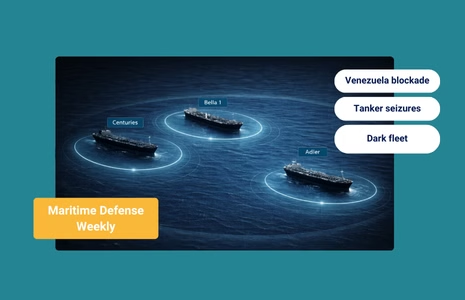
U.S. forces seized Centuries, a non-sanctioned tanker carrying Venezuelan oil, signaling a shift toward behavior-based maritime enforcement.
A third tanker, Bella 1, was intercepted en route to Venezuela, confirming a graduated blockade model based on sanctions status, risk behavior, and destination.
Ukraine struck a Russian shadow fleet tanker in the Mediterranean, more than 2,000 km from its border, eliminating geographic sanctuary for dark fleet operations.
Sweden detained the sanctioned Russian cargo vessel Adler in the Baltic Sea, raising the prospect of expanded European enforcement against the shadow fleet.
Western Hemisphere: Venezuela Enforcement Escalates
A Non-Sanctioned Tanker Is Seized
When the U.S. Coast Guard boarded the tanker Centuries (IMO 9206310) in international waters off Venezuela, its AIS signal placed it near Aruba and Curaçao. Windward data confirms the vessel was operating far closer to the Venezuelan coast, a familiar pattern seen across dark fleet activity.
Unlike the Skipper, seized the previous week, Centuries was not on any U.S. sanctions list. This is the first confirmed case of a non-designated tanker being seized under the new enforcement posture. The decision appears to have been driven not by designation, but by behavior.
Windward’s Maritime AI™ platform had flagged Centuries ashigh risk since June 2024, 2025, due to repeated GNSS manipulation, identity and location tampering, irregular business structure, and multiple ship-to-ship transfers with a sanctioned tanker linked to the Russian regime. The vessel’s opaque ownership structure, Hong Kong-based management, and rapidly shifting fleet flags further align it with known dark fleet typologies.
These seizures signal a material shift. The blockade around Venezuela is no longer limited to sanctioned vessels – it now extends to tankers that either carry sanctioned oil or exhibit dark fleet behavior.
That shift became clearer with yesterday’s interception of a third vessel, Bella 1(IMO 9230880). Unlike Centuries, Bella 1 is fully designated by OFAC under the SDGT and Iran sanctions programs, and is controlled by the sanctioned Turkish company Louis Marine Shipholding. The Guyana-flagged crude tanker was intercepted north of the Lesser Antilles while still en route to Venezuela, before reaching the loading zone. This vessel has been flagged as high risk by Windward’s Maritime AI™ platform since April 2023 as a result of multiple smuggling risk indicators, such as dark activities, deviations from normal shipping patterns, multiple identity changes, and uneconomical behavior.
The path of Bella 1. Source: Windward Maritime AI™ Platform.
Together, the three seizures reflect a graduated enforcement model: a sanctioned vessel at Venezuela’s doorstep, a high-risk tanker seized after loading, and a designated ship intercepted en route before any cargo changed hands.
This is no longer a single “message” seizure but an operating model in which sanctions status, behavioral risk, and destination are fused. Given the scale of Venezuela’s coastline, intercepting vessels in international waters is operationally logical, and from a legal standpoint, Bella 1 presented the clearest case, having already been designated under Iran-related authorities and flagged as high risk for smuggling by Windward as early as April 2023.
Immediate Effects in the Caribbean
Windward intelligence detected at least 30 sanctioned vessels operating near Venezuela as enforcement pressure escalated. Within hours of the Centuries seizure, several began deviating from their course or turning away, indicating real-time disruption to energy flows.
Caribbean dark fleet activity continues to surge. Over the past 30 days, 116 vessels linked to Iran, Venezuela, or Russia made more than 130 visits to the region. Many remain uninsured, falsely flagged, or engaged in deceptive shipping practices. As in prior enforcement cycles, operators are responding with increased GNSS manipulation and reliance on ship-to-ship transfers to obscure cargo origin.
Adaptive Rerouting Patterns Emerging
Windward data indicates that enforcement pressure is already reshaping dark fleet behavior beyond the Caribbean. Between December 13-20, Iranian-flagged vessel port calls in Iran fell 18% compared to expected baselines (234 actual vs. 285 expected), while the duration of dark activity by Iran sanctions-risk vessels in Brazilian waters surged 223% (129.74 hours vs. 40 expected).
At the same time, vessels with Venezuelan sanctions risk conducted 161% more ship-to-ship transfers in Brazilian waters (13 actual vs. 5 expected). The pattern points to tactical rerouting rather than disengagement, with operators shifting loitering, transshipment, and obscuration activities away from enforcement-heavy zones toward alternative hubs in the South Atlantic.
While Venezuela’s coastline makes a fully airtight blockade unlikely, seizures and boardings are functioning as visible warning signals. Exports may continue in the short term, but the willingness of operators to carry Venezuelan oil is already eroding.
The Mediterranean: No Sanctuary for the Shadow Fleet
Ukraine expanded the battlespace this week, striking the tanker Qendil(IMO 9310525) in the Mediterranean using aerial drones. The strike occurred more than 2,000 kilometers from Ukrainian territory, marking the fourth shadow fleet tanker hit in three weeks.
Qendil makes a U-turn in the Mediterranean. Source: Windward Maritime AI™ Platform
Windward data shows Qendil was sanctioned by the UK and EU, experienced four AIS blackouts, and operated under shell company ownership. Unlike previous targets falsely claiming Gabonese registration, Qendil was flagged to Oman, underscoring that the legitimacy of the flag alone no longer offers protection.
The strike mirrors patterns last seen during the Iran-Iraq conflict, where merchant vessels became instruments of economic pressure. The message to Russia’s estimated 1,300 dark fleet vessels is that geographic distance no longer provides sanctuary.
Baltic Sea: Europe Tests Its Own Red Lines
This week, Swedish authorities detained the Russian cargo vessel Adler(IMO 9179854) after it anchored in Swedish waters due to a mechanical failure – a common risk across the aging and isolated shadow fleet.
According to Windward data, Adler has been designated on the OFAC SDN list since May 2022 and is owned and managed by entities explicitly sanctioned for supporting Russia’s war effort. The vessel is owned by M Leasing LLC and managed by MG-Flot LLC, both sanctioned by the EU, UK, UN, and U.S. authorities. MG-Flot has also been sanctioned under the EU’s Iran sanctions regime for its role in supporting Russia.
The Adler’s path from Russia’s Bronka Port to being anchored and detained off Sweden’s western coast.
Operationally, Adler exhibits multiple high-risk indicators. It flies the Russian flag, has conducted seven port calls to Russia, most recently at Bronka Port on December 15, 2025, and operates within a sanctioned ownership and management network. Its detention was not a random incident, but the result of a degrading fleet forced into jurisdiction by mechanical failure.
The timing is notable. Just days after U.S. seizures off Venezuela and Ukraine’s strike in the Mediterranean, Senator Lindsey Graham issued an explicit call to action, “Seize the ships. Help stop the war.” His bipartisan resolution urges the U.S. administration to physically seize shadow fleet vessels if Russia refuses to negotiate a just peace.
The question now is whether Sweden’s move marks the start of broader European enforcement in the Baltic, mirroring the U.S. approach in the Caribbean, or remains an isolated case enabled by circumstance rather than policy.
Global Maritime Implications
Taken together, these developments point to a fundamental change in maritime risk. Enforcement is increasingly behavior-driven rather than list-based, exposing shadow fleet operations wherever they operate. As pressure increases, GNSS manipulation, false narratives at sea, and complex ownership structures are likely to intensify.
The seizure of Centuries and Bella 1, alongside Ukraine’s strike on Quendil and Sweden’s detention of the sanctioned cargo vessel Adler, crystallizes the shift. A blockade that began as a sanctions tool is rapidly becoming a tanker blockade, reinforced by growing political calls to physically seize shadow fleet vessels, with global implications for energy flows, maritime security, and escalation dynamics.
Everything you need to know about Maritime AI™ directly to your LinkedIn
Venezuela on Notice: What Comes Next for Dark Fleet Enforcement
At a Glance From Seizure to Sustained Pressure The seizure of the VLCC Skipper off Venezuela was not an isolated enforcement action. It marked the opening move in a broader escalation of pressure against sanctions-evading tanker networks. Within days of the seizure, the United States announced a blockade on sanctioned oil tankers entering and leaving...
Maritime Defense Weekly: Venezuela Blockade, Dark Fleet Under Fire
The Week in Focus Three developments this week carry direct implications for maritime operations worldwide: the U.S. announcing a blockade on sanctioned Venezuelan tankers as Caribbean dark fleet activity surges 95% year-on-year; Ukraine expanding drone strikes against Russia’s sanctions-evasion tankers in the Black Sea; and escalating air-sea confrontations in the East China Sea prompting a...
The Dark Fleet Is No Longer Invisible: What the Venezuela Tanker Seizure Signals
At a Glance From Monitoring to Intervention The dark fleet – tankers engaging in dark activities while moving sanctioned oil, cycling through false flags, and obscuring ownership – has continued to expand, reaching more than 1,900 vessels by the end of Q3. Governments had visibility into this activity. What was less consistent was how that...
An Iranian-Linked Tanker Fleet Is Operating Off the U.S. Coast Right Now
At a Glance What the Data Shows Over the past month, Windward detected an unusual concentration of tankers in and around the Caribbean Sea with elevated sanctions and compliance risk. In Q4 2024, WIndward recorded 119 area visits by vessels with similar risk profiles. In Q4 2025 to date, that number has already reached 233,...